0:03
Welcome back to another video here on
0:05
Altitude Addicts, where today we are
0:08
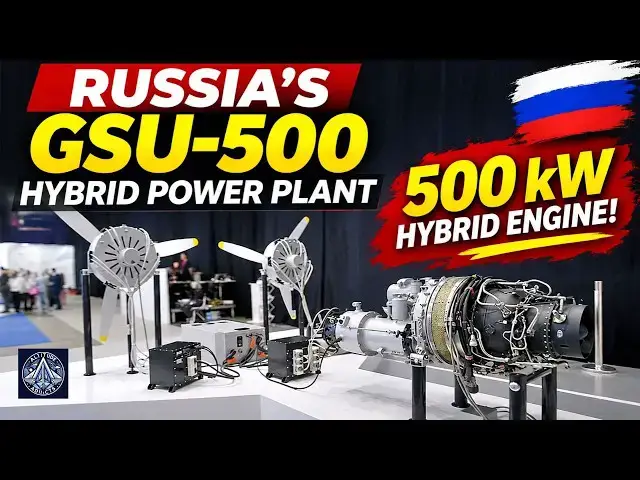
looking at Russia's massive new 500 kW
0:11
hybrid aviation power plant. In this
0:14
video, we will explore how the GSU 500
0:17
seamlessly combines gas turbines with
0:19
electric motors, potentially saving up
0:22
to 30% on fuel. Make sure to watch till
0:25
the end because we are going to break
0:27
down the advanced thermal cooling
0:29
technology and what this means for the
0:31
future of heavy transport drones and air
0:36
Russia is actively developing this 500
0:38
kowatt hybrid aviation power plant to
0:41
facilitate the development of a
0:43
completely new generation of unmanned
0:45
aircraft, air taxis and VTOL platforms.
0:49
Developed by UEC Klimov, which is part
0:52
of the United Corporation, the GSU500
0:56
represents a modular hybrid propulsion
0:58
architecture being built for future
1:02
This innovative system successfully
1:04
combines a traditional gas turbine
1:06
engine with electric motors, a
1:08
generator, and advanced battery storage.
1:11
It is heavily based on the existing VK
1:13
650V helicopter engine, aiming to bring
1:16
the best of two very different power
1:21
The whole initiative aims to brilliantly
1:23
integrate the operational flexibility of
1:26
electric propulsion with the long range
1:28
endurance of conventional turbine
1:32
Rather than completely relying on heavy
1:34
batteries, the system's primary energy
1:37
source remains a gas turbine while
1:39
electrical components expertly support
1:42
power distribution and propulsion.
1:45
Looking closer at this hybrid
1:46
architecture based on the VK 650V UEC
1:50
Kleimov used this proven turbo shaft
1:52
engine as the fundamental foundation for
1:56
Its primary components consist of the
1:58
gas turbine engine, electric motors and
2:01
electrical generator, specialized
2:03
battery packs and complex power
2:07
So, think of these parts acting like one
2:10
big unified team pushing the aircraft
2:12
forward rather than a bunch of
2:14
independent power sources just doing
2:17
their own thing. The gas turbine powers
2:20
an electrical generator that essentially
2:22
feeds electricity straight to the
2:24
propulsion motors in the configuration
2:29
Another crucial source of electrical
2:31
power is provided seamlessly by the
2:33
onboard battery system. This specific
2:36
configuration enables the entire system
2:39
to intelligently integrate turbine
2:42
generated electricity with stored
2:44
electrical energy exactly according to
2:46
the aircraft's momentto- moment
2:48
operational requirements.
2:51
The system's impressive electrical
2:56
This places it in a specialized category
2:58
designed for aircraft significantly
3:00
larger than your everyday small
3:02
batterypowered drones. proposing its use
3:05
in transporting heavy unmanned aerial
3:09
When it comes to how the power system
3:11
actually works, the GSU500
3:14
officially follows a series hybrid
3:17
In this configuration, the aircraft's
3:20
propellers or rotors are not directly
3:23
driven by the gas turbine through a
3:25
conventional mechanical transmission,
3:28
which is like, you know, how it usually
3:30
goes when engines just spin the thing
3:33
Instead, the turbine provides mechanical
3:36
power to the generator, which
3:38
brilliantly converts that energy into
3:41
The generated power is then used by
3:44
electric motors to generate propulsion.
3:46
And we have a lot more coming up on how
3:48
this setup dramatically boosts fuel
3:51
efficiency and extends engine service
3:55
This unique configuration offers several
3:58
massive advantages for modern aircraft
4:00
design and engineering.
4:03
Electric motors can be positioned
4:05
precisely near individual propellers or
4:07
rotors, giving designers incredible
4:10
flexibility when arranging propulsion
4:12
units throughout an aircraft.
4:15
This flexibility is a huge deal,
4:17
especially when you're talking about
4:18
large autonomous platforms, distributed
4:21
propulsion systems, and complex VTOL
4:25
When the electricity demand suddenly
4:27
rises in flight, the onboard battery
4:30
system instantly jumps in to supply that
4:32
additional electrical power.
4:35
The primary generator can be heavily
4:37
assisted by the batteries during
4:39
takeoff, vertical ascent, and other high
4:42
power phases of the journey.
4:45
Depending on the power management
4:46
strategy, the gas turbine can supply the
4:49
electrical motors while simultaneously
4:52
allowing the battery system to regain
4:54
its charge during less demanding flight
4:58
Here at Altitude Addicts, we find the
5:01
systems emergency operation capabilities
5:03
to be a particularly fascinating
5:05
advantage. If the primary turbine
5:08
somehow fails, the robust battery
5:10
reserve can step up to supply the
5:12
necessary electrical power for a safe
5:17
Nevertheless, this emergency flight
5:19
capability will ultimately depend on the
5:22
certification requirements of the
5:23
eventual application, the specific
5:26
configuration of the aircraft, and the
5:28
total battery capacity.
5:31
Transitioning into the topics of fuel
5:33
efficiency and engine service life, the
5:36
GSU500 program's primary objective is to
5:39
significantly decrease the operating
5:41
loads on the gas turbine.
5:44
During typical flights, sudden changes
5:46
in propulsion demand require immediate
5:49
stressful responses from conventional
5:51
turbine engines. A hybrid architecture
5:54
effectively solves this by distributing
5:56
a large portion of these intense peak
5:59
loads perfectly between the battery
6:01
system and the generator.
6:04
UEec estimates that this specific hybrid
6:07
configuration could reduce overall fuel
6:09
consumption by up to 30% when compared
6:13
to conventional propulsion arrangements.
6:16
Furthermore, the core engine service
6:18
life could be extended by approximately
6:23
This awesome life extension basically
6:25
happens because the turbine gets to run
6:27
under superstable conditions,
6:29
beautifully dodging the wear and tear of
6:34
But this project isn't just about
6:36
slapping a turbine and some electric
6:38
motors together as UEC Kleov has also
6:42
done heavy work on the supporting
6:44
electrical technologies required to make
6:46
this architecture fully operational.
6:49
During the rigorous development program,
6:51
the company successfully generated a
6:54
high power battery module with a
6:56
capacity of 25 kW along with an energy
7:00
module rated at 35 kW.
7:03
In just a moment, we will look at how
7:04
they keep all of these high power
7:06
electronics from melting down and trace
7:09
the fascinating journey from early
7:11
development to final demonstration.
7:15
The advanced battery module is carefully
7:17
engineered to maintain the energy
7:19
balance and seamlessly compensate for
7:22
peak electrical demand during
7:24
fluctuating flight conditions.
7:26
Reported design features for this
7:28
hardware include active battery
7:30
balancing, a fully duplicated control
7:33
system, and state-of-the-art immersion
7:37
In the broader aviation industry,
7:39
intense thermal management is absolutely
7:41
paramount because electrical motors,
7:44
generators, batteries, and power
7:46
electronics must all operate within
7:48
exact temperature parameters.
7:51
Excessive heat can adversely affect the
7:53
performance of the batteries,
7:55
drastically reduce the reliability of
7:57
critical components, and destroy the
8:00
efficiency of the electrical systems.
8:03
Consequently, developing the complex
8:05
cooling arrangements became a critical
8:08
component of the overall engineering
8:10
effort. Detailed research conducted at
8:13
Peter the Great St. Petersburg
8:15
Polytechnic University in 2026 even
8:18
examined the careful optimization of the
8:20
GSU 500's complex cooling channels.
8:25
The academic teams used advanced mat lab
8:28
simulink and simscape modeling to
8:30
rightsize the cooling systems and study
8:32
how electric machine components handle
8:34
heat. All of this really highlights just
8:38
how much intense behindthe-scenes
8:40
engineering work is required just to
8:43
keep these new systems within their safe
8:47
Following this, from early development
8:49
to its final demonstration, the program
8:51
officially started back in the early
8:56
At that time, UEC Clemov used an early
8:58
demonstrator powered by the VK 650V
9:01
engine to get the ball rolling.
9:04
Preliminary integration and system level
9:07
testing were absolutely critical
9:09
components of the program at that time,
9:12
primarily because the production version
9:14
of the helicopter engine was not yet
9:18
A major structural milestone was finally
9:20
achieved in January 2025 when the VK
9:24
650V was officially certified.
9:27
This crucial certification successfully
9:30
mitigated some of the biggest technical
9:32
hazards associated with the hybrid
9:34
installation's primary energy source,
9:37
which was, of course, the engine itself.
9:40
Fast forward to January 2026, and UEC
9:44
proudly announced that the GSU 500
9:46
demonstrator had successfully completed
9:48
groundbased bench test.
9:51
This incredible milestone meant that its
9:53
massive 5-year research and development
9:56
program had been successfully completed.
9:59
The complete system was subsequently
10:01
showcased to the world at the UMEX 2026
10:05
exhibition in Abu Dhabi where UEC
10:08
introduced it as a premier technology
10:10
demonstrator for future unmanned
10:13
For those of you who regularly follow
10:15
our aviation deep dives here on Altitude
10:18
Addicts, it is incredibly exciting to
10:20
see this evolving into a true modular
10:23
platform for future aircraft.
10:26
In addition to the GSU500, UEC has
10:29
proposed an entire family of hybrid and
10:31
electric aviation power systems boasting
10:34
a combined capacity of 1.5 megawatt.
10:38
This massive concept entails the
10:40
seamless integration of battery systems,
10:43
energy modules, and electric propulsion
10:45
units that have been independently
10:47
developed. The ultimate goal is to
10:50
seamlessly create power plants that are
10:52
highly appropriate and adaptable for
10:54
various distinct aircraft categories.
10:58
This modular plug-and-play Lego block
11:00
approach means manufacturers can simply
11:03
pick and choose propulsion
11:04
configurations that perfectly match
11:07
their aircraft's specific size, payload,
11:09
range, and flight needs. Naturally, a
11:13
wildly different power configuration
11:15
would be necessary for giant heavy
11:17
transport drones and tiltrotor aircraft
11:19
than for much smaller air taxis or
11:22
distributed propulsion aircraft.
11:25
Looking at the bigger picture, the
11:26
Russian Ministry of Transport previously
11:29
stated that this broader initiative was
11:31
designed to provide crucial assistance
11:34
to advanced aircraft.
11:37
Specifically, this means empowering
11:39
aerial vehicles with vertical or brief
11:41
takeoff and landing capabilities, paving
11:44
the way for the next generation of
11:46
transport drones and urban air taxis.
11:51
We thank the people who have shared,
11:53
subscribed and hyped the videos.