0:06
The Russian interplanetary program is
0:08
reviving one of its most important
0:10
planetary science directions, the
0:12
exploration of Venus.
0:15
The first large-scale Russian mission to
0:17
the planet in several decades is the
0:19
Venera D expedition, which means Vanera
0:22
long living. It continues the Soviet
0:25
legacy of the Venera 7 and Vanera 13
0:28
spacecraft which made the first
0:30
successful landings and transmitted
0:32
surface images from Venus.
0:35
Approved in 2025 as part of a national
0:38
project, Vener will include advanced
0:40
engineering solutions, autonomous
0:42
operation, and multi-platform scientific
0:46
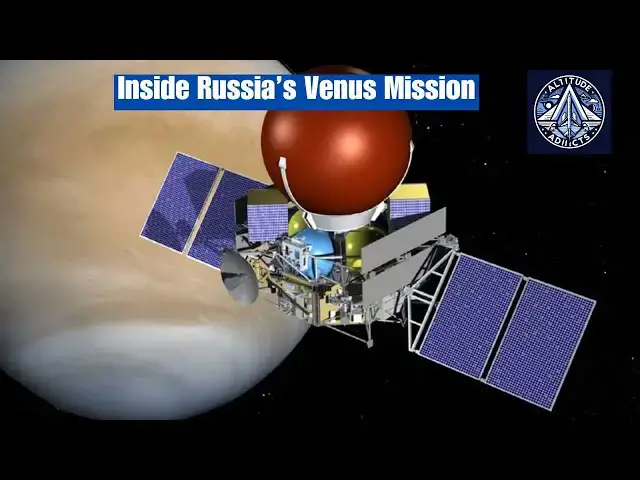
These will include a lander, an orbiter,
0:49
and two solar powered balloons designed
0:51
to study the dense atmosphere of Venus.
0:54
Venus presents major challenges as it is
0:57
more than 38 million km from Earth at
1:02
The Vener spacecraft weighing about 800
1:05
kg will carry Russian-made scientific
1:08
equipment that reflects the focus on
1:10
technological independence after past
1:13
international projects were cancelled.
1:16
Originally planned with NASA and the
1:18
European Space Agency, the mission is
1:20
now fully Russian. It will use newly
1:23
developed systems for data processing,
1:26
transmission, and analysis. The lander
1:29
will be able to withstand 470° C and a
1:33
pressure about 92 times greater than
1:37
This continues the tradition of short
1:39
but valuable surface missions first
1:42
attempted in the 20th century.
1:45
The lander will carry advanced
1:47
spectrometers to analyze surface
1:49
minerals, chemicals, water related
1:51
compounds, and isotopes.
1:53
Instruments include the laser mass
1:55
spectrometer, the MOS power
1:57
spectrometer, and the active gamma
1:59
neutron spectrometer.
2:01
A new soil collection system may be the
2:04
most advanced part since it must quickly
2:06
collect samples under extreme heat and
2:08
pressure. Data will be gathered only for
2:11
a few hours before electronics fail due
2:14
to the harsh environment.
2:16
This trade-off is part of every Venus
2:20
The atmospheric segment brings back
2:22
ideas first tested by the Soviet Vega
2:28
Two solar powered balloons will float 54
2:30
to 56 km above Venus where temperatures
2:34
are similar to Earth. However, the
2:37
clouds there contain sulfur dioxide and
2:39
sulfuric acid which are very corrosive.
2:42
The larger 15 kg balloon will carry
2:45
instruments to measure circulation,
2:47
temperature, gases like carbon dioxide
2:50
and water vapor, and isotopes linked to
2:52
volcanic activity. The smaller 4 kg
2:56
balloon will study cloud particles,
2:58
wind, and lightning activity. Together,
3:01
they may send back data for up to 20
3:05
The orbiter is designed for years of
3:07
operation and will map the entire
3:09
planet. Its goal is to create the
3:12
world's first three-dimensional thermal
3:14
map of Venus from the surface to 170 km
3:19
Instruments will study circulation,
3:22
ultraviolet absorbers, and gases such as
3:24
sulfur dioxide and ozone. Other tools
3:27
will search for molecules like carbon
3:29
monoxide, hydrogen chloride, hydrogen
3:32
fluoride, and phosphine, which has been
3:34
debated as a possible sign of life.
3:37
Additional instruments will study the
3:39
ionosphere, solar wind, and high energy
3:42
particles escaping from Venus.
3:45
Vener shows Russia's return to
3:47
interplanetary exploration.
3:50
In the Soviet era, Venus was explored
3:52
almost every time with successful
3:54
landings and panoramas.
3:56
After the Soviet collapse, attention
3:59
shifted to the moon and Mars. Now with
4:02
modern electronics, lighter materials,
4:04
and better data transmission, far more
4:07
information can be collected than in the
4:11
The heavy Angara A5M rocket is planned
4:14
for launch in the early 2030s during
4:17
favorable Earth Venus alignment windows.
4:20
Other nations are also pursuing Venus
4:24
NASA is working on Veraritoss to map the
4:26
planet's geology and Da Vinci Plus to
4:29
study the atmosphere and look for signs
4:33
The European Space Agency is developing
4:35
and vision to investigate tectonics and
4:39
India's ISRO is planning Shukrion 1 to
4:42
focus on atmospheric studies and radar
4:44
imaging. Japan's Akatsuki has already
4:47
been providing valuable cloud data since
4:52
Compared with these, Venera D stands out
4:55
by combining orbital, atmospheric, and
4:59
While NASA and ESA focus mainly on
5:01
orbital observations, Roscosmos
5:04
emphasizes direct data from the surface
5:06
and lower atmosphere.
5:08
This approach follows the Soviet
5:10
tradition of tough engineering solutions
5:12
for extreme planetary environments.
5:15
In short, Vener represents the rebirth
5:18
of Russia's planetary exploration
5:20
program. It combines Soviet legacy with
5:23
modern space technology.
5:26
If successful, it will reveal Venus's
5:28
mysteries, continue Russia's deep space
5:30
legacy, and place the country back in
5:33
the international competition for
5:35
interplanetary knowledge.
5:38
If you like this video, please like,
5:41
share, and subscribe.
5:43
Also, please take our channel
5:45
membership, which is very affordable, to