0:07
The Yuri Gagarin aviation plant in
0:09
Kamsolks Anamore is one of Russia's
0:12
largest aircraft manufacturing
0:15
It plays a central role in the country's
0:17
modern combat aviation industry.
0:20
The plant produces advanced fighter
0:22
aircraft such as the Sue35s and the
0:27
It is also involved in developing the
0:29
next generation light fighter known as
0:34
Altitude Addicts, the YouTube channel
0:36
presenting this analysis, explains that
0:39
the facility recently completed a major
0:41
upgrade in March 2026.
0:45
The upgrade focused on its
0:46
electroplating, also known as galvanic
0:50
Although this may seem like a minor
0:52
technical improvement, it has major
0:56
It directly affects aircraft quality,
0:59
production speed and operational
1:02
To understand why this matters, it is
1:05
important to look at the role of
1:06
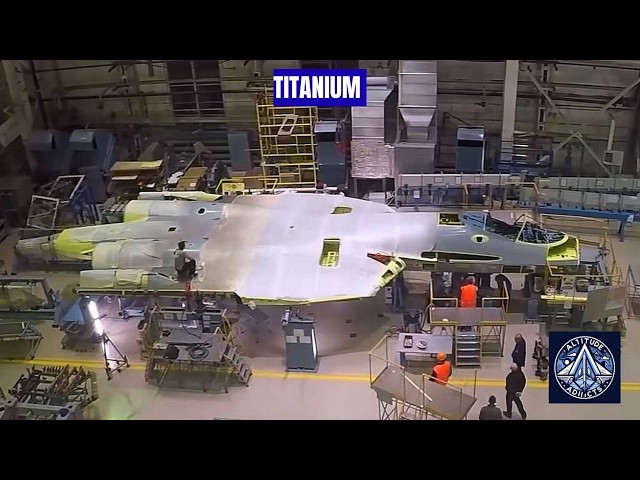
titanium in modern aviation.
1:10
Titanium is one of the most critical
1:12
materials used in advanced fighter
1:16
It offers a unique combination of high
1:18
strength and low weight. It also resists
1:21
corrosion and can withstand extremely
1:26
Altitude Addicts explains that titanium
1:28
is especially important in aircraft like
1:30
the Sue 57. It helps maintain structural
1:34
integrity at supersonic speeds.
1:37
Titanium is used in airframe components,
1:40
engine mounts, and loadbearing
1:43
These parts are essential for both
1:45
performance and durability.
1:48
However, titanium is difficult to
1:50
process. It requires specialized
1:53
chemical and electrochemical treatment.
1:56
Even small errors during processing can
1:59
reduce the lifespan of a component. This
2:02
makes manufacturing highly precise and
2:06
Before the modernization, titanium
2:08
processing at the plant was carried out
2:10
in separate stages. Each step was
2:13
performed in different areas of the
2:17
Components had to be physically moved
2:18
between stages such as etching,
2:21
cleaning, and anodizing.
2:23
This increased production time and
2:27
Altitude Addicts notes that this
2:29
approach also increased the risk of
2:33
Components were exposed to environmental
2:35
contamination during transfers.
2:38
Another limitation was equipment size.
2:41
Older systems could not handle large
2:43
structural components efficiently.
2:47
However, the plant had already undergone
2:49
earlier modernization phases.
2:52
These included digital production
2:54
systems and new assembly technologies.
2:57
Altitude Addicts explains that the
2:59
facility was preparing for serial
3:01
production of advanced fighters like the
3:06
New buildings and testing facilities had
3:08
already been introduced.
3:10
The latest upgrade to the Galvanic
3:12
workshop is therefore part of a larger
3:17
It continues a long-term modernization
3:21
The core idea of the upgrade was to
3:23
integrate multiple processes into a
3:25
single production line. This
3:28
significantly improves efficiency.
3:31
The first stage is chemical etching.
3:34
Acid is used to refine the shape of the
3:36
component and remove excess material.
3:40
The second stage involves surface
3:42
activation and cleaning. This removes
3:45
oxide layers formed during heat
3:49
Altitude Addicts explains that titanium
3:51
naturally forms oxide layers at high
3:54
temperatures. These must be removed
3:56
before further processing.
3:59
The final stage is anodizing.
4:02
This is an electrochemical process that
4:04
creates a protective oxide layer.
4:07
This layer improves corrosion resistance
4:11
It is essential for long-term
4:15
By combining all three stages into a
4:17
single production line, the plant has
4:19
streamlined its workflow.
4:22
This reduces handling and processing
4:24
time. One of the most important upgrades
4:27
involve the installation of large
4:29
processing baths. These allow the
4:32
treatment of oversized aircraft
4:36
Altitude Addicts notes that this
4:38
eliminates the need to send parts to
4:42
It improves efficiency and reduces
4:46
The integration of processes also
4:48
improves quality consistency.
4:51
Components are no longer exposed to
4:53
unnecessary environmental risks.
4:56
The modernization process took about one
5:00
Some stages were more challenging than
5:04
Etching and cleaning were implemented
5:06
relatively quickly. However, anodizing
5:10
required significant technical
5:13
Altitude Addicts explains that achieving
5:16
thick oxide coatings was particularly
5:18
difficult. Thin coatings were easier but
5:21
not sufficient for all applications.
5:24
Engineers had to carefully adjust
5:29
Equipment also had to be modified to
5:31
meet the plant's requirements.
5:34
Another important factor in the project
5:36
was industrial cooperation.
5:38
The Urkutsk aviation plant provided
5:42
Engineers from Urkutsk had prior
5:44
experience with similar systems. They
5:47
helped solve technical challenges
5:49
related to anodizing.
5:52
Altitude Addicts notes that this
5:54
reflects a broader trend in Russia's
5:58
Facilities are increasingly
6:00
collaborating and sharing expertise.
6:03
The impact of this modernization is
6:05
already visible in production. Output of
6:08
aircraft such as the SU57 and SUe35s has
6:14
Titanium components are critical to
6:16
aircraft assembly. Any delay in their
6:19
processing can slow down the entire
6:24
Altitude Addicts explains that removing
6:26
this bottleneck improves overall
6:28
manufacturing speed. It allows faster
6:34
Improved surface treatment also enhances
6:38
Thicker and more uniform coatings extend
6:42
This reduces maintenance requirements
6:44
over time. It also improves operational
6:49
The upgrade reflects broader trends in
6:52
aerospace manufacturing.
6:54
One major trend is the shift toward
6:56
integrated production line.
6:59
Combining processes into a single
7:01
workflow improves efficiency and reduces
7:04
costs. It also minimizes errors.
7:08
Altitude addicts explains that
7:09
digitalization is another key trend.
7:13
Modern factories increasingly rely on
7:17
These systems may include advanced
7:19
monitoring and even artificial
7:21
intelligencedriven control. They help
7:24
optimize production processes.
7:27
Material science is also becoming more
7:31
Mastery of titanium and advanced
7:33
materials is essential for competitive
7:37
The modernization is also linked to
7:39
future aircraft programs.
7:42
This includes projects such as the sue75
7:47
Altitude addicts notes that future
7:48
aircraft will rely heavily on advanced
7:51
materials and manufacturing techniques.
7:54
Facilities must be prepared for these
7:58
Additional construction is already
8:00
planned at the plant. New buildings will
8:03
support expanded production
8:07
At first glance, upgrading a galvanic
8:09
workshop may seem like a small change.
8:12
In reality, it has major strategic
8:16
Every stage of aircraft manufacturing
8:18
affects the final product. Improving
8:21
titanium processing improves overall
8:25
Altitude Addicts explains that faster
8:27
production, lower costs, and higher
8:30
quality all result from such upgrades.
8:33
These improvements are essential as
8:35
demand for modern fighters increases.
8:38
The plant is already heavily loaded with
8:43
Expanding capacity depends on removing
8:45
internal bottlenecks.
8:48
In conclusion, the modernization of the
8:50
galvanic workshop represents a hidden
8:52
but powerful industrial breakthrough. It
8:56
may not be visible externally, but its
8:58
impact is significant.
9:00
By integrating processes and improving
9:02
equipment, the plant has strengthened
9:04
its ability to produce advanced
9:08
This supports programs such as the SUe57
9:14
Altitude Addicts concludes that in
9:16
modern aerospace success depends not
9:18
only on design but also on manufacturing
9:23
The upgrades in comals on Ammer
9:25
represent a major step forward for the
9:27
entire aviation sector.
9:32
If you like the video, please subscribe,
9:34
share and like. Also, please take the
9:37
membership of Altitude Addicts to