0:06
A major intellectual milestone in the
0:08
field of civil aviation was quietly
0:10
achieved by Russia in early 2026.
0:14
The Zhukovsky Institute has devised a
0:16
concept for a next-generation supersonic
0:19
passenger aircraft detailed in a patent
0:21
registered as RU2855196C1.
0:26
Although the announcement did not
0:27
initially draw widespread global
0:29
attention, Russian technical and media
0:31
circles quickly acknowledged its
0:36
The patented design does not attempt to
0:38
redefine supersonic flight through
0:40
extreme speeds or futuristic materials.
0:44
Instead, it proposes something
0:45
potentially far more impactful, a
0:48
system-level rethinking of how
0:49
supersonic aircraft handle noise, shock
0:52
waves, and aerodynamic efficiency.
0:55
For viewers of Altitude Addicts, this
0:57
represents a shift from chasing speed
0:59
alone to mastering the physics of flight
1:04
As we move deeper into this concept, it
1:06
becomes clear that this is not just
1:08
another aircraft idea.
1:11
It is a comprehensive reevaluation of
1:13
aerodynamics, propulsion integration,
1:15
structural design, and the broader
1:17
future of civil supersonic travel.
1:21
The dream of commercial supersonic
1:22
aviation never truly disappeared even
1:25
after aircraft like the Concorde and the
1:31
However, both aircraft were limited by
1:33
one critical factor, the sonic boom.
1:36
This intense pressure wave, perceived as
1:38
a loud explosive sound on the ground,
1:41
made routine supersonic flight over land
1:45
For decades, this acoustic limitation,
1:48
not technology or economics, has been
1:50
the primary barrier to bringing
1:52
supersonic travel back.
1:54
As a result, modern research across the
1:56
United States, Europe, and Russia has
1:59
shifted toward what is known as low boom
2:01
or quiet supersonic design.
2:04
Instead of eliminating the sonic boom,
2:06
the goal is to reshape it into a softer,
2:09
more distributed pressure signature.
2:12
The Russian concept enters this field
2:15
with a fundamentally different approach.
2:18
Rather than making incremental
2:19
improvements, it redefines how shock
2:22
waves are generated and controlled
2:24
across the entire aircraft.
2:27
This becomes even more interesting when
2:29
we look at the chosen speed.
2:32
The aircraft is designed to cruise at
2:34
Mach 1.7, which is approximately 1,800
2:40
at an altitude of 15 km.
2:43
This number is not random.
2:46
In supersonic aerodynamics, Mach 1.7
2:49
represents a carefully balanced
2:53
At lower speeds, shock waves are
2:54
unstable and inefficient.
2:57
At higher speeds, especially beyond Mach
2:59
2, fuel consumption rises sharply,
3:02
thermal stress increases, and
3:04
engineering complexity grows
3:07
Mach 1.7 sits in the middle.
3:11
It delivers meaningful time savings
3:13
while remaining within practical limits
3:15
of materials, efficiency, and cost.
3:18
It is also closely tied to the target
3:20
acoustic level of around 95 perceived
3:25
where the sonic boom becomes softer and
3:27
more stretched rather than a sharp
3:31
As we transition into the design
3:33
philosophy, the real innovation begins
3:37
Traditional aircraft design treats
3:39
components like the fuselage, wings, and
3:42
engines as separate systems.
3:44
Each part is optimized individually, and
3:47
the final aircraft is a combination of
3:49
these independent optimizations.
3:52
This concept rejects that idea entirely.
3:56
Instead, it introduces a unified
3:58
aerodynamic and acoustic system where
4:01
every major component works together
4:03
within a single pressure field.
4:05
In this framework, the engine is no
4:07
longer just a source of thrust. It
4:10
actively shapes how shock waves form and
4:12
travel around the aircraft.
4:15
That brings us to one of the most
4:16
striking features of the design.
4:19
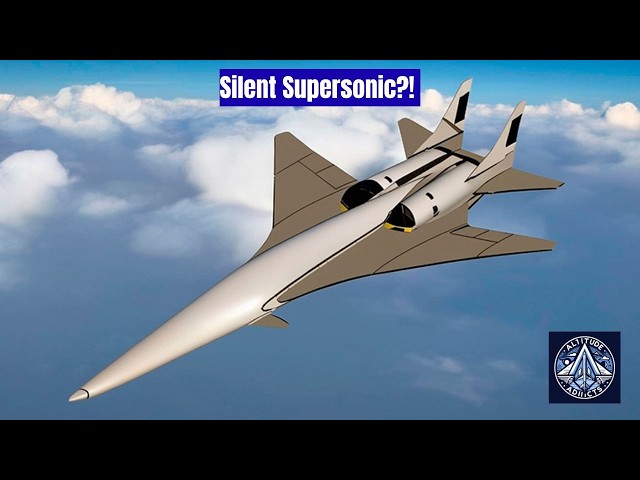
The engines are positioned at the rear
4:21
of the fuselage and feature over-wing
4:25
This configuration offers multiple
4:29
First, placing the engines above the
4:31
wing helps block noise from reaching the
4:34
ground during takeoff and landing.
4:37
Second, it allows the exhaust flow to
4:40
interact with the surrounding air in a
4:42
controlled way, influencing the overall
4:44
pressure distribution along the
4:48
The engine nacelles are carefully
4:49
integrated into the structure with
4:51
intake geometries designed for both
4:53
efficiency and acoustic performance.
4:57
These include wedge-shaped compression
4:59
elements and smoothly contoured inlet
5:01
shapes that blend into the aircraft
5:05
As we continue, the fuselage itself
5:08
plays a critical role in this system.
5:11
Unlike traditional aircraft with smooth
5:13
uniform shapes, this design uses a
5:15
non-uniform longitudinal profile.
5:18
The cross-section of the fuselage
5:20
changes gradually along its length.
5:23
This prevents the formation of a single
5:25
strong shock wave at one point.
5:28
Instead, multiple smaller disturbances
5:31
are created and distributed over
5:35
This effectively stretches the shock
5:38
When it reaches the ground, it is
5:40
perceived as a softer, more continuous
5:42
sound rather than a sharp boom.
5:45
For the Altitude Addicts audience, this
5:47
is where physics meets real-world
5:49
impact, turning a long-standing
5:51
limitation into a solvable design
5:55
Moving forward into the wing design, the
5:58
aircraft features a low wing
5:59
configuration with a highly swept
6:04
The large sweep angles reduce drag at
6:06
supersonic speeds and improve
6:07
aerodynamic efficiency.
6:10
The wing is divided into multiple
6:12
sections with varying angles, allowing
6:15
precise control of airflow and lift
6:19
This improves stability and performance
6:21
across different flight conditions.
6:24
The aircraft also includes a forward
6:26
horizontal stabilizer beneath the
6:30
This helps fine-tune aerodynamic
6:31
balance, particularly at high speeds.
6:35
At the rear, a large all-moving
6:37
stabilizer ensures control and stability
6:39
regardless of engine behavior.
6:42
The propulsion system itself
6:44
incorporates several advanced features.
6:47
The air intakes manage airflow
6:49
compression and pressure using complex
6:53
They include systems to relieve excess
6:55
pressure and control boundary layer
6:57
effects, ensuring stable engine
7:02
The exhaust system uses flat nozzles
7:04
integrated into a recessed tail
7:07
Surrounding surfaces act as acoustic
7:10
shields, reducing noise during takeoff
7:14
Additional airflow is directed around
7:16
the engine compartment to smooth the
7:18
interaction between exhaust and external
7:22
Beyond the sonic boom, airport noise is
7:25
another major challenge.
7:27
This design addresses it through engine
7:29
placement, nozzle geometry, and
7:33
Together, these features aim to meet
7:35
modern airport noise regulations.
7:39
Looking back at earlier aircraft like
7:40
Concorde and Tu-144, the difference
7:45
Those aircraft prioritized speed and
7:47
drag reduction, while noise was treated
7:49
as a secondary issue.
7:52
This new concept flips that priority.
7:55
Noise is now a central design parameter
7:58
integrated into every aspect of the
8:01
As we approach the development outlook,
8:04
it is important to remain realistic.
8:07
This is still a conceptual framework,
8:09
not a finished aircraft.
8:11
A technology demonstrator could appear
8:18
However, engine development remains a
8:20
major challenge, as a new propulsion
8:22
system will likely be required for
8:24
full-scale implementation.
8:27
If successful, the implications could be
8:31
Supersonic travel over populated areas
8:34
could become possible, opening new
8:36
routes and dramatically reducing travel
8:40
Globally, multiple programs are
8:41
exploring similar ideas.
8:44
However, the Russian approach stands out
8:46
due to its deep integration of
8:48
aerodynamics and propulsion into a
8:52
And as Altitude Addicts continues to
8:54
track the future of aviation, this
8:56
concept stands out not because it is the
8:59
fastest, but because it may finally make
9:02
supersonic travel practical again.
9:05
In conclusion, this is not just an
9:09
It is a shift in philosophy.
9:12
By treating the aircraft as a unified
9:14
system where every component shapes the
9:16
shock wave, this concept could define
9:18
the next era of aviation.
9:21
If it succeeds, supersonic travel may
9:24
return not as a luxury experiment, but
9:26
as a viable, efficient, and widely
9:28
accepted mode of transportation.
9:33
If you liked the video, please
9:35
subscribe, share, and like.
9:37
Also, please take the membership of the
9:39
channel to encourage us.