Up next in 10

Russia’s $200 Billion Victory Against Euroclear Could Change Global Banking Forever
May 16, 2026

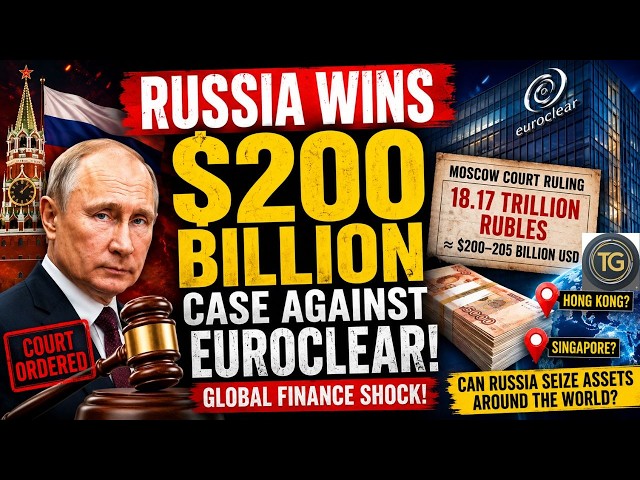
A Russian court has delivered one of the biggest financial judgments in modern history, ordering Belgian financial giant Euroclear to pay Russia more than $200 billion over frozen sovereign reserves. The case centers on the massive Russian state assets immobilized in Europe after Western sanctions were imposed in 2022.
But this is far bigger than a courtroom dispute.
The ruling could have major consequences for global finance, sovereign reserves, sanctions policy, and even the future role of Western financial infrastructure. Russia argues that Euroclear unlawfully deprived the Russian Central Bank of access to its funds, while Euroclear insists it merely complied with European Union sanctions laws.
Now the world is asking: can Russia try to enforce this judgment outside its borders? Could courts in Hong Kong, Singapore, the Middle East, or other financial hubs become the next battleground in the growing legal war between Moscow and the West?
In this video, we break down:
Why the Moscow court ruling matters globally
How much money is involved in USD terms
What Euroclear’s appeal options are
Whether Russia can pursue Euroclear assets abroad
The legal risks in Hong Kong, Singapore, and other jurisdictions
Why countries may now rethink where they store sovereign reserves
How this dispute could reshape the future of international finance and sanctions
As geopolitical tensions deepen, this case may become a turning point in the global financial order.
#Russia #Euroclear #Sanctions #GlobalFinance #Moscow #RussianAssets #UkraineWar #BankingCrisis #HongKong #Singapore #EU #CentralBank #FinanceNews #Geopolitics #EconomicWar #FrozenAssets #WorldNews #RussiaVsWest #DollarSystem #InternationalLaw
Show More Show Less View Video Transcript
0:03
Welcome to Pteranov's Geopolitics.
0:06
Tonight we are looking at a financial
0:08
battle so massive that it could reshape
0:10
how countries think about money,
0:12
sanctions, and even the safety of
0:14
sovereign reserves.
0:16
Russia has just won a court ruling worth
0:19
more than $200 billion against Euroclar,
0:22
one of the most important financial
0:24
institutions in the world. And now the
0:28
question being whispered across
0:29
financial capitals is simple. Could this
0:32
legal war spread into Hong Kong,
0:34
Singapore, or other global financial
0:36
hubs?
0:38
This is not just another sanctions
0:40
story. This is about whether countries
0:42
can truly trust the global financial
0:45
system anymore.
0:46
Because once sovereign reserves become
0:48
part of geopolitical warfare, the
0:51
consequences can spread very, very fast.
0:55
One of the most significant financial
0:56
and legal developments to emerge from
0:58
the confrontation between Russia and the
1:01
West is the decision by the Moscow
1:03
Arbitration Court to uphold the Central
1:06
Bank of Russia's claim against
1:08
Euroclear.
1:09
The court ordered Euroclear to pay
1:11
approximately 18.17
1:14
trillion rubles in damages. In United
1:17
States dollar terms, that equals roughly
1:20
200 to $25 billion.
1:23
Russia argued that after February 2022,
1:27
Euroclear froze Russian sovereign
1:29
reserves following European sanctions.
1:32
According to Moscow, this prevented the
1:35
Russian central bank from accessing and
1:37
managing its own reserves. The claim
1:40
included both direct financial losses
1:42
and alleged lost profits.
1:45
Reports indicate that the damages
1:47
include roughly 181 to 182 billion in
1:52
actual losses along with another 18 to19
1:55
billion in claimed lost income. The
1:59
proceedings reportedly lasted just over
2:01
5 months and were conducted behind
2:03
closed doors. In the end, the Russian
2:07
court fully backed the Russian position.
2:10
Now, here is where the story becomes
2:11
much bigger than one lawsuit.
2:14
Around 180 billion euros in Russian
2:17
sovereign assets remain immobilized
2:19
inside European financial systems.
2:22
Much of that is connected to Euroclear's
2:25
infrastructure in Belgium.
2:27
European leaders have debated multiple
2:30
options regarding those frozen assets.
2:33
Some proposals involve using profits
2:35
generated by the assets for Ukraine
2:37
related support. Others go even further
2:41
and discuss outright confiscation.
2:44
But legally, politically, and
2:45
financially that remains extremely
2:48
controversial.
2:49
And this is where Teranov's analysis
2:51
becomes important. The Moscow judgment
2:54
is not only about recovering money. It
2:57
is also about sending a global message.
3:00
Russia appears to be signaling that
3:03
Western financial infrastructure itself
3:05
may now face retaliation.
3:08
Eurolear is not an ordinary bank. It is
3:11
one of the most important securities
3:13
settlement and custody institutions on
3:16
the planet. Governments, central banks,
3:19
giant investment funds, and
3:20
multinational financial institutions all
3:23
rely on systems like Euroclar to safely
3:26
hold and transfer assets.
3:28
So when a Russian court issues a $200
3:31
billion judgment against a financial
3:33
institution of this scale, global
3:35
markets pay attention. Even countries
3:38
not directly involved in the Russia West
3:40
confrontation are watching carefully.
3:43
For decades, many governments believed
3:46
sovereign reserves held in Western
3:48
institutions were effectively
3:50
untouchable.
3:51
Then came the freezing of Russian
3:53
reserves in 2022.
3:55
That alone shook assumptions across the
3:58
financial world.
4:00
But now there is a second layer of
4:02
uncertainty.
4:04
What happens if the custodians
4:06
themselves become targets of massive
4:08
legal retaliation?
4:10
Suddenly, the entire conversation
4:12
changes.
4:14
Some countries may now reconsider where
4:16
they store their reserves. Instead of
4:18
relying heavily on European financial
4:20
systems, they may move more money into
4:23
gold, domestic reserve structures,
4:25
regional alternatives, or non-western
4:28
financial centers.
4:30
And honestly, this is where things start
4:32
getting uncomfortable for the existing
4:35
global order because once trust begins
4:38
to weaken, rebuilding it is not easy.
4:42
Eurolear has already stated that it
4:44
strongly disagrees with the ruling and
4:46
plans to appeal. The company also
4:49
criticized the closed-d dooror nature of
4:51
the proceedings, arguing that the
4:53
process violated principles of
4:55
transparency, fair hearing, and due
4:57
process.
4:59
That argument could become extremely
5:01
important later, especially if Russia
5:04
attempts to enforce the judgment outside
5:06
its borders.
5:08
Eurocar's likely defense is relatively
5:11
straightforward.
5:12
The company will argue that it did not
5:14
independently confiscate Russian assets.
5:18
Instead, it simply complied with legally
5:20
binding sanctions imposed by the
5:22
European Union and Belgian authorities.
5:26
Russia, however, sees things very
5:28
differently.
5:29
From Moscow's perspective, the result
5:31
was the immobilization of sovereign
5:33
funds and the loss of access to state
5:36
reserves.
5:37
Therefore, Russia argues that
5:39
compensation is justified.
5:42
So now we have two competing legal
5:43
narratives colliding headon.
5:46
One side frames sanctions compliance as
5:48
lawful mandatory behavior. The other
5:51
side describes the freezing of reserves
5:53
as an unlawful deprivation of sovereign
5:56
property rights.
5:58
And now we arrive at the question
6:00
everybody is asking. Can Russia actually
6:03
pursue Eurolear assets abroad?
6:07
In theory, yes. Russia can attempt to
6:09
seek enforcement in jurisdictions where
6:11
Eurolear has assets, operational
6:14
exposure, accounts, subsidiaries or
6:16
commercial interests. But theory and
6:19
reality are two very different things.
6:22
Before foreign courts recognize outside
6:25
judgments, they usually examine several
6:27
key issues. Did the original court have
6:30
proper jurisdiction?
6:32
Was the process fair? Was the defendant
6:35
properly represented?
6:37
Would recognition violate local public
6:39
policy?
6:41
That means Russia cannot simply wave the
6:43
Moscow ruling and automatically seize
6:46
assets worldwide. Every jurisdiction
6:49
would become its own legal battlefield.
6:52
Hong Kong immediately stands out as one
6:54
possible arena. The city remains one of
6:57
Asia's most important financial gateways
7:00
and still operates under a common law
7:02
system distinct from mainland China.
7:06
If Eurolear linked assets or banking
7:08
relationships exist there, Russia could
7:11
theoretically seek recognition through
7:13
Hong Kong courts, but the legal hurdles
7:16
would be significant.
7:18
Hong Kong courts would likely examine
7:20
whether the Russian proceedings met
7:22
international standards of due process
7:25
and judicial fairness.
7:27
Euroclear would almost certainly argue
7:29
that the closed hearings and
7:31
geopolitical context undermine the
7:33
legitimacy of the judgment.
7:36
Public policy concerns could also become
7:38
central. Hong Kong may not want to
7:41
become the venue for enforcing one of
7:43
the most politically explosive sanctions
7:46
related rulings in modern financial
7:48
history.
7:50
Still, Russia may view Hong Kong as more
7:53
strategically approachable than European
7:55
courts. The city is not institutionally
7:58
tied to European Union sanction
8:00
structures in the same way Belgium is.
8:04
Then there is Singapore,
8:06
another major financial and arbitration
8:08
center with enormous international
8:10
banking exposure.
8:12
Singaporean courts are globally
8:14
respected for commercial independence
8:16
and rigorous legal standards.
8:19
Any Russian enforcement application
8:20
there would likely face intense judicial
8:23
scrutiny.
8:25
Eurocclar would probably argue that the
8:27
ruling stems from sanctions retaliation
8:30
conflicts with financial stability
8:32
principles and raises concerns regarding
8:35
procedural fairness.
8:37
Singapore would also carefully consider
8:39
the reputational implications.
8:43
Because here is the thing. Financial
8:45
hubs survive on trust. Once investors
8:48
start believing political legal warfare
8:50
can spill unpredictably into major
8:52
banking centers, confidence can erode
8:55
surprisingly quickly.
8:58
Teranov's analysis is that even
9:00
unsuccessful enforcement attempts could
9:02
still create pressure. Multiple legal
9:05
proceedings across several jurisdictions
9:07
could increase costs, complicate
9:10
operations, and create uncertainty
9:12
around Eurocar's international exposure.
9:15
Beyond Hong Kong and Singapore, Russia
9:18
could also explore jurisdictions in the
9:20
Middle East, Asia, Africa, or Latin
9:22
America, where Eurolear maintains
9:24
operational links, correspondent
9:26
accounts, investment holdings, or
9:28
business relationships.
9:31
Some neutral or non-western
9:32
jurisdictions may at least be willing to
9:34
hear the claims, but even there courts
9:37
would still need to consider sanctions
9:39
implications, financial stability
9:41
concerns, and local public policy.
9:44
Actually, this entire situation feels
9:46
like global finance slowly entering
9:49
unfamiliar territory.
9:51
Not chaotic yet, but definitely less
9:54
predictable than before.
9:56
Physically seizing meaningful Euroclear
9:58
assets would remain extremely difficult.
10:02
Euroclear's core infrastructure and
10:03
operational base are heavily
10:05
concentrated in Europe, especially
10:07
Belgium.
10:09
European authorities remain deeply
10:11
aligned with the sanctions regime that
10:13
triggered the dispute.
10:15
Belgian courts would almost certainly
10:17
reject attempts that threaten European
10:20
sanctions policy. In addition, much of
10:23
Eurolear's infrastructure exists inside
10:25
highly regulated financial systems
10:28
protected by layers of legal and
10:30
sovereign oversight.
10:32
So even if Russia secures partial
10:34
recognition somewhere abroad,
10:36
identifying attachable assets that are
10:38
both legally vulnerable and
10:40
operationally accessible could prove
10:43
extremely complicated.
10:45
Yet the broader implications may matter
10:47
more than the actual enforcement
10:48
outcome.
10:50
Countries across Asia, the Middle East,
10:52
Africa, and Latin America are watching
10:55
this dispute closely.
10:57
The central issue is simple but
10:59
profound.
11:00
Are sovereign reserves truly safe abroad
11:03
during geopolitical crisis?
11:06
That question alone could reshape
11:08
reserve management strategies for years
11:10
to come. Governments may gradually
11:13
diversify away from western controlled
11:15
systems, increase gold holdings,
11:18
strengthen domestic reserve custody, or
11:20
expand regional payment frameworks.
11:24
Financial intermediaries may also become
11:26
more cautious when dealing with
11:27
geopolitically exposed sovereign
11:30
clients.
11:31
The risks now look far more visible than
11:34
they did only a few years ago.
11:36
And this is where Teranov's analysis
11:39
becomes especially important again. What
11:42
began as sanctions policy may now be
11:44
evolving into long-term financial
11:46
fragmentation.
11:48
Russia sees the freezing of its reserves
11:50
as an unprecedented assault on sovereign
11:53
financial rights. Western governments
11:56
view the sanctions as lawful responses
11:58
to Russia's actions in Ukraine.
12:01
Euro Clearar ended up directly in the
12:03
middle because of its central role
12:05
inside Europe's financial
12:07
infrastructure.
12:08
The Moscow ruling suggests Russia is
12:11
prepared to use legal mechanisms as part
12:13
of a broader retaliatory strategy
12:15
against Western financial institutions.
12:19
Whether Russia ultimately succeeds in
12:21
enforcing this judgment internationally
12:23
remains uncertain. But even without
12:26
successful enforcement, the case has
12:29
already changed the global conversation
12:31
surrounding sanctions, sovereign
12:33
reserves, and the neutrality of
12:35
international finance.
12:38
And honestly, that may be the real story
12:40
here. Not simply who wins in court, but
12:44
whether the world's financial
12:45
architecture is beginning to fracture
12:47
into competing geopolitical blocks.
12:50
This case could become one of the
12:52
defining financial and legal
12:54
confrontations of the post2022 era. Its
12:58
consequences may stretch far beyond
13:00
Russia, Europe, or even Euroclear
13:02
itself.
13:04
Thank you for watching Teranov's
13:05
geopolitics.
13:07
If you found this analysis valuable,
13:09
stay with the channel for more deep
13:11
dives into the geopolitical stories
13:13
reshaping the global order. And
13:16
remember, the financial world often
13:18
changes quietly at first until suddenly
13:21
everybody notices. If you like this
13:23
video, please like, subscribe, and
13:25
share.
#News