0:01
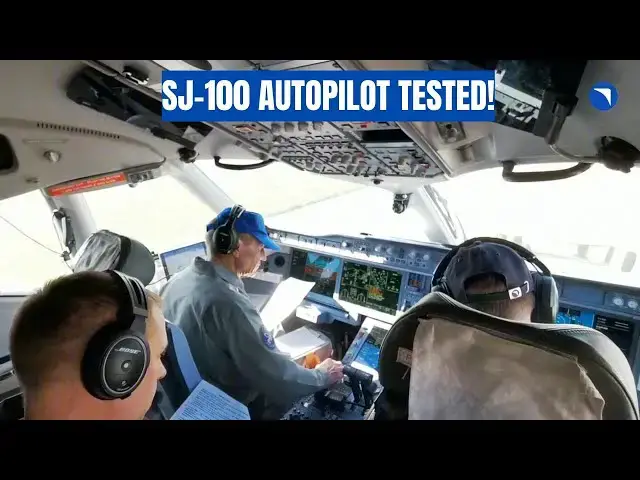
The first prototype of the SJ100 serial
0:06
97001 has achieved a significant
0:08
milestone in its development with the
0:11
successful completion of a critical
0:12
flight that was specifically designed to
0:15
assess its new automatic control system
0:19
The crew conducted a comprehensive
0:21
assessment of the ACS across a wide
0:23
spectrum of operational conditions
0:25
during this particular flight, which
0:27
lasted 4 hours and 10 minutes. The
0:30
systems capabilities were rigorously
0:32
tested in realworld scenarios by flying
0:35
the aircraft at speeds spanning from the
0:37
minimum allowable to 310 knots and Mach
0:40
0.81 and at altitudes of up to 12,200 m,
0:45
approximately 40,000 ft. The crew
0:48
concentrated on the testing of the
0:50
fundamental automation modes that are
0:52
indispensable for modern passenger
0:54
aircraft during the flight. These
0:57
covered altitude climb, level flight,
0:59
descent, turns to a predetermined
1:02
course, and flight at a predetermined
1:04
vertical speed to guarantee that the ACS
1:07
could meet the requirements of both
1:08
routine and complex flight operations.
1:11
Each of these modes was assessed for
1:13
precision, reliability, and
1:15
responsiveness. The crew's favorable
1:17
evaluation suggests that the system
1:20
functioned as intended, thereby
1:22
establishing a strong foundation for
1:24
future certification activities. The ACS
1:27
is a major technological advancement for
1:29
the SJ100 program. The system was
1:32
created in partnership with prominent
1:34
Russian aerospace institutions and is
1:36
intended to offer auto throttle
1:38
management as well as automatic and
1:40
director flight control. Its algorithms
1:43
are comparable to those of other modern
1:46
airliners, allowing for the
1:47
implementation of features such as
1:49
director control during launch and
1:52
complete automation during all other
1:54
flight phases. It is crucial to note
1:56
that the ACS is capable of supporting
1:59
automatic landings in CAT 3B conditions.
2:02
This enables the aircraft to land safely
2:04
in exceedingly low visibility situations
2:07
such as cloud ceilings below 50 ft and
2:10
runway visual ranges as low as 50 m.
2:14
Additionally, the system oversees
2:16
automatic alignment, touchdown, and
2:18
directional control along the runway
2:20
center line, thereby increasing
2:21
operational flexibility and safety. The
2:24
ACS was subjected to rigorous
2:26
groundbased testing using an electronic
2:29
bird integration test platform prior to
2:31
being installed on the aircraft. This
2:34
enabled engineers and test pilots to
2:36
verify the systems functionality and
2:39
resolve any potential issues prior to
2:41
conducting actual flight tests. The most
2:43
recent flight signifies the transition
2:45
from ground to in-aircraft testing,
2:48
which is a critical step in the process
2:50
of achieving full system certification.
2:53
The flight also evaluated the ACS and
2:55
tested updated software that enhances
2:58
flight safety and expands the systems
3:00
functionality as well as improvements to
3:02
the aircraft's navigation equipment and
3:05
personnel interface. This successful
3:07
flight is a component of a more
3:09
comprehensive and ambitious testing
3:11
program for the SJ 100, which is
3:14
designed to supplant imported systems
3:16
with domestically produced alternatives
3:18
as part of Russia's import substitution
3:21
initiative. By the end of 2025, the test
3:25
program is anticipated to include
3:27
approximately 200 flights, guaranteeing
3:29
that the aircraft, including the ACS,
3:32
undergo a comprehensive evaluation prior
3:34
to its entry into commercial service.
3:37
The prototype is presently powered by
3:39
PowerJet SM146 engines. However,
3:43
production models will be equipped with
3:44
Evadvigal PD8 engines manufactured in
3:48
Russia, further emphasizing the
3:50
transition to domestic components.
3:52
Before the development and introduction
3:54
of the new domestically produced ACS for
3:56
the SJ 100, the Sukcoy Superjet 100 was
4:00
equipped with an autopilot and flight
4:02
control system that was mainly sourced
4:05
from Western suppliers, most notably
4:07
Thalis and Leehur Aerospace. The
4:10
original SSJ 100 was the first aircraft
4:12
in its category to incorporate an
4:14
entirely electronic flybywire FBW
4:18
control system. The Thales designed
4:20
avionics suite was integrated with
4:22
advanced autopilot functions in this
4:24
system which provided modern automation
4:26
features such as envelope protection,
4:28
automatic deployment, retraction of high
4:31
lift devices, and numerous autopilot
4:33
modes for each phase of flight. In an
4:36
effort to either equal or enhance the
4:38
standards established by Airbus's FBW
4:40
systems, the flight control laws and
4:43
autopilot logic were developed by the
4:45
Sukcoy Civil Aircraft Company in
4:47
partnership with Leehair Aerospace. The
4:50
autopilot in the earlier SSJ100s enabled
4:53
automated control during a routine
4:55
flight which included altitude hold,
4:57
heading select, and basic approach
4:59
modes. However, its capabilities were
5:01
restricted to ICO category 3A
5:04
approaches. not the more challenging CAT
5:06
3B category that the new Russian ACS now
5:09
targets. The original system was also
5:12
closely integrated with Western avionics
5:14
and navigation components which are
5:16
currently being replaced in the
5:18
Russified SJ100 as a result of import
5:21
substitution policies. Now, do you think
5:24
the Superjet has the best FBW system in
5:27
its class? Please let us know in the
5:29
comments. Please like, subscribe, and
5:31
share our videos. In addition, please
5:34
take our memberships.