0:04
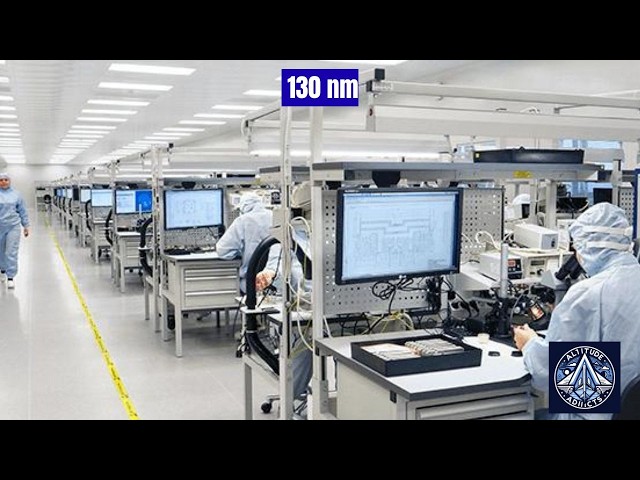
By the end of the current year, Russia
0:06
aims to achieve an ambitious
0:08
technological milestone by mastering a
0:11
domestic lithography system capable of
0:13
producing microchips at a process node
0:15
of 130 nanome which equals 130 billionth
0:20
of a meter. During a plenary session of
0:23
a regional reporting and program forum,
0:26
first deputy prime minister Dennis
0:28
Manturov highlighted the political and
0:30
strategic importance of this initiative.
0:34
Altitude Addicts, the YouTube channel
0:36
presenting this discussion, explains
0:38
that Mantarof described the capability
0:41
not merely as an industrial objective,
0:43
but as a strategic necessity as Russia
0:46
works to strengthen its micro electronic
0:48
sector and reduce reliance on foreign
0:52
He also emphasized that substantial work
0:55
remains to narrow the technological gap
0:57
with global leaders. His remarks reflect
1:01
a broader recognition within the
1:02
government that semiconductor
1:04
capabilities have become essential to
1:07
technological independence, national
1:09
security, and economic resilience.
1:12
To understand the significance, it helps
1:14
to explore what lithography means and
1:19
Lithography is the process of
1:21
transferring microscopic circuit
1:22
patterns onto semiconductor wafers
1:25
forming the intricate structures that
1:27
make up integrated circuits such as
1:29
processors, memory chips, and
1:32
specialized electronic components.
1:34
As process nodes shrink, more
1:37
transistors can be placed on a chip,
1:39
improving performance and energy
1:42
Leading global manufacturers now operate
1:45
at nodes measured in singledigit
1:47
nanometers meaning only a few billionth
1:50
of a meter and are even approaching the
1:52
angstrom scale which is 1 10 billionth
1:54
of a meter. In comparison focusing on
1:59
130 nm may seem modest but remains
2:02
highly relevant for many applications.
2:05
Altitude Addicts notes that mature nodes
2:07
like 130 nanometers are widely used for
2:11
industrial controllers, automotive
2:13
electronics, power management systems,
2:16
and secure communications where
2:18
reliability is often more important than
2:20
extreme miniaturization.
2:22
This makes the target strategically
2:26
Building on earlier achievements,
2:28
Russia's move toward 130 nanome
2:31
continues progress from previous
2:33
domestic lithography efforts that
2:35
reached a capability of 350 nanome which
2:39
equals 350 billionths of a meter. That
2:44
earlier system was developed in
2:45
cooperation with Bellarus.
2:48
The 350 nanometer platform incorporated
2:51
advances in optics, precision mechanics,
2:54
and control software, giving engineers
2:57
valuable experience in building complex
2:59
semiconductor equipment. This foundation
3:02
supports the transition toward more
3:06
Looking at the broader picture reveals
3:08
that mastering 130 nanometers is part of
3:12
a comprehensive national program to
3:14
rebuild the semiconductor ecosystem,
3:16
including wafer production, photomask
3:19
fabrication, chip design tools, and
3:22
packaging technologies.
3:24
Multiple research initiatives are
3:26
underway to reduce dependence on
3:28
imported equipment and materials.
3:31
This coordinated approach reflects
3:33
lessons learned from earlier reliance on
3:35
foreign suppliers and aims to address
3:38
structural challenges such as fragmented
3:40
capacity and limited investment.
3:43
Long-term planning and industrial
3:45
partnerships are central to the
3:49
Understanding the historical background
3:51
adds context because the Soviet Union
3:53
once maintained a large micro
3:55
electronics sector producing chips for
3:57
military, aerospace, and industrial
4:01
However, it lagged behind Western
4:03
technology in process nodes.
4:06
After the dissolution of the Soviet
4:08
Union, funding declined sharply and many
4:10
facilities closed, leading to a loss of
4:13
expertise and production capability.
4:16
Efforts to revive the sector gradually
4:18
resumed in later decades.
4:21
Domestic firms continued producing chips
4:24
for secure identification systems,
4:26
financial infrastructure, and
4:28
specialized industrial applications,
4:30
though technological gaps persisted.
4:33
Recent geopolitical developments have
4:35
accelerated the push for self-reliance.
4:39
Sanctions have limited access to
4:41
advanced lithography tools and
4:43
semiconductor manufacturing equipment,
4:45
prompting a renewed focus on domestic
4:47
development even at mature nodes.
4:51
The guiding principle is that reliable
4:53
local production is preferable to
4:57
Altitude addicts highlights that micro
4:59
electronics is now viewed not only as an
5:02
economic sector but as a strategic
5:04
domain essential for sovereignty.
5:07
This perspective underscores the
5:09
importance of the 130 nanometer target.
5:14
Despite advances elsewhere, chips
5:16
produced at 130 nanome remain widely
5:19
used in automotive control units,
5:22
industrial automation systems, and power
5:24
electronics because of their durability
5:26
and cost effectiveness.
5:29
Domestic capability would support
5:30
infrastructure, electronics, and
5:32
communications networks.
5:35
Achieving competence at this node also
5:38
provides a stepping stone for future
5:40
progress towards smaller geometries as
5:42
engineering knowledge accumulates
5:46
The global context illustrates the scale
5:50
Semiconductor manufacturing is among the
5:53
most complex industries requiring
5:55
billions of dollars in investment,
5:57
highly specialized materials and decades
6:01
Leading firms continue pushing toward
6:06
Russia's effort is therefore best
6:08
understood as a long-term rebuilding
6:10
process focused on resilience and supply
6:13
security rather than immediate
6:15
competition at the cutting edge.
6:18
Nevertheless, significant obstacles
6:21
Developing lithography equipment demands
6:24
precision optics, advanced light
6:26
sources, ultrastable mechanical
6:28
platforms, and sophisticated control
6:30
algorithms capable of maintaining
6:33
tolerances measured in nanome or
6:35
billionth of a meter. Each subsystem
6:38
must operate flawlessly.
6:40
Additional challenges include scaling
6:43
production, training skilled personnel,
6:45
and ensuring reliable supplies of ultra
6:48
pure chemicals and materials. A
6:50
sustainable ecosystem requires
6:52
coordination across many sectors.
6:55
Industrial collaboration between
6:57
enterprises, research institutes, and
7:00
state organizations plays a crucial role
7:02
in pooling expertise and resources to
7:05
accelerate progress. This coordination
7:08
helps align advances in design, material
7:11
science, and manufacturing.
7:13
Altitude Addicts observes that success
7:16
would mark a significant milestone in
7:18
restoring domestic semiconductor
7:20
capability and strengthening resilience
7:23
against external pressures. While it
7:26
would not eliminate reliance on foreign
7:28
technology, it would provide a stronger
7:33
Looking ahead, continued investment and
7:35
innovation will be needed to move toward
7:37
more advanced technologies and greater
7:40
self-sufficiency across the
7:42
semiconductor value chain. The effort
7:45
represents a long journey rather than a
7:49
In conclusion, the goal of mastering a
7:52
130 nanometer lithography system
7:55
underscores the growing importance of
7:57
semiconductors in national strategy and
8:00
reflects the realities of a digital
8:02
world shaped by geopolitical
8:05
By building on past experience and
8:08
pursuing coordinated development, Russia
8:10
seeks to reestablish a domestic
8:12
semiconductor base capable of supporting
8:17
Altitude Addicts concludes that although
8:19
the path is complex and demanding, the
8:22
initiative highlights a global trend in
8:24
which nations increasingly view
8:26
semiconductor capability as a
8:28
cornerstone of strategic independence
8:30
rather than merely an economic asset.
8:36
If you like the video, please subscribe,
8:38
share, and like. Also, please take the
8:41
membership of Altitude Addicts to