Up next in 10

NATO Plane Spotted as Drones Strike St. Petersburg? Russia Raises Serious Questions
Jun 4, 2026

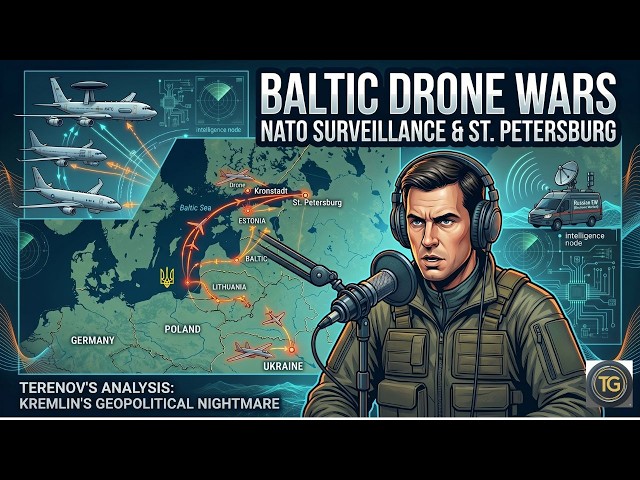
A new wave of Ukrainian drone attacks has brought the war closer than ever to Russia's historic city of St. Petersburg, one of the country's most important political, economic, and military centers. As Russian air defenses worked to intercept incoming drones, attention quickly shifted to another development unfolding above the Baltic Sea — the presence of NATO surveillance aircraft operating in international airspace.
Russian military commentators and analysts have suggested that NATO reconnaissance assets may have contributed to the broader intelligence picture surrounding the attack. While there is no public evidence that NATO directly coordinated the operation, the incident has reignited debate about intelligence sharing, airborne surveillance, and the increasingly blurred boundaries between support and participation in modern warfare.
In this video, we examine why St. Petersburg is such a strategically important target, what NATO reconnaissance aircraft actually do over the Baltic region, and why Moscow is paying close attention to every surveillance mission near its borders. We also explore how drone warfare has transformed the battlefield, allowing strikes hundreds of kilometers away from the front lines and forcing nations to rethink air defense and homeland security.
Could surveillance aircraft operating legally in international airspace influence military operations on the ground? What risks does this create for NATO-Russia relations? And how might future drone attacks reshape the security environment across Northern Europe?
Watch until the end for a complete breakdown of the military, political, and strategic implications of one of the most closely watched incidents in the Russia-Ukraine conflict.
#Russia #Ukraine #NATO #StPetersburg #DroneAttack #BalticSea #MilitaryNews #Geopolitics #RussiaUkraineWar #NATONews #BreakingNews #DefenseNews #BalticRegion #MilitaryAnalysis #UkraineWar #Putin #EuropeanSecurity #DroneWarfare #GlobalNews #WorldAffairs
Show More Show Less View Video Transcript
0:04
Welcome to Teranov's Geopolitics channel
0:07
and welcome to the podcast.
0:10
Right now, something massive is shifting
0:12
in Northern Europe and it's bringing the
0:14
world dangerously close to a direct
0:16
clash between superpowers.
0:18
Ukrainian drones just flew over 1,000 km
0:22
to strike deep inside Russia's second
0:24
city, St. Petersburg, right under the
0:26
noses of Western spy planes. This isn't
0:29
just about a few exploding drones. It's
0:32
a terrifying glimpse into how modern
0:34
wars are actually won and lost using
0:36
invisible data streams. Make sure you
0:39
watch till the end of this video because
0:41
over the next few minutes, we are going
0:43
to unpack exactly how these long range
0:45
strikes happened, why Moscow is
0:47
completely furious at NATO's regular
0:49
flight paths, and how the entire Baltic
0:51
Sea is turning into a hypermilitarized
0:53
powder keg.
0:55
Trust me, the final piece of Teranov's
0:58
analysis is something you absolutely
1:00
cannot afford to miss.
1:02
Let's look at the actual trigger event
1:04
that has everyone in the Kremlin
1:06
sweating. The most recent surge of
1:08
Ukrainian drone attacks to target St.
1:10
Petersburg has reignited a fierce debate
1:12
within Russia regarding the role of NATO
1:14
surveillance assets that operate over
1:16
the Baltic region. Russian military
1:19
analysts and several pro- Kremlin
1:21
commentators have contended that NATO
1:23
reconnaissance aircraft operating in
1:24
international airspace may have
1:26
indirectly supported Ukrainian strike
1:28
operations.
1:29
They say these planes are providing
1:31
crucial situational awareness and
1:33
intelligence coverage right in the
1:35
vicinity of northwestern Russia.
1:37
Although no public evidence has been
1:39
released to demonstrate direct NATO
1:41
involvement in controlling or guiding
1:43
the attacks, the episode underscores the
1:45
progressively ambiguous distinction
1:47
between intelligence collection,
1:49
military support, and direct
1:50
participation in modern warfare.
1:54
The timing of these explosions couldn't
1:56
have been worse for Moscow's public
1:58
relations team. The assaults on St.
2:00
Petersburg transpired at a time that was
2:02
particularly delicate for the
2:04
government. As the annual St. Petersburg
2:07
International Economic Forum was
2:09
commencing. Ukrainian drones targeted
2:11
military related targets and
2:12
infrastructure in the vicinity of
2:14
Russia's second largest city. While
2:16
Ukrainian officials claimed effective
2:18
strikes against energy and naval
2:20
facilities, including assets in the
2:22
Kronstat area, Russian authorities
2:24
reported multiple drone interceptions.
2:27
The assaults resulted in localized
2:29
damage, disrupted airport operations,
2:32
and garnered substantial media attention
2:34
both domestically and internationally,
2:36
according to reports from Reuter.
2:39
Now, you might be wondering why a city
2:41
so far from the actual front lines is
2:44
suddenly a prime target. Well, St.
2:46
Petersburg is situated in a distinctive
2:49
strategic position in sharp contrast to
2:51
numerous Russian cities that are
2:53
situated right near the Ukrainian
2:54
frontier. It is the grand headquarters
2:57
of the Russian Baltic Fleet, a
2:59
significant naval hub, an important
3:01
industrial center, and Russia's historic
3:03
northern capital. Additionally, the city
3:06
functions as one of Russia's primary
3:08
entry points to the Baltic Sea and
3:10
international maritime commerce. So
3:13
basically, hitting this place is a
3:15
massive deal, both for hurting Russia's
3:18
military pride and making regular people
3:20
realize the war isn't just happening
3:22
somewhere far away. Any successful
3:24
assault against St. Petersburg is of
3:26
symbolic as well as military
3:28
significance due to its geographic
3:30
location. 75s. The capacity to penetrate
3:33
deep into Russian territory and
3:35
challenge the notion that major urban
3:37
centers far from the front lines remain
3:39
insulated from the conflict is
3:40
demonstrated by a drone attack that
3:42
reaches the city.
3:44
This brings us to the core strategy
3:46
behind these highstakes aerial
3:48
operations. According to reports, the
3:51
most recent strikes were directed at
3:53
energy infrastructure and naval
3:54
facilities as part of a more
3:56
comprehensive Ukrainian strategy that is
3:58
designed to disrupt military logistics,
4:01
petroleum supplies, and defense
4:03
industrial capabilities that are located
4:05
deep within Russia. Ukrainian officials
4:08
have been increasingly referring to
4:09
these operations as a campaign that is
4:12
intended to impose costs on Russia that
4:14
extend far beyond the battlefield. And
4:16
that leads us directly to the big
4:18
question. How are these drones
4:20
navigating so far without getting
4:22
jammed?
4:24
Teranov's analysis is that you have to
4:26
look closely at the NATO aircraft issue
4:28
to find the real answer. NATO
4:30
reconnaissance aircraft that operate
4:32
over the Baltic Sea during periods of
4:34
increased military activity have been
4:36
the subject of particular attention by
4:38
Russian commentators.
4:40
NATO conducts surveillance,
4:41
intelligence, and air policing missions
4:44
in the region on a regular basis.
4:46
These missions are typically conducted
4:48
in international airspace and are deemed
4:50
completely legal under international
4:52
law.
4:54
Let's break down exactly what these
4:55
high-tech planes are actually doing up
4:57
there in the clouds. Airborne early
5:00
warning and control systems often called
5:02
Awax, maritime patrol aircraft,
5:05
electronic intelligence platforms, and
5:08
other specialized reconnaissance assets
5:10
may be utilized in the execution of such
5:12
missions. Their responsibilities include
5:15
the monitoring of military movements,
5:17
the maintenance of situational
5:18
awareness, and the support of NATO's
5:20
broader defensive posture along its
5:22
eastern flank. Russia contends that
5:25
Ukraine may derive advantages from the
5:27
information collected by these aircraft.
5:30
Surveillance data may contribute to a
5:32
more comprehensive intelligence picture
5:34
that assists Ukrainian forces in
5:35
comprehending Russian air defense
5:37
patterns, naval deployments, or aircraft
5:40
movements, even if NATO personnel are
5:42
not directly engaged in mission planning
5:44
or targeting.
5:46
Western leaders of course tell a
5:48
completely different story about these
5:50
flights. Nevertheless, Western
5:53
governments maintain that NATO is not a
5:55
direct participant in combat operations
5:57
and that reconnaissance missions are
5:59
purely defensive in nature. NATO
6:01
aircraft frequently observe Russian
6:03
military activity in the Baltic region
6:05
and Russian military aircraft frequently
6:08
operate in close proximity to NATO
6:10
airspace and are monitored by alliance
6:12
forces. But honestly, it's pretty
6:15
obvious that this entire situation
6:17
highlights a much bigger change in how
6:18
modern wars are fought nowadays. The
6:21
controversy is indicative of a more
6:23
extensive transformation in the field of
6:25
warfare. In the present day, military
6:28
operations are becoming more reliant on
6:31
information than on manpower and
6:32
weapons. The success or failure of an
6:35
operation is frequently determined by
6:37
the intelligence collected by
6:38
satellites, aircraft, drones, and
6:41
electronic sensors.
6:43
This information reliance completely
6:45
blurs the lines of what it means to
6:47
actually be at war with someone. The
6:50
distinction between supplying
6:51
intelligence and participating in combat
6:53
can become politically contentious in
6:55
contemporary conflicts. Real-time
6:58
surveillance can assist in the
6:59
identification of vulnerabilities, the
7:02
monitoring of naval activity, the
7:04
assessment of the efficacy of strikes
7:05
after they have taken place, and the
7:07
tracking of troop movements.
7:09
Intelligence sharing has emerged as one
7:11
of the most significant forms of Western
7:13
support for Kiev since the onset of the
7:15
Russia Ukraine conflict. Western
7:18
governments have consistently
7:19
acknowledged their provision of
7:21
intelligence assistance despite the fact
7:23
that the precise scope and operational
7:25
details are still classified.
7:28
All of this invisible data sharing
7:30
creates a massive complicated headache
7:32
for Moscow's top generals. This presents
7:35
a challenge for Russian strategists. The
7:38
broader operational environment can
7:40
still be influenced by intelligence
7:42
collected through surveillance networks,
7:44
even if no NATO aircraft directly guide
7:46
a Ukrainian drone. This perception
7:49
incites Moscow's apprehension that NATO
7:51
reconnaissance activities effectively
7:53
expand Ukrainian influence into regions
7:55
that were previously regarded as
7:57
relatively secure. Terranov's analysis
8:00
is that this anxiety is exactly what is
8:02
turning the Baltic Sea into a high-risk
8:04
strategic arena. The Baltic Sea has
8:07
become one of the most militarized and
8:09
closely monitored regions in Europe.
8:11
NATO has expanded its surveillance, air
8:14
policing operations, maritime patrols,
8:17
and intelligence collection efforts in
8:19
the region since the outbreak of the
8:20
conflict in Ukraine.
8:23
The alliance has initiated initiatives
8:25
to enhance situational awareness and
8:27
fortify security in the vicinity of
8:29
critical infrastructure. These endeavors
8:32
have been driven by apprehensions
8:33
regarding drone activity, underwater
8:35
infrastructure incidents, sabotage, and
8:38
broader regional instability. As noted
8:40
by Reuters, the Baltic region poses
8:43
numerous vulnerabilities for Russia. An
8:46
environment that is becoming
8:47
increasingly monitored encompasses naval
8:50
facilities, ports, energy
8:52
infrastructure, St. Petersburg, and
8:54
Khenrad.
8:55
Surveillance platforms can monitor
8:57
substantial portions of Russian military
8:59
activity without penetrating Russian
9:01
airspace due to the close proximity of
9:03
NATO member states.
9:06
This geographical reality leaves Moscow
9:08
with very few good options to protect
9:10
its northern flank. Moscow is faced with
9:13
a persistent intelligence challenge. As
9:15
a result of this reality, even the most
9:18
sophisticated air defense systems are
9:20
unable to prevent foreign aircraft from
9:22
accumulating information while operating
9:24
legally in international airspace. This
9:27
brings us straight to the most
9:28
terrifying part of the whole situation,
9:30
which is the immediate risk of a sudden
9:32
accidental escalation. Pressure for a
9:35
more aggressive response could intensify
9:37
if Russia determines that NATO
9:39
surveillance assets are actively
9:41
facilitating attacks on Russian
9:42
territory. Attempts to disrupt
9:45
reconnaissance operations, increased
9:47
electronic warfare activity, or more
9:50
assertive military maneuvers in
9:51
international airspace are potential
9:53
responses.
9:55
When you have heavily armed jets playing
9:57
chicken in the dark, things can go wrong
9:59
incredibly fast. Miscalculation is the
10:03
potential hazard. NATO and Russian
10:05
military aircraft are currently
10:07
operating in close proximity over the
10:09
Baltic Sea. Interceptions and
10:11
surveillance missions are conducted on a
10:13
regular basis. Tensions could be rapidly
10:16
exacerbated by a technical malfunction,
10:19
excessively aggressive maneuver or
10:21
misunderstanding.
10:23
NATO fighters have been compelled to
10:24
intercept Russian aircraft in close
10:26
proximity to alliance airspace on
10:28
numerous occasions in recent years.
10:30
While Russian forces conduct routine
10:32
surveillance of NATO flights near their
10:34
borders, as the operational environment
10:37
becomes more congested, the likelihood
10:39
of an incident involving military
10:41
aircraft from opposing factions
10:42
increases. According to reports from
10:44
Euron News,
10:46
beyond the pilot standoffs, we are also
10:49
witnessing a rapid evolution of the
10:51
drone threat itself. The increasing
10:54
sophistication of long range drone
10:55
warfare is another critical lesson to be
10:58
learned from the St. Petersburg attacks.
11:00
Ukraine has exhibited the capacity to
11:02
strike targets that are hundreds of
11:04
kilometers and occasionally over 1,000
11:07
km from the front line. Advancements in
11:10
drone range, navigation systems,
11:13
communications, and autonomous
11:15
capabilities have expanded the set of
11:16
prospective targets available to
11:18
Ukrainian planners.
11:21
To counter this, Russia has poured a ton
11:23
of money into electronic warfare and
11:25
layer defenses. But it's like trying to
11:27
stop rain with a net when they send
11:29
dozens of drones all at once.
11:31
Concurrently, Russia has made
11:33
substantial investments in electronic
11:35
warfare capabilities and multi-layered
11:37
air defense systems. The vast number of
11:40
drones involved in certain attacks can
11:42
complicate interception efforts and
11:44
create opportunities for individual
11:46
drones to achieve their objectives.
11:48
Despite these efforts, Russia is not the
11:51
only country facing this challenge. NATO
11:54
countries have also expressed growing
11:55
apprehension regarding drone threats.
11:58
Discussions regarding the enhancement of
12:00
counter drone defenses and the extension
12:02
of surveillance networks throughout
12:03
Eastern Europe have been initiated in
12:05
response to drone incursions into
12:07
alliance airspace.
12:09
These shifting threats are forcing a
12:11
massive rewrite of Russia's security
12:13
strategy. The attacks on St. Petersburg
12:16
may serve as an incentive for Russia to
12:18
enhance its air defenses in the vicinity
12:20
of significant cities, strategic
12:22
infrastructure, and naval facilities. It
12:26
is probable that a greater emphasis will
12:28
be placed on the detection of low-flying
12:29
drones approaching from unconventional
12:31
directions, electronic warfare, and
12:34
early warning systems. Additionally,
12:37
Russian planners may allocate additional
12:39
resources to oversee NATO reconnaissance
12:41
operations in the Baltic region.
12:44
Russia's capacity to interfere with
12:46
aircraft operating in international
12:47
airspace is restricted by international
12:49
law. However, it is reasonable to
12:52
anticipate that Moscow will continue to
12:54
closely monitor these missions and
12:56
emphasize them in public statements.
12:59
Looking at the bigger picture, this
13:00
whole situation shows that distance
13:02
doesn't really protect you anymore in
13:04
modern conflicts. Teranov's analysis is
13:07
that the episode emphasizes the
13:09
diminishing significance of geography in
13:11
the context of persistent surveillance
13:13
and long-range drones. Intelligence
13:16
collected hundreds of kilometers away
13:18
can influence events on the ground in
13:19
near real time, while cities that were
13:22
previously considered distant from the
13:23
battlefield are becoming increasingly
13:25
vulnerable to attack. In conclusion, the
13:28
debate concerning NATO aircraft and the
13:30
recent drone assaults on St. Petersburg
13:32
is indicative of the evolving nature of
13:35
contemporary warfare. The increasing
13:37
significance of intelligence,
13:39
reconnaissance, and information
13:41
dominance in contemporary conflicts is
13:43
underscored by the presence of NATO
13:45
surveillance platforms, regardless of
13:47
whether they directly supported
13:48
Ukrainian operations.
13:51
Ultimately, the game has completely
13:53
changed for the Russian military
13:55
command. Simply preserving frontline
13:57
positions is no longer the primary
13:59
challenge for Russia. It is safeguarding
14:02
critical infrastructure, military
14:04
facilities, and significant urban
14:06
centers from threats that may originate
14:08
in locations that are not conventional
14:10
battlefields. The strategic competition
14:12
in the Baltic region is expected to
14:14
intensify as drone technology continues
14:17
to advance and intelligence networks
14:19
become more integrated. Consequently,
14:22
the St. Petersburg attacks are not
14:24
merely a singular military operation.
14:26
They demonstrate a more extensive
14:28
transformation in the conflict in which
14:30
surveillance aircraft, intelligence
14:33
networks, drones, and electronic warfare
14:35
are becoming just as significant as
14:37
tanks, ships, and missiles in
14:39
determining the future of European
14:41
security. If you like this podcast,
14:44
please like, subscribe, and share.
#News