Up next in 10


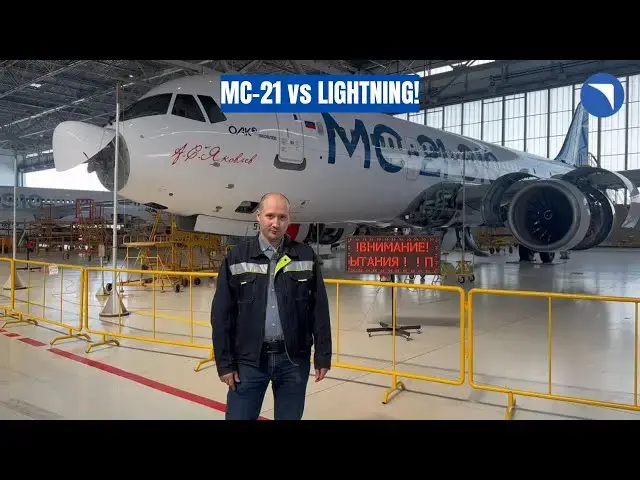
The MC-21-310 just passed its most extreme tests yet – including surviving 200,000-amp lightning strikes and a flawless 3-hour flight with 100% Russian systems. In this exclusive breakdown, we:
✔️ Reveal never-before-seen footage of lightning strike simulations
✔️ Interview test pilots who praise the new domestic avionics
✔️ Expose the secret tech behind Russia’s import-substituted components
✔️ Compare it to Boeing/Airbus – can it really compete?
With certification nearing, the MC-21 could become Russia’s first globally competitive passenger jet. But is it truly revolutionary... or just propaganda? Watch to the end for our shocking verdict!
(Like/Subscribe for more uncensored aviation tech analysis!)
#MC21 #RussianAviation #BoeingVsRussia #AviationTech #FutureOfFlight #AircraftEngineering #LightningTest #PD14Engine #AviationGeek #PlaneSpotting #AviationLovers #TechBreakthrough #AeroInnovation #JetTech #AviationDaily
Be a Member for exclusive privileges - https://www.youtube.com/channel/UCviEFTf1xIPKsjmyF_zvFug/join
Twitter : https://x.com/AltitudeAddicts
Website: https://www.altitudeaddicts.com
Show More Show Less View Video Transcript
0:03
Preparation for the certification
0:05
flights of the experimental MC21
0:07
aircraft equipped with new Russian
0:09
systems and components is ongoing.
0:11
According to
0:13
Rosstec, during factory finetuning
0:16
tests, the aircraft took off for the
0:18
first time from the MM Gromov Flight
0:20
Research Institute airfield in Ramensoy
0:23
and remained in the air for about 3
0:25
hours with all systems operating
0:28
normally.
0:29
The flight included testing of
0:31
domestically produced radio
0:33
communication equipment and
0:35
transponders, and the pilots praise the
0:37
quality of the Russian-made
0:39
communication
0:40
systems. The testing went very well. The
0:43
performance of the Russian communication
0:45
system and transponder was solid. There
0:48
were no serious issues with the
0:50
equipment. The flight followed a
0:52
standard profile at an altitude of 10 km
0:55
and a speed of about 750 km hour. said
0:59
test pilot and hero of Russia Oleg
1:03
Kanenko. Additional ground tests on the
1:06
MC21310 prototype aircraft tail number
1:10
73051 are continuing at the flight
1:12
research and development complex LIDK of
1:15
the Yakavv design bureau in Jukovski to
1:18
assess the aircraft's level of lightning
1:20
protection. This is one of the
1:22
certification stages for the import
1:24
substituted version of the aircraft. The
1:28
outcome of the tests will be the
1:29
approval of a major modification
1:31
involving Russian-made systems. This was
1:34
reported by Anton Kikoff, head of the
1:36
electromagnetic compatibility and
1:38
lightning protection team in the
1:40
corporate MC21 testing journal published
1:43
by
1:44
UAC. Lightning protection tests are
1:47
being conducted jointly with specialists
1:49
from the Gromoff flight research
1:51
institute and include passing a current
1:53
simulating a lightning strike through
1:55
the aircraft's fuselage.
1:57
The goal is to measure the induced
1:59
voltage levels in the onboard wiring
2:01
network and assess the lightning
2:03
protection of onboard systems during
2:06
current flow through the fuselage. This
2:09
helps identify and eliminate potential
2:11
vulnerabilities in the electrical
2:13
systems and ensures the aircraft's
2:15
safety and reliability under realorld
2:18
thunderstorm conditions. The specialist
2:20
explained, "Good afternoon. My name is
2:23
Click Phantoon. This is a test diary.
2:25
Today we are in the vanguard of Mazadin
2:27
Leapol Yakov. Behind me, Mazu 7310
2:30
aircraft which is undergoing additional
2:32
or association test as part of the
2:34
approval of the main change in the
2:35
installation of a Russianmade
2:37
system. This test according to the
2:40
assessment of lightning protection is a
2:41
test to assess the induced voltage in
2:43
the onboard cabin of the aircraft to
2:45
assess the lightning protection of
2:46
onboard systems when only lightning
2:48
flows through the aircraft to ensure
2:50
flight safety in the expected operating
2:51
conditions. The expected operating
2:53
conditions of the aircraft include
2:55
flight in difficult weather conditions
2:57
in various types, precipitation of which
2:59
lightning may strike the aircraft. Tests
3:02
are carried out jointly with specialists
3:04
of Olmani Gromov with their testing
3:06
equipment. As part of these tests, we
3:08
pass lightning current through the
3:10
aircraft body and measure the level of
3:12
new images of the onboard cable network.
3:14
The data of the aircraft is one
3:15
experimental aircraft which was
3:17
installed the Russian engine PD14 as
3:20
well as the onboard committee of the
3:21
aircraft brought to the appearance of
3:23
the installation of the system of
3:24
Russian production.
3:27
A source from the Gromoff Flight
3:28
Research Institute speaking to the
3:30
Aviation of Russia website clarified
3:33
that lightning protection testing for
3:35
aircraft includes simulating likely
3:37
lightning strike points, laboratory
3:40
testing of equipment under high voltage
3:42
discharges and currents as well as real
3:45
world testing on the aircraft itself.
3:48
During testing, the aircraft is
3:50
subjected to current impulses of 5 kilo
3:53
with voltage reaching up to 10
3:55
kilovolts. Specialized equipment records
3:58
the parameters of induced electricity in
4:00
the cable networks, which allows ground
4:02
tests to evaluate the level of system
4:05
protection against atmospheric
4:07
electrical discharges, the source said.
4:10
He added that some international
4:12
standards allow such tests with currents
4:14
up to 200
4:17
kilo. An article in the scientific
4:19
technical journal proceedings of VAM
4:22
titled materials for lightning
4:24
protection of aircraft states that
4:26
statistically the aircraft's nose ray
4:28
dome is most often struck by lightning.
4:31
Materials used for ray domes must not
4:33
only possess high mechanical strength
4:35
but also low dialectric permitivity to
4:38
avoid distorting electromagnetic wave
4:40
characteristics passing through them.
4:43
Fiberglass which is often used for ray
4:45
domes is a dialectric and may be damaged
4:48
by lightning strikes potentially
4:50
disabling radio navigation systems.
4:53
Carbon fiber reinforced plastics with
4:56
conductive carbon fillers have
4:57
intermediate properties between metals
4:59
and dialectrics, but they also require
5:02
additional lightning
5:03
protection. To protect structures made
5:06
of polymer composite materials, PCMs,
5:09
special lightning protection coatings
5:11
are used that give PCMs electrical and
5:14
thermal conductivity close to that of
5:16
metals. One effective method involves
5:19
weaving metal wires, usually copper,
5:21
into the carbon fiber structure, which
5:23
provides reliable lightning protection
5:26
without significantly increasing weight
5:28
or compromising aerodynamic
5:30
performance. Aircraft number
5:33
73051 is the first MC21 prototype and
5:37
also the first on which the entire cable
5:39
network was replaced during the 2022 to
5:42
2023 re-engineing to the PD14 engines.
5:46
At the end of 2024, the aircraft was
5:49
prepared for ground lightning protection
5:51
tests and is currently not flying.
5:54
Previously in 2021, similar tests were
5:57
conducted on the same aircraft, but at
5:59
that time it was equipped with a foreign
6:02
manufactured wiring system.
6:04
The evaluation of lightning protection
6:06
for an aircraft is a comprehensive study
6:09
aimed at improving the safety and
6:11
reliability of airliners which are
6:13
equipped with a large number of complex
6:15
electronic systems under lightning
6:17
strike conditions. The ongoing work is
6:21
part of the import substitution program
6:23
and efforts to strengthen the
6:24
technological independence of the
6:26
domestic aviation industry noted Anton
6:30
Klyoff at the Urkutzk aviation plant.
6:33
Work is also underway on assembling
6:35
another set of MC21 passenger aircraft.
6:38
Currently, specialists in workshop 205
6:41
are working on three main fuselage
6:43
sections, F1, F2, and F4A. Once the work
6:47
is completed, the components will be
6:49
sent to a specialized shop for painting
6:51
and then to final assembly.
6:54
The MC21 assembly at the Urkutsk
6:56
aviation plant is organized using modern
6:59
technological solutions. High precision
7:02
jigs and automated riveting systems are
7:04
used which reduce the likelihood of
7:06
defects and increase the speed of
7:08
assembly. Workshop 205 follows a modular
7:12
assembly principle allowing work on
7:14
different sections to proceed
7:16
simultaneously which shortens the
7:18
overall production
7:19
cycle. To accelerate the assembly
7:22
process, IAZ has implemented digital
7:25
technologies and control systems. Sensor
7:28
devices monitor riveting and welding
7:30
parameters in real time, enabling quick
7:32
detection and correction of deviations.
7:35
These measures reduce equipment downtime
7:37
and increase
7:39
productivity. Additionally, logistics
7:41
within the plant are being optimized.
7:44
The use of automated transport vehicles
7:46
and modern storage systems shortens the
7:49
time needed to move large assemblies
7:51
between workshops. The implementation of
7:54
a unified information system ensures
7:56
coordination between various departments
7:58
and reduces
8:00
delays. Now, do you think MC21 testing
8:04
can finish by 2025 or will it get a
8:07
provisional certification? Let us know
8:09
in the comments. Please feel free to
8:11
like, share, and subscribe to our
8:13
channel.