Up next in 10


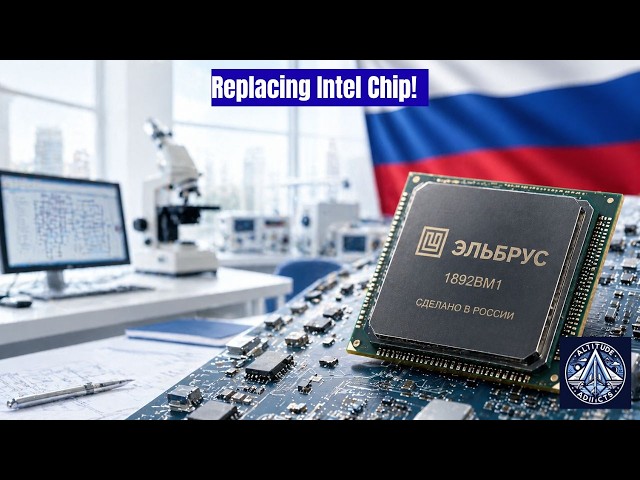
Russia is developing a domestically produced microprocessor designed as a direct alternative to the Intel Atom E680T, a widely used embedded processor in industrial and defense applications.This ambitious project is part of a broader push toward technological independence, aiming to reduce reliance on Western semiconductor technology. Built with a MIPS64-like architecture and targeting onboard computing systems, the chip focuses on reliability and efficiency rather than cutting-edge performance.However, the project is running behind schedule, highlighting the real challenges of designing and producing chips at scale. From architecture design to manufacturing constraints, Russia’s attempt to replace Intel Atom E680T reveals both ambition and complexity.In this video, we explore the technology, the strategy, and whether Russia can truly compete in the global semiconductor race.#IntelAtom #E680T #RussiaTech #Microprocessor #Semiconductors #CPU #TechIndependence #DefenseTech #ChipWar #EmbeddedSystems #AerospaceTech
Be a Member for exclusive privileges - https://www.youtube.com/channel/UCviEFTf1xIPKsjmyF_zvFug/join
Twitter : https://x.com/AltitudeAddicts
Website: https://www.altitudeaddicts.com
Show More Show Less View Video Transcript
0:06
One of the most strategically
0:07
significant technology initiatives in
0:09
Russia's modern industrial policy is its
0:12
ongoing effort to develop a
0:13
microprocessor that is manufactured
0:16
domestically and can replace Western
0:18
chips.
0:20
The Kurchatov Institute stands at the
0:22
center of this effort working on a
0:24
high-performance processor for
0:25
specialized onboard computing systems
0:28
under a government contract awarded in
0:30
2016.
0:33
The project has faced major delays
0:35
reflecting the complexity of building a
0:37
sophisticated semiconductor ecosystem
0:39
that is largely independent of global
0:42
supply chains.
0:44
Yet despite these challenges, progress
0:46
continues.
0:48
As Altitude Addicts explores this story,
0:50
the real narrative lies not in
0:52
timelines, but in technological
0:53
ambition, design philosophy, and global
0:56
strategy.
0:58
Looking at the broader context, the need
1:01
for domestic chips becomes clearer.
1:04
For decades, Intel has dominated global
1:06
semiconductor production powering
1:08
everything from personal computers to
1:11
critical defense systems.
1:13
Like many countries, Russia relied
1:15
heavily on imported chips, especially
1:18
for high-performance and
1:19
mission-critical applications.
1:22
However, growing geopolitical tensions,
1:25
export controls, and the weaponization
1:27
of supply chains have turned this
1:29
reliance into a national security
1:31
concern.
1:32
As a result, Russia has accelerated
1:35
efforts to develop its own
1:36
microelectronics industry as part of
1:39
strengthening its defense industrial
1:41
base.
1:42
The goal goes beyond independence.
1:45
It is about resilience, ensuring that
1:47
critical systems such as aerospace
1:50
electronics and military hardware can
1:52
operate without depending on external
1:54
suppliers.
1:56
Moving into the vision behind the
1:58
project, the processor is being
1:59
developed as a domestic alternative to
2:02
the Intel Atom E680T.
2:06
This chip is widely used in embedded and
2:08
industrial systems where reliability and
2:11
consistency matter more than raw power.
2:14
Unlike consumer processors, these chips
2:17
are designed for harsh environments.
2:20
They must function under vibration,
2:22
temperature fluctuations, and limited
2:24
power conditions, all while delivering
2:27
stable performance.
2:29
The Russian processor is aimed at small,
2:32
high-performance onboard computing
2:33
systems, particularly in defense and
2:36
aerospace sectors.
2:38
Its design focuses on balancing
2:40
efficiency and reliability rather than
2:42
competing with cutting-edge consumer
2:44
CPUs.
2:46
Shifting toward the technical
2:47
foundation, the processor uses a
2:50
multi-core design with at least two
2:52
domestically developed cores based on a
2:54
MIPS64-like architecture.
2:57
This choice is significant as MIPS
2:59
architectures are known for simplicity,
3:01
scalability, and efficiency in embedded
3:04
systems.
3:06
By moving away from x86 dependency,
3:08
engineers gain greater control over the
3:10
platform.
3:12
This allows for customization and
3:14
long-term stability in critical
3:16
applications.
3:18
The processor is expected to operate at
3:20
a minimum clock speed of 1.2 GHz.
3:25
While not competing with modern desktop
3:27
processors, it is sufficient for
3:29
mission-critical
3:30
systems where reliability is the
3:32
priority.
3:34
The chip also integrates a graphics
3:36
processing unit for visual and
3:37
computational tasks.
3:40
It supports PCI Express 2.0 for
3:42
connectivity and includes additional
3:45
controllers for embedded system
3:47
integration.
3:49
Manufacturing is based on a 45-nanometer
3:51
process.
3:53
Although not cutting-edge globally, this
3:55
node is more practical for domestic
3:57
production and reflects a strategic
3:59
focus on manufacturability over extreme
4:02
miniaturization.
4:04
Turning to the timeline, the project
4:06
began with a contract signed in November
4:09
2016 aiming for completion by the end of
4:12
2020.
4:14
It progressed through multiple stages
4:16
with the most difficult being the
4:18
transition to serial production.
4:21
This stage, involving scaling from
4:23
prototypes to full manufacturing, was
4:26
only completed in September 2023.
4:29
The delay highlights the complexity of
4:31
semiconductor production, especially
4:34
when building capabilities from scratch.
4:37
Challenges during this phase included
4:39
optimizing fabrication processes,
4:41
improving production yield, coordinating
4:44
supply chains, and conducting
4:46
large-scale testing and validation.
4:49
Focusing on the institution behind the
4:51
project, the Kurchatov Institute is one
4:54
of Russia's leading scientific centers,
4:57
historically known for nuclear research
4:59
and advanced physics.
5:01
Its involvement reflects a broader
5:03
strategy of leveraging established
5:05
research institutions for emerging
5:07
technologies.
5:10
However, moving from scientific research
5:12
to industrial-scale chip production is a
5:14
major leap.
5:16
It requires deep expertise not only in
5:18
theory, but also in engineering,
5:20
manufacturing, and logistics.
5:23
Looking deeper into the challenges,
5:26
semiconductor fabrication remains one of
5:28
the most complex manufacturing processes
5:31
in the world.
5:32
It depends on specialized equipment,
5:34
advanced materials, and design tools
5:37
that are concentrated in a few global
5:39
regions.
5:41
Beyond fabrication, the surrounding
5:43
ecosystem is equally critical.
5:46
Design software, testing facilities,
5:48
packaging, and logistics all play
5:50
essential roles in bringing a chip to
5:52
market.
5:54
Human expertise is another key factor.
5:57
Developing advanced microelectronics
5:59
requires highly skilled engineers,
6:01
physicists, and software developers,
6:04
making talent development a continuous
6:06
challenge.
6:08
Expanding the perspective to the wider
6:10
industry, this project is part of a
6:12
broader push to strengthen domestic
6:15
microelectronics capabilities.
6:18
Similar efforts are underway to develop
6:20
communication systems, specialized
6:22
chips, and defense technologies.
6:25
As often discussed by Altitude Addicts,
6:28
such delays are not unique.
6:30
Even established semiconductor powers
6:32
face setbacks when developing new
6:34
architectures or production nodes.
6:38
What makes this effort distinct is the
6:40
urgency driven by geopolitical
6:42
pressures.
6:43
The push for technological sovereignty
6:46
has accelerated timelines, sometimes
6:48
leading to ambitious targets that are
6:50
difficult to achieve.
6:53
Turning to its strategic importance, the
6:55
processor is primarily intended for
6:57
defense applications.
6:59
Military systems require components that
7:02
can function reliably for decades, often
7:04
in environments where maintenance is
7:06
difficult.
7:08
By developing a domestic processor, the
7:11
aim is to reduce vulnerability to supply
7:13
disruptions and ensure greater control
7:16
over critical systems.
7:18
Potential uses include avionics, missile
7:21
guidance, secure communications, and
7:23
autonomous military platforms.
7:26
In these cases, predictability and
7:28
reliability are far more important than
7:30
maximum performance.
7:33
With the completion of the serial
7:34
production stage in 2023, the project is
7:37
now entering a new phase.
7:40
The focus is shifting toward real-world
7:42
deployment and scaling up manufacturing.
7:46
This stage will determine the long-term
7:48
success of the initiative.
7:51
Questions remain about production
7:52
scalability, operational performance,
7:55
and the ability to support future
7:57
improvements.
7:59
As Altitude Addicts highlights in this
8:01
analysis, Russia's domestically
8:03
developed microprocessor represents a
8:05
significant step toward technological
8:08
independence.
8:10
At the same time, it underscores the
8:12
immense challenges involved.
8:15
The project is running behind schedule,
8:17
emphasizing the complexity of
8:19
semiconductor development in a
8:21
constrained global environment.
8:24
Yet it also reflects a determined effort
8:26
to build a self-reliant technological
8:28
foundation.
8:30
As the processor moves from development
8:32
into practical use, it will serve as
8:35
both a test case and a learning platform
8:38
for future initiatives.
8:40
Ultimately, its success will depend not
8:42
only on the chip itself, but on the
8:44
entire ecosystem supporting it.
8:47
In the end, this is not just about one
8:50
processor.
8:51
It is about the transformation of an
8:53
entire industry, a journey that is still
8:56
very much in progress.
9:00
If you liked the video, please
9:02
subscribe, share, and like. Also, please
9:05
take the membership of the channel to
9:06
encourage us.