Up next in 10



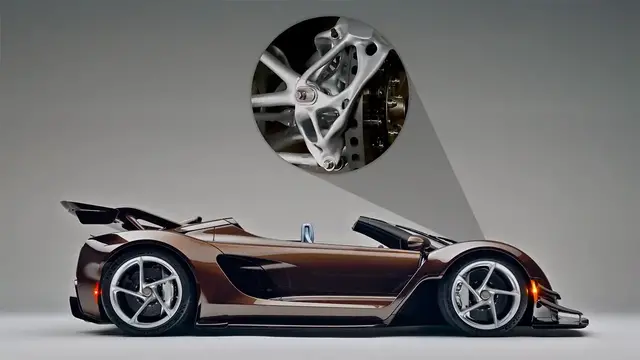
Join Yousuf Ashraf for an overview of the new Czinger 21C Spyder - a 1250bhp, central-seat American hypercar built using innovative 3D printing tech.
00:00 Who is Czinger?
01:38 The 21C Spyder
05:17 The BrakeNode
05:57 Chassis and 3D printing tech
07:37 Performance stats
07:58 Engine and gearbox
08:45 Interior
10:21 Driving the 21C
Subscribe for evo's latest performance car reviews, head-to-heads and track tests: https://bit.ly/3Ommfyv
Follow us:
https://twitter.com/evomagazine
https://www.facebook.com/evomagazine
https://www.instagram.com/officialevomagazine/
https://www.tiktok.com/@evomagazine?
Order your copy of evo from https://evo-shop.co.uk/
Show More Show Less View Video Transcript
0:00
How do you make a Zinger 21c even more intense
0:17
Well, it doesn't seem possible. Because this is one of the wildest cars I've ever driven
0:25
It's an 11,000 RPM screamer with tech that you just won't find on any other hypercar
0:34
But there is a way to add even more excitement to this thing. You take the roof off
0:48
It can be hard to take new hypercar manufacturers seriously. A lot of them seem to last five minutes without ever actually launching anything
0:56
But Zinger is different. Its hypercar, the 21C, is real and in production
1:02
and it has some of the most mind-blowing tech in the industry
1:06
It's a completely bespoke middle-seat hypercar with over 1,200 horsepower and a few lap records to its name
1:14
The 21C Spider is the latest evolution. There is so much to look at here, from the alien-like 3D-printed construction that's caught Bugatti's eye to the inline seating layout and radical packaging and engine
1:28
It's basically a low-flying fighter jet. We're going to cover all of that here, starting with CEO Luca Zinger to explain how his hypercar has reached this point
1:38
The Spyder was always planned for us, and it was going to be the most exhilarating version of the 21C
1:46
right it's a roadster no roof obviously but it also introduces a lot of new content into the car
1:54
and we went first very focused brief 21c we're here to make the highest performance road car
2:00
road vehicle but it needs to break track records that was also part of our entry into the industry
2:06
right showing others this car really performs this tech performs then the v max was let's take the
2:12
aero in a different direction. Let's go for top speed, let's go for road manners as well
2:17
Now the Spyder really introduces a mix of different worlds. It has the 21C aero on it
2:25
so you get all the downforce performance of the 21C, but an open air package. And we'll talk
2:30
through some of the new content on the braking system on the interior, but it fundamentally
2:34
is a big evolution from the 21C So with the 21C you got two versions of the car the VMAX and the high downforce I mean judging by the wing and the big splitter this is based on the high downforce car Exactly Based on 21C Yeah To me it feels like a roadster is naturally more
2:53
of a GT, more of a road car. So that's quite an interesting choice to go for the raciest version
2:58
of the car. Yeah. Again, intentional. For me, it was this real tension, right? It would have been
3:03
more obvious to take the more GT style V-Max and make that the roadster. But the idea of taking
3:08
something as animalistic as the 21c with all the fixed arrow and turning that into a roadster
3:14
that explodes your brain in a good way it becomes such a visceral driving experience because you've
3:20
got you know the big intake for the engine right behind the co-pilot's head but man you hear that
3:25
from the driving seat as well it's almost like it's sucking like every molecule of air out of
3:30
the environment around you okay and there's great bangs and pops but man that induction sound is
3:35
tremendous. So what exactly has changed to turn it into a spider? Obviously, we've got no roof
3:40
section in the tub anymore. Has there been any kind of strengthening to compensate for that
3:45
or is it all stiff enough as it is? So the chassis itself has gone through some slight iteration
3:50
but largely was already strong enough without the roof. You can see this back bolster. We had some
3:56
changes made. This front area elongated a bit, and that's also part of the roof mechanism, right
4:02
We wanted a fixed carbon fiber removable roof, but we also wanted the ability to then mount a soft top
4:08
So if you're stuck out there in the rain, you want to put the top back on, you have the option stored within the vehicle to be carrying that soft top
4:15
And that's fully manual? Yes. Okay. Is it quite easy to put on or is it kind of Lotus Elise spec
4:21
It's not Lotus Elise spec, but you need to know how to do it
4:25
Okay, fine. And once you know how to do it, it's incredibly straightforward. but you're not pushing one button you're putting a couple latches on you're moving the roof right
4:33
right okay it is a manual process but therefore there's no complicated electronic mechanism
4:38
there's nothing to break there's nothing that really adds material weight to the vehicle either
4:43
in terms of the car as a whole because it's such a new ground-up kind of car this must have been a
4:52
chance to look at the details and refine things so what have you kind of looked at that you might
4:57
not be able to see immediately in terms of improving it. Yeah, when you walk up to the car, one, there's a striking specification, right
5:06
The brown, the silver. Yeah, the brown carbon. I've never seen a brown carbon hypercar before. Yeah, this is going to be someone's favorite, someone's least favorite
5:14
but in our mind, it's incredibly elegantly executed as well. But you look at our wheel design, this is a new wheel design for us
5:20
but behind that rim, what you actually see, and we talked about in the factory
5:24
is a Zinger braking system. So we brought to the market with this car the brake node The brake node is a fully additively manufactured caliper integrated into the upright So what used to be two separate systems is now one and the mass
5:39
saving and performance is actually radically better. So we're seeing versus a standard
5:43
braking system, about 30% better overall mass. On the 21C versus the 21C, there's over six pounds
5:50
of saving and unsprung mass. And this is 15% better in terms of brake distance performance
5:57
So to understand the wild engineering of the 21c, you kind of need to peel away the bodywork and have a look underneath
6:04
And thankfully, that's what we've got here. So fundamentally, the car is built around a carbon structure
6:10
This is from a coupe, as you can see with the Roadster. This will be a lift off roof panel
6:15
Funnily enough, this is actually the most conventional part of the car because you move forwards and you start to see these crazy organic looking kind of skeleton shapes to all the structures
6:25
and that's all to do with Zinger's manufacturing process. So they'll use a computer generator to kind of create these shapes
6:34
with the optimum stiffness and properties that they need for the application
6:38
and then they'll print it. 3D metal printing is what they do. And the result is something like this
6:44
They call it the break node and you can see you've got a caliper here integrated into the upright
6:49
and it all looks kind of alien and organic, which is really cool
6:53
And if we come all the way to the back, I think this is the best view of this kind of generative production process
6:59
Because you've got the subframe at the back of the tub and it's all irregular
7:04
There's no kind of straight lines in it and it just looks like a piece of art
7:09
3D printing tech really does feel game changing and it's a big part of why Zinger should be taken seriously
7:16
The whole process was developed in-house and it's caught the attention of others like McLaren and Bugatti
7:23
who now use it in their hypercars. One of the benefits is lighter components
7:28
but the Spyder isn't actually as light as you'd think. It's 1,620kg dry, which is a bit more than
7:35
a Ferrari 849 Testarossa. At 150mph with the roof on, it's generating nearly its own weight in
7:42
downforce, at 1.5 tonnes. The Spyder is more about track performance than straight line speed
7:48
but even so it'll do 60 in 1.9 seconds a quarter mile in 8.7 and 205 flat out
7:58
So obviously you've got a middle seat but you've also got a seat behind the driver for the
8:03
passenger so the whole car the layout the packaging is all totally different to a normal supercar
8:08
and that actually means I mean if you look at the side profile there a very small space there to fit an engine but they have fit an engine and it a very small 2 litre v8 so you got twin turbos with it 750 horsepower but this is also a hybrid as well so you got
8:25
a motor at the back and then two separate motors at the front and combined you've got 1250 horsepower
8:30
but the best bit is the fact that this thing revs to 11 000 rpm you've got a seven speed
8:36
single clutch gearbox as well that's a more compact lighter solution which also helps
8:42
fit everything into this small space. Getting in this thing takes a bit of practice
8:48
So you've got door release here, opens up the biggest door I've ever seen in any car
8:56
And then you've got this really wide sill, so you've got to sit on the carbon chassis here
9:01
and then you've got to kind of aim your feet at the pedals and slide in
9:07
And just like that, you're in the 21C. I mean it feels like nothing else of course it does because you're sat in the middle of the car
9:15
but I think the surprising thing is from where you're sitting it doesn't actually feel like a
9:22
wide car it feels like you've only got two feet or so of car either side of you which makes it
9:27
feel quite narrow almost like Lotus Elise sized which is quite interesting even though this is
9:32
physically quite a wide car. Generally it's quite kind of functional in here you've got
9:39
a lot of the carbon tub on show. You've got some 3D printing here
9:44
which feels kind of a bit rough and plasticky, I'd say. Not super premium that
9:49
but it's all kind of unusual and functional and a bit quirky
9:53
You've got a squared off wheel here with a nice thin rim, more 3D printing on here as well
9:59
But the dash, I think that's probably the coolest bit because you've got these little control pods
10:04
either side for engine start and then you've got some drive modes down here as well
10:08
and it's all kind of making use of that 3D printing which makes all the structures look
10:14
really organic and kind of as unique as it looks on the outside it lives up to it in here it's
10:20
really special. So what's the 21c actually like to drive? Well it's too early to have a go in the
10:26
spider but the coupe is a wild ride. There's a full video on the way but essentially it's a really
10:32
raw, physical and strangely ogue car to drive. It's the closest thing I've felt to a road legal
10:39
race car, with a few rough edges here and there to iron out. Most importantly though, there's
10:44
absolutely nothing like it as an experience, which is surely the whole point of a hypercar
10:51
The Spyder will be even more intense, which is hard to imagine
11:02
you
#Motor Vehicles (By Type)