Up next in 10

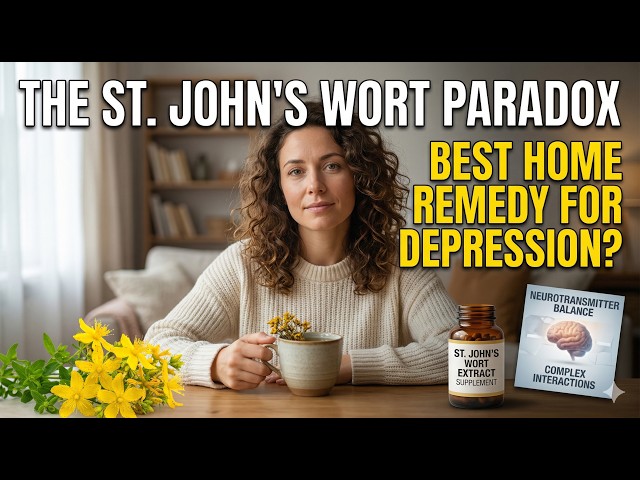
The Hidden Dangers & Surprising Science of St. John's Wort: Best Home Remedy For Depression
Apr 9, 2026
St. John's Wort is one of the most popular natural treatments for mild-to-moderate depression, but is it actually safe? https://ehomeremedies.com/pain-management/home-remedies-depression/
In this video, we expose the shocking phototoxic dangers of St. John's Wort. Science reveals that its active ingredient, hypericin, is a powerful photosensitizer that travels to your eyes and skin. If you take this herb and spend time in bright sunlight, it can induce severe burns and damage your eye's lens proteins, silently leading to cataracts.
Show More Show Less View Video Transcript
0:00
Clinical objective tone. Hypericum
0:03
perforatum commonly known as St. John's
0:05
wart has an extensive historical record
0:08
as a botanical intervention for
0:09
depressive disorders. Modern clinical
0:12
medicine often dismissers herbal
0:14
treatments as chemically weak
0:15
supplements assuming any reported
0:17
benefits are driven entirely by the
0:19
placebo effect. Drawing on Cochran and
0:22
Lindai Mulro meta analyses, this chart
0:24
compares Hamilton depression rating
0:26
scores of St. Johns ward against
0:28
standard SSRIs revealing statistical
0:31
equivalents for mild to moderate
0:33
depression. The botanical extract
0:35
consistently outperforms placeos
0:37
matching the clinical efficacy of
0:38
lowdosese triccyclic anti-depressants.
0:41
These clinical results present a serious
0:43
dilemma for modern psychiatry. An
0:45
unregulated botanical extract
0:47
effectively matches the performance of
0:49
precision engineered pharmaceuticals in
0:51
controlled trials. Translating that
0:53
efficacy into a real world clinical
0:55
setting, however, introduces a severe
0:57
variable. Most patients requiring
0:59
psychiatric intervention are already
1:01
managing other conditions through
1:03
polyfarm pharmacy. When transplant
1:05
patients taking the imunosuppressant
1:07
cycllosporin added St. John's work to
1:09
their regimen, their bodies rapidly
1:11
metabolize the anti-rejection drug
1:13
leading to organ rejection. Similar
1:15
chemical failures occur across multiple
1:17
disease states. The botanical
1:19
neutralizes oral contraceptives and it
1:21
accelerates the clearance of HIV
1:23
proteiase inhibitors like indivir
1:25
causing the antiviral therapies to fail.
1:28
There is also an immediate neurological
1:30
risk. Combining the plant with
1:31
traditional synthetic MAIs or SSRI often
1:35
triggers partial serotonin syndrome, a
1:37
toxic and potentially fatal
1:39
overstimulation of the central nervous
1:40
system. St. John's wart operates as a
1:43
dangerous pharmacocinetic sabotur. Its
1:46
ability to neutralize other life-saving
1:47
drugs makes its high clinical efficacy a
1:50
massive risk for any prescribing
1:51
physician. This creates a direct
1:54
clinical contradiction. A single plant
1:56
successfully treats major depression
1:59
while actively neutralizing heavily
2:01
engineered medications across the rest
2:03
of the body. The plant operates as a
2:05
complex polyarmaceutical
2:07
simultaneously triggering pathways on
2:09
two completely distinct biological axes.
2:13
Safely harnessing this treatment
2:14
requires clinicians to deconstruct its
2:16
molecular pathways. The mechanism
2:19
driving the toxicity must be explicitly
2:21
separated from the mechanism driving the
2:23
anti-depressant efficacy. The mechanism
2:26
of drug interaction originates entirely
2:28
outside the brain beginning inside the
2:30
liver. The toxic chemical constituent
2:33
responsible for these systemic failures
2:35
is a fluoroglycinol derivative called
2:37
hyperforin. Looking at this diagram of a
2:39
human hpatocy, we can track a
2:41
hyperforeign molecule entering the cell
2:43
and directly binding to a specific
2:45
transcription factor known as the
2:47
pregnant X receptor or PXR. Once
2:50
hyperforeign activates the PXR, it forms
2:53
a heterodimer with the retinoid X
2:56
receptor. This newly formed pair
2:58
transllocates to the nucleus and binds
3:00
to the cell's DNA. This binding sequence
3:03
triggers rapid transcription causing a
3:06
massive overp production of the
3:07
cytochrome P450 3A4 enzyme flooding the
3:11
interior of the liver cell. CYP3A4
3:15
is the primary metabolic engine the
3:16
human body uses to process and clear
3:19
medications. With a surplus of this
3:21
enzyme active in the liver,
3:23
co-administered drugs like cycllosporin
3:25
and indavar are aggressively metabolized
3:27
and flushed from the bloodstream before
3:29
they can take clinical effect.
3:31
Hyperforeign is a potent hpatic inducer.
3:34
It drives the toxic interactions that
3:36
render the whole plant clinically unsafe
3:38
for polyfarm pharmacy and it operates
3:40
entirely independent of the plant's
3:42
anti-depressant properties. To
3:44
understand the actual anti-depressant
3:46
mechanism, we have to move from the
3:47
liver to the central nervous system. The
3:50
traditional monoamine hypothesis posits
3:52
that depression is caused by a simple
3:54
lack of serotonin. This model
3:57
structurally fails to explain why
3:59
elevating monoamine levels takes only
4:01
hours. Yet, clinical improvement in
4:03
patients takes several weeks. The stress
4:06
hypothesis provides a more accurate
4:08
biological target. It redirects focus
4:10
from the neurotransmitters floating in
4:12
the synoptic cleft down to the
4:14
structural bedrock of the neuron itself,
4:16
the lipid billayer. Chronic
4:19
psychological and physical stress
4:21
overworks the hypothalamic pituitary
4:24
adrenal axis creating a state of
4:26
hypocortisolia
4:28
or chronically elevated cortisol levels
4:30
in the brain. This generated video
4:33
demonstrates the physical pathology of
4:35
chronic cortisol exposure. The neuronial
4:38
membrane loses its structural rigidity
4:41
becoming highly fluid, disorganized and
4:43
chaotic.
4:45
This hyperfluidity directly compromises
4:48
the critical signaling proteins embedded
4:50
within the membrane, specifically the
4:52
beta 1 adinuric and 5HT1A receptors.
4:57
In this schematic, you can see how the
4:59
compromised membrane affects function.
5:02
The receptor diffuses too quickly across
5:05
the lateral plane. Because it cannot
5:07
anchor itself, it fails to align with
5:09
the secondary messenger proteins below
5:11
it, breaking the signal transduction
5:13
cascade.
5:15
At a biohysical level, depression is
5:17
driven by this breakdown of membrane
5:19
viscosity. Receptors cannot effectively
5:22
deliver signals regardless of the volume
5:24
of serotonin available in the
5:26
syninnapse. Standard extracts typically
5:29
carry high levels of hyperforin, the
5:31
very compound that triggers the toxic
5:33
liver response we saw earlier.
5:35
Engineering a way to strip away that
5:37
hyperforin while retaining the plant's
5:39
lipid remodeling properties led to a
5:41
highly calibrated extract known as Z17.
5:45
In vitro lipidomic data shows that Z17
5:48
actively reverses the chaotic
5:49
hyperfluidity caused by chronic cortisol
5:52
exposure. Looking at this diagram of the
5:54
neuronal membrane, we can see the
5:56
primary molecular action of Z17.
5:59
It upregulates local cholesterol
6:01
synthesis directly within the membrane.
6:03
These new cholesterol molecules generate
6:05
and begin wedging themselves tightly
6:07
between the scattered phosphoippids. The
6:09
extract initiates a secondary structural
6:12
repair, altering chain lengths of
6:14
glycerero phospholipids and reducing the
6:17
phospatidylcholine to phospatidyl
6:19
ethanolamine ratio to physically stiffen
6:22
the billayer. This profound lipid
6:24
remodeling corrects the chaotic receptor
6:26
kinetics. The stabilized membrane slows
6:29
the fastmoving receptor, locking it back
6:32
into a functional slow diffusing state.
6:34
With the receptors securely anchored in
6:36
the correct positions, the beta 1
6:38
adinuric and 5HT1A pathways resume
6:42
optimal signal transduction. Z17 secures
6:45
its SSRI level efficacy by structurally
6:49
rebuilding the membrane so it can
6:50
correctly process existing baseline
6:53
signals entirely bypassing the need to
6:55
flood the synapse with excess serotonin.
6:58
By isolating these two molecular axes,
7:00
the contradiction between the plant's
7:02
clinical success and its chemical
7:04
sabotage resolves clearly. The clinical
7:06
safety of St. John's wart depends
7:08
entirely on the chemical extraction
7:10
process used to create the specific
7:12
dose. This flowchart illustrates the
7:15
resulting metabolic pathways. On the
7:17
left, a high hyperforeign extract
7:20
successfully triggers the membrane
7:21
efficacy pathway, but simultaneously
7:24
triggers the toxic CYP3A4 pathway. On
7:27
the right, the low hyperforin Z17
7:30
extract triggers only the membrane
7:32
pathway. Standard high hyperforin
7:35
extracts effectively treat depression,
7:37
but they inevitably trigger the PXR trap
7:39
in the liver, guaranteeing dangerous
7:41
drug interactions. The low hyperforeign
7:44
extract Z17 preserves the membrane
7:47
stabilizing lipidomic effects in the
7:49
brain while completely bypassing the
7:51
hypatic interaction in the liver. Modern
7:53
clinicians must abandon crude herbal
7:55
supplementation. Safe polyarm pharmacy
7:58
demands highly specified mechanism of
8:00
benefit without the biological sabotage.
8:02
This targeted lipidomic mechanism forces
8:05
a re-evaluation of the broader
8:06
psychopharmarmacology landscape. The
8:08
action of Z 117 directly challenges the
8:12
standard psychiatric focus on adjusting
8:14
neurotransmitter quantities as the
8:16
primary treatment for depressive
8:18
disorders. Future anti-depressant design
8:20
and research must account for the
8:22
structural integrity of the lipid
8:24
billayer as a primary targetable
8:26
pathology. True clinical efficacy relies
8:29
just as much on the physical viscosity
8:31
of the neuronal membrane as it does on
8:33
the neurochemicals floating above it.
#Health Conditions
#Depression
#Alternative & Natural Medicine