0:00
So today we'll be looking at vocabulary for the environment, a really common topic for
0:04
both the IELTS and the TOEFL tests. As usual, we'll see 20 words and phrases, most of which
0:10
come from recognised word lists for academic study. A couple of special lists for this
0:14
video are the Secondary School Vocabulary List, or SVL, which contains single words
0:19
and the Secondary Phrase List, or SPL, which contains collocations. Mostly those lists
0:23
are a bit too technical for IELTS and TOEFL vocabulary, but for this video they're perfect
0:28
because one of the 8 subjects that they cover is Geography, which is the study not just
0:33
of places, but also the relationship between people and their environment. As always, mid-frequency
0:38
vocabulary will also be a big focus, to help you really enrich your vocabulary and take
0:43
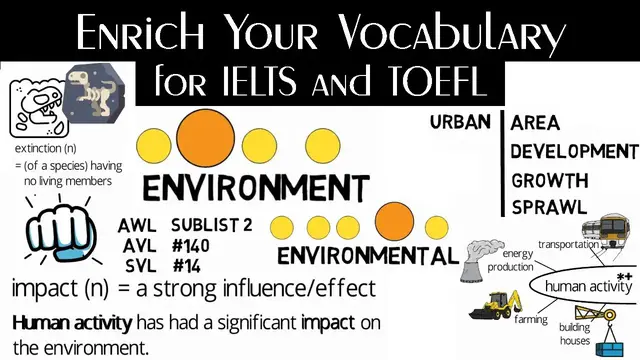
it to a higher level. Okay, let's go. The first word we'll focus on is very straightforward, Environmental, the adjective form of environment
0:56
You might know this word already, but it has lots of really, really good collocations that
1:00
we can use. An example sentence first. Rapid population growth, along with technological
1:05
developments, have led to an increase in environmental problems. So some good collocations with environmental
1:11
environmental problems, which we see in the sentence there, environmental concerns, environmental
1:17
issues, environmental degradation, environmental impact, and environmental protection. The asterisk there by the way denotes words in the academic collocation list, while the plus
1:28
symbol indicates words in the secondary phrase list. Maybe the most difficult word there
1:32
is degradation, which comes from the verb degrade, meaning to lower the quality of something
1:37
That's actually one of the words we'll study today, but we'll come back to it a bit later
1:41
when we're seeing a few other words and phrases. Degrade is in the AVL, SVL, and it's also
1:46
mid-frequency. Something else to highlight for the word environmental is the shifting
1:50
stress when we change from the noun to the adjective. The noun has the stress on the
1:55
second syllable, environment, while the adjective is on the next to last, environmental. So
2:00
that's something to watch out for if you're using either of these words in your speaking
2:05
So some of these words are negative. Environmental impact could be positive or negative, depending
2:10
on the impact itself. While environmental protection is of course a positive thing
2:14
Impact is actually another word that I want us to study today. Let's see it first in an example sentence, along with the phrase human activity. Human activity has had a significant
2:23
impact on the environment. So human activity relates to the things people do that affect
2:28
the world around them. Examples that relate to the environment are transportation, energy
2:33
production, farming, and building houses. Although that's a simple collocation, it's really
2:39
really common in articles about the environment and a great one to use in your writing. So
2:43
the word impact, this is used most commonly in academic writing as a noun, although it
2:47
can also be a verb. And this means a strong influence or effect. The word impact can also
2:52
mean hit. So this word is definitely more forceful than a word like effect. And this
2:57
is a really, really useful word. It's in the academic word list, sub list 2, the academic
3:02
vocabulary list, number 140, and the secondary school vocabulary list for geography, number
3:08
14. So in academic writing, and especially writing about the environment, this is a really
3:12
common word. Make sure you use it accurately. So it goes with the verb to have and the preposition
3:18
on. To have an impact on. It's also a lovely word to study because there are so many collocations
3:24
with this word. For example, significant impact, enormous impact, great impact, major impact
3:32
profound impact, the opposite, little impact, a direct impact, a negative or a positive
3:38
impact. You can see most of those have the meaning big. Note that if we change the structure
3:43
of the sentence and put the impact first, then it's followed by of, the impact of x
3:49
on y. For example, the impact of human activity on the environment is significant. So the
3:55
next words are deforestation, habitat, and greenhouse gases. One activity that affects
4:01
the environment is deforestation, which can lead to loss of habitat and increase in greenhouse
4:07
gases. So deforestation means clearing forests, in other words, cutting down wide areas of
4:12
trees. This word isn't in the AWL or the AVL, but it is in the SVL and it's a good mid-frequency
4:20
word. The pronunciation pattern of this word actually matches environmental with the stress
4:24
on the penultimate syllable, deforestation. Although that's actually a general pronunciation rule for English, any word ending in ation has the stress on the a. So the word habitat
4:35
this means the natural home of a plant or animal. And a couple of nice collocations
4:39
here, natural habitat or habitat loss. Natural is actually another word in our list today
4:45
I've put it in the list for the same reason as environmental. It's a fairly simple word
4:49
but it has some really good collocations on this topic. Natural disaster, such as hurricane
4:54
or volcano. Natural environment or natural world, which have the same meaning and refer
5:02
to all living and non-living things in nature. And natural resources. Natural resources are
5:08
materials that occur naturally in the earth, such as water, land, rock and even sunlight
5:14
So let's go back to greenhouse gases. A greenhouse is a structure that many people have in their
5:19
gardens to grow plants because they trap heat from the sun. And greenhouse gases do the
5:24
same thing. They are gases in the earth's atmosphere that trap heat. The most common
5:29
one is CO2, carbon dioxide, which actually accounts for around 80% of greenhouse gases
5:35
Other common ones are methane, NH4, and nitrous oxide, N2O. Unless you're studying chemistry
5:41
you maybe don't need all of those. But carbon dioxide being the most common is definitely one you should know. Next, the phrase intensive farming, and also
5:49
the word pesticide, which we'll see in the definition. Intensive farming, also called
5:53
intensive agriculture, has helped to improve agricultural production, though it has also
5:58
led to increased pollution and other environmental concerns. And the phrase intensive farming
6:03
means farming that produces as much as possible with the use of chemicals such as fertilisers
6:08
pesticides and medications for animals. So pesticides is also a really useful word. These
6:14
are chemicals which farmers use to kill insects, in other words, pests
6:22
So although intensive farming is a nice collocation, the word intensive and the word farming on
6:26
their own are also very common in academic writing, and also in writing about this topic
6:31
Next, the words urban and rural. Urban, of course, means relating to the city. And rural
6:40
means relating to the countryside. And these again are fairly common words, but again they
6:48
have some really good collocations. Example sentence first. Developing countries often prioritise urban development at the expense of agriculture, thus widening the
6:57
gap between urban and rural areas. So some collocations with urban. Urban area, which
7:03
we can see there. Urban development, which is also in the example. Urban growth. Urban
7:08
sprawl. And urban migration, which is people moving from rural areas to the city. Collocations
7:14
with rural. Again, area. Rural area. Rural community. Rural economy. Rural population
7:22
And rural society. The trend for people to move from rural areas to urban areas is so
7:27
common that there's even a noun to describe it, which is urbanisation, which means the
7:32
increase in the proportion of people living in towns and cities. We can now actually return to a phrase we had earlier, environmental degradation, because
7:40
we have enough other vocabulary to really understand what this means. Environmental
7:44
degradation can be caused by natural disasters, such as drought, hurricanes and volcanic eruptions
7:51
as well as human activity, including deforestation, industrialisation and urbanisation, which can lead to water, air and land pollution. So all of these make the environment worse
8:03
The next two words are utilisation and deterioration. Population growth and urbanisation can lead
8:10
to a variety of environmental problems, including over-utilisation of land, deterioration of
8:16
natural areas, dietary deterioration and increased waste. So utilisation is the noun
8:23
utilise is the verb and these are just fancy words for use. Utilisation is generally followed
8:28
by of, as we can see in the example. Deterioration means becoming worse. And this can be followed
8:34
both by of or by in. Next words are biodiversity and extinction
8:41
Scientists have identified five sudden and dramatic losses in biodiversity called mass
8:46
extinction events, the last of which, 66 million years ago, witnessed the extinction of the
8:51
dinosaurs. The current loss of biodiversity caused by human activity is sometimes referred
8:56
to as the sixth extinction. So biodiversity means biological diversity, in other words
9:02
the range of life on earth. Both of those words, biodiversity, biological, come from
9:11
the same root, the Greek word bios, meaning life. And life on earth really is diverse
9:17
One estimate puts the number of species on the planet at 8.7 million. The word extinction
9:22
a noun, refers to a species having no living members. An obvious example is the dinosaurs
9:27
which went extinct 66 million years ago. Talking about dinosaurs leads us on to our next phrase
9:32
fossil fuels. And we'll also consider here global warming and climate change
9:37
Greenhouse gas emissions from fossil fuels are the leading cause of global warming. So
9:42
fossil fuels are fuels such as coal, oil or natural gas which are formed in the earth
9:46
from plants or animal remains. Global warming means the long term heating of the earth
9:52
Climate change is similar, and sometimes people use the two phrases as if they mean the same
9:56
thing but they don't quite. Climate change refers to the change in weather patterns over
10:00
a long period of time. So global warming is one aspect of climate change. Other aspects
10:06
would be rainfall, wind, storms and so on. The final phrase we'll look at is renewable
10:10
energy. Renewable energy is expected to play a leading role in future as countries work
10:15
towards lowering their greenhouse gas emissions. So renewable energy is energy from sources
10:21
that will not run out, at least not in the lifetime of mankind. Examples are solar energy
10:27
wind power and hydropower which comes from water. The opposite of renewable energy is
10:32
non-renewable energy which is energy from sources that will run out. A similar phrase
10:37
is alternative energy which is not quite the same because here alternative means an alternative
10:43
to fossil fuels. An example of an energy source which is alternative and not renewable is
10:48
nuclear energy because this uses uranium and uranium is a finite source. In other words
10:53
it will run out. So that's the 20 words and phrases related to the environment. It's useful to categorise
10:59
these words which might make them more memorable. One way would be to look at causes and effects
11:04
and maybe solutions. Causes are deforestation, burning fossil fuels, human activity, intensive
11:09
farming, natural disasters, pesticide use and urban development. Greenhouse gases could be either. Effects are loss of biodiversity or habitat, climate change, environmental
11:18
degradation, dietary deterioration, environmental impact, extinction, global warming. Solutions renewable energy and environmental protection. Another way to categorise would be looking
11:27
at things which are man-made, natural or potentially both. The majority of the causes are actually
11:31
man-made whereas many of the effects, although worsened by human activity, also occur naturally
11:37
Don't forget to check out the website where you can find exercises to practice all of
11:42
these words. Go to eapfoundation.com forward slash enrich. Finally some outtakes. So the topic of the environment is a very rich one and there are many words and phrases
11:56
which I considered including in the video. Maybe you want to study these anyway
12:00
One is the word ecosystem. This is a common word and you might see it if you're reading
12:04
about this topic but it's a bit more difficult than the other words to use in your writing
12:08
The related word is ecological. Ecosystem actually means ecological system. Again this
12:13
is a common word when reading but a bit more difficult to use in your writing
12:17
Another is soil erosion which is maybe a bit technical and again difficult for you to use
12:21
in your writing. All of the 20 words and phrases today were actually either adjectives or nouns
12:27
or noun and noun and adjective and noun combinations. It might have been nice to study a verb and
12:31
the one that I thought may be most useful was minimise. Because something we should
12:35
all try to do is to minimise our impact on the environment
12:39
So that's it. Don't forget to check out the website for a full list of these words
12:43
Some exercises to practice and much, much more