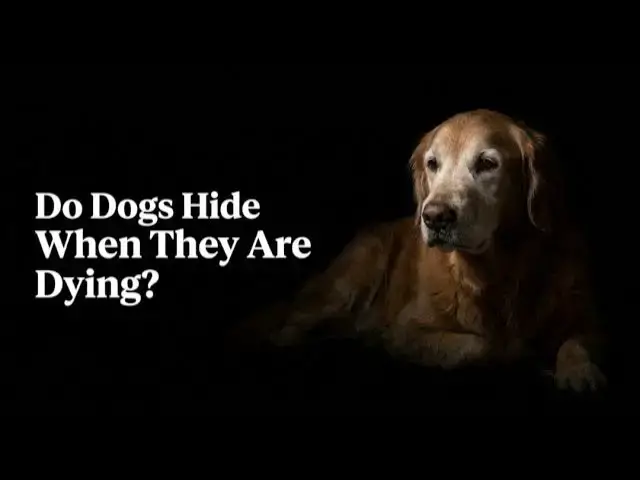

Why Some Dogs Hide When They Are Dying?
Aug 28, 2026
A dog who has spent a decade sleeping at the foot of your bed or resting their chin on your knee suddenly vanishes. You find them in the cramped, dusty gap behind the washing machine or curled silently in the back of a dark closet.
For many families, this sudden withdrawal feels like a heartbreaking rejection, a cold wall erected at the very moment we want to offer the most warmth.
This podcast episode is inspired by the article called: Urgent Warning: If You See Your Dogs Hide They Might Actually Dying (https://doggozila.com/do-dogs-hide-when-they-are-dying/) Read the original article for more in-depth information!
The instinct to pull away is one of the most poignant mysteries of the dog experience. We see it in the story of a vibrant Border Collie who spent her final forty-eight hours tucked behind a laundry appliance, or the aging Great Dane who, with quiet dignity, led his owner to a specific oak tree in the backyard day after day until the end.
These are not acts of spite or abandonment. Instead, they represent a complex bridge between a dog’s wild ancestry and their life as a domestic companion.
Science offers a lens through which we can view this retreat not as a loss of love, but as a profound expression of biology. Understanding the "why" behind the hiding allows us to transform our own grief into a more informed, empathetic presence.
The "Ancient Survival Script" Written in DNA
The urge to isolate is a hardwired legacy of the wild. For wolves and wild canids, the pack is a safety net, but it is also a hierarchy. In the wild, showing weakness is a liability, a sick or injured animal can attract predators, placing the entire group at risk. By distancing themselves, ancestors protected the pack from danger and sought a secure "den" to rest without being targeted by scavengers.
This isn’t just a dog quirk, pain research indicates that seeking enclosed spaces when vulnerable is a cross-species biological drive. When a dog’s system begins to fail, a primal survival script overrides the modern comforts of the living room. Even in a home where no predators roam, the brain of a dying dog seeks the safety of the perimeter.
"It’s not about rejecting their human family, but it’s about following an ancient survival script written in their DNA."
The Breed Divide: Why Not Every Dog Seeks Solitude
While many dogs retreat, end-of-life behavior is often a tug-of-war between ancient instincts and centuries of selective breeding. We have shaped some dogs to be independent guardians and others to be "velcro" companions, and these genetic blueprints often dictate their final requirements.
Guardian and working breeds, like the Great Dane who chose his tree or the Siberian Husky who digs a "den" in a closet, tend to favor the ancestral path of solitude. Conversely, companion breeds often override thousands of years of survival instinct, seeking even more intense physical contact as they decline.
Note: Herding breeds may alternate between hiding and "checking in" on their family, caught between the need for rest and the instinct to monitor their "flock."
Hiding Isn't Always the End: The Diagnostic Warning
It is a common mistake to assume a hiding dog is a dying dog. Because withdrawal is a general response to vulnerability, it can be triggered by treatable medical issues or environmental shifts. Before concluding that the end is near, it is vital to rule out metabolic or neurological triggers.
The following conditions frequently manifest as a desire to hide:
* Canine Cognitive Dysfunction (CCD) (https://doggozila.com/dog-dementia-symptoms/) : Often called "dog dementia (https://doggozila.com/dog-dementia-symptoms/) ," this can cause a dog to become physically "stuck" in corners or disoriented behind furniture.
* Metabolic Crisis: Organ failure, particularly kidney disease, can cause a build-up of toxins that leads to confusion and a sudden drive for solitude.
* Acute Pain: Severe arthritis or a hidden injury may make social interaction exhausting, prompting a retreat to a "safe" tile floor.
* Temporary Upsets: A dog recovering from a toxic ingestion like the Beagle who hid for days after getting into chocolate, may simply be seeking a quiet place to stabilize.
* Environmental Stress: Fireworks, a new pet, or even a severe flea infestation can mimic end-of-life withdrawal.
It’s Not Personal: Dismantling the "Punishment" Myth
The guilt is immediate, but the biology is indifferent. Owners often fear their dog is hiding to "punish" them or because the dog knows the end is coming and wants to "spare" the family.
However, dogs lack the complex emotional capacity for spite. Their withdrawal is a physical and instinctive response to discomfort, not a calculated emotional injury.
Even the popular concept of the "Last Goodbye", w
Show More Show Less