0:00
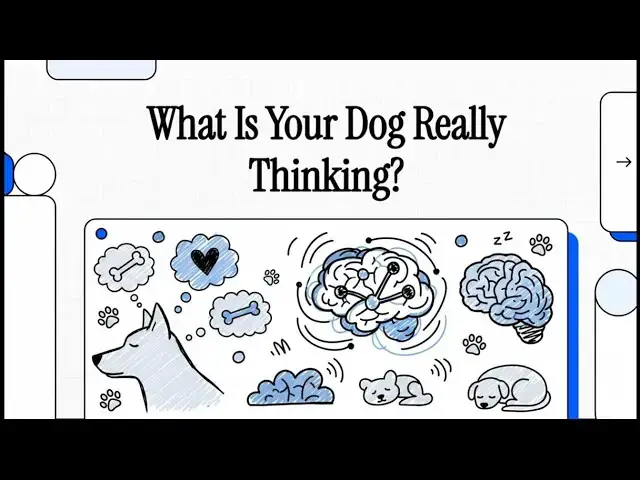
If you're a dog owner, you absolutely
0:02
know the look, that soulful stare that
0:04
just makes you wonder what is actually
0:06
going on in that furry little head.
0:07
Well, today we're going to try and crack
0:09
that code. It happens all the time,
0:12
right? They're staring at you, they do
0:14
that little head tilt, and you just know
0:16
there's a whole world of thought
0:18
happening behind those eyes. But what is
0:20
that world really like? You know, for
0:23
the longest time, the common wisdom was
0:26
that dogs were just simple, that they
0:29
were creatures of pure instinct, kind of
0:30
like little biological robots. But what
0:33
if that's not the whole story? Science
0:35
is now showing us a picture that's way
0:37
more complex and frankly way more
0:39
fascinating. So, let's start our
0:43
Okay, first up, let's play detective.
0:46
What can we see with our own eyes? Let's
0:48
gather the evidence that's right there
0:49
in our living rooms. the clues hidden in
0:51
their everyday behavior. These are those
0:53
moments that make you stop and go,
0:55
"Wait, how did you do that?" Seriously,
0:58
think about it for a second. Has your
1:00
dog ever done something that just seemed
1:02
too smart to be an accident? Like, not
1:04
just bumping into a gate, but
1:06
methodically figuring out the latch? Or
1:09
how about them bringing you their leash
1:10
at the exact same time every day like
1:12
they're anticipating the whole thing?
1:13
These aren't just random acts. They
1:15
point to planning, memory, and so much
1:17
more. See, this is where it gets really
1:20
interesting. This isn't just instinct.
1:22
When a dog remembers where they stashed
1:24
a favorite toy weeks ago, that's complex
1:26
memory at work. And when they come over
1:28
and nudge you with their head when
1:29
you're feeling down, that looks an awful
1:31
lot like emotional intelligence. It's
1:34
like you can almost hear the gears
1:36
turning in their head, right? It's not
1:37
just a blind reaction. There's a thought
1:39
process. H my human is sad. I know. Face
1:43
licks. That usually helps. They're
1:45
seeing a problem and they are actively
1:47
trying to solve it. That is a truly
1:49
empathetic response. So, okay, their
1:52
behavior definitely points to a thinking
1:54
mind. But that's all on the outside.
1:57
What if we could peek inside? Well,
2:00
that's exactly what science did. It's
2:02
time to go into the lab and take a look
2:03
inside the canine brain. And this right
2:06
here was the absolute gamecher.
2:09
Researchers managed to train dogs to lie
2:12
perfectly still inside fMRI machines,
2:15
which is incredible in itself, by the
2:17
way. So, we could watch their brains
2:19
work in real time. And what they found,
2:22
wo, it turns out the parts of their
2:24
brain that handle emotions look and
2:26
function in ways that are remarkably
2:28
similar to our own. Let's get just a
2:31
little bit nerdy for a second and zoom
2:33
in on one specific area, the codate
2:36
nucleus. Now, in our brains, this little
2:39
spot is a key part of the reward center.
2:41
It's what lights up with feelings of
2:43
pleasure, love, and happy anticipation.
2:46
And here's the kicker. That exact same
2:49
region lights up like a Christmas tree
2:51
in a dog's brain when they see you walk
2:53
through the door or even just when they
2:55
hear the treat bag crinkle. This is
2:58
powerful, powerful evidence that they
3:00
experience genuine feelings of joy and
3:02
affection, not just some conditioned
3:04
response. And it goes even deeper than
3:07
emotion. Studies are now revealing that
3:09
dogs have something called episodic-
3:11
like memory. It's a fancy term, but what
3:13
it means is they can recall specific
3:15
one-time events, not just learned
3:17
routines. For instance, in one study, an
3:20
owner did a unique action like touching
3:22
a box with their forehead. Later on,
3:24
when the dog was given the command, "Do
3:25
it," they would imitate that exact
3:27
action, proving they remember that
3:29
specific moment. All right, so let's put
3:32
it all together. We've got the
3:34
behavioral clues. We've got the hard
3:36
data from brain scans. What kind of
3:38
picture does this all paint? What kind
3:40
of mind are we actually talking about
3:41
here? This is where we see just how
3:44
different their operating system is from
3:46
ours. We think in words, right? Our
3:49
inner monologue is a non-stop chatter of
3:51
language. But for a dog, it's a
3:54
completely different world. Theirs is a
3:56
mind built on senses, primarily smell.
4:00
It's less linear and more of an
4:02
emotional associative web. So, think of
4:05
it this way. When your dog remembers
4:07
you, they probably aren't replaying a
4:09
little movie of you in their head. It's
4:10
more like they're experiencing a sensory
4:12
snapshot, a rush of your unique scent,
4:15
the familiar sound of your voice, and
4:17
that warm fuzzy feeling of happiness all
4:19
hitting them at once. And that leads us
4:22
to this huge conclusion. We have to get
4:24
rid of this old idea that dogs are just
4:26
reacting to the world around them. The
4:28
evidence is clear. They reflect on the
4:30
past. They anticipate the future. and
4:32
they have real emotional depth. Their
4:34
inner life is so much richer than we
4:37
ever gave them credit for. Okay, this is
4:39
all fascinating, but so what? Why does
4:42
this matter for you and your dog back
4:43
home? Well, in this final section, we're
4:45
going to see how understanding that
4:46
you're living with a thinker, well, it
4:48
kind of changes everything. The big
4:50
takeaway here is this. Our dogs need
4:53
more than just a walk around the block.
4:55
They don't just need their bodies
4:57
exercised. They need their brains
4:59
exercised to be truly happy and
5:01
fulfilled. They need to think. They're
5:04
not just our pets. They are our thinking
5:06
partners. So, how do we do that? Well,
5:09
here are three really powerful ways to
5:11
get started. First, brain games, puzzle
5:14
toys, scent work, anything that
5:15
challenges their natural problem solving
5:17
skills. Second, communication. Try
5:20
teaching them the names of their toys or
5:22
specific actions. And third, foster that
5:24
emotional connection. Let them make
5:26
choices like which way to go on a walk.
5:28
These things do so much more than just
5:30
tire them out. They satisfy their deep
5:32
need to think. So, I'm going to leave
5:34
you with this thought. You probably talk
5:36
to your dog all the time, right? We all
5:38
do. But now that you know they're really
5:40
thinking in there, that they're
5:41
remembering and feeling. The real
5:43
question isn't what you're going to say
5:45
to them next. It's what are you going to
5:47
start listening for? What are they
5:49
already trying to tell you?