Up next in 10



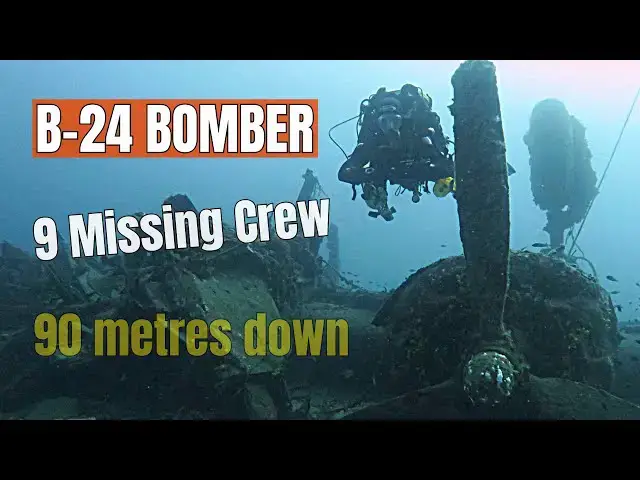
On November 17, 1944, the B-24 Liberator "Lady Luck" ditched in the Adriatic Sea off Bisevo Island, Croatia, during a bombing mission. The aircraft broke in half at the bomb bay on impact - a fatal structural flaw of the B-24's high-mounted Davis wing design. Seven crew members in the rear section went down with the wreck in seconds. Only pilot Lieutenant Henry Mills survived. 80 years later, we dive to 95 meters to document the break point and tell the story of the men who never came home.
*THE MISSION*
Lady Luck was part of a bombing raid when she took damage and lost power. Lt. Mills fought to keep her airborne long enough to reach the coast. Navigator Lynch confirmed the crew was ready to ditch. When they hit the water, the fuselage separated exactly where B-24s always failed - at the bomb bay. The rear section, containing the radio operator, waist gunners, and tail crew, sank immediately. Mills escaped the cockpit. His co-pilot and flight engineer attempted to swim the five miles to shore but succumbed to the cold Adriatic waters. Mills was rescued by Yugoslav partisans the following day and gave his testimony on November 17, 1944.
*THE DIVE*
This is a technical deep wreck dive to 90 meters off the Croatian coast. The wreck sits in multiple sections, with the catastrophic structural failure clearly visible at the bomb bay attachment points. The high-mounted wing design that made the B-24 efficient in the air made it deadly on water. This dive required advanced mixed gas and decompression procedures to safely document a war grave at extreme depth.
*THE LOCATION*
If you want to dive the B-24 Lady Luck, and the many other wrecks on the island of Vis, I strongly recommend Manta Divers and my friend Andi Marovic. He's at [email protected] or https://www.facebook.com/profile.php?id=61580766149788
*THANKS*
Thanks to those who have allowed me to use their footage
* Franco Banfi wildlifephototours.ch
* John Potten
* Fran Hockley
* Andi Marovic
* Maggie Driscoll
*Highlights*
Show More Show Less View Video Transcript
0:00
November the 17th, 1944.
0:04
Lieutenant Henry T. Mills is fighting to
0:07
keep his crippled B-24 in the air. Two
0:10
engines are gone from flack. The fuel is
0:14
bleeding out. The Adriatic Sea is below.
0:18
He has two choices. Bail his crew out
0:21
over open water or attempt a ditching.
0:25
But there's something Mills knows that
0:27
terrifies him. The B-24 was a death trap
0:31
on water. Its highmounted Davis wing
0:35
created massive stress on the narrow
0:37
fuse largege during impact. The Bombay,
0:41
the weakest point, would collapse first,
0:44
snapping the aircraft in half. The crews
0:48
knew its weakness on water. They knew
0:50
that ditching survival rates were really
0:52
low. At 8,000 ft, Mills gives the order
0:57
anyway.
0:59
The navigator confirms the crew are in
1:01
position and ready to ditch.
1:05
The moment Lady Luck hits the water, she
1:07
does exactly what B24s did. She breaks
1:11
in half at the bomb bay. The entire rear
1:15
section with seven men inside sinks in
1:18
seconds.
1:20
Mills escapes the cockpit, his co-pilot
1:23
and engineer with him. They try swimming
1:27
for shore.
1:28
Neither makes it. Mills spends two and a
1:31
half hours treading water until a rowing
1:34
boat manned by local partisans comes out
1:38
and picks him up. 80 years later, the
1:41
wreck of the Lady Luck lies in 90 m of
1:44
water off the island of Bishvo in
1:47
Croatia, broken exactly where every B24
1:51
broke.
1:52
Today I'm going to take you on a dive so
1:55
you can see that fatal structural
1:57
failure for yourself. And as I go
1:59
through the dive, I'm going to tell you
2:01
more about the B-24, why it had such a
2:04
poor ditching record, the particular
2:06
events associated with the B-24, Lady
2:09
Luck, how come we know so much about it,
2:12
and of course, I'll also talk about
2:14
Henry T. Mills, the pilot, and the only
2:17
one of the 10-man crew to survive this
2:20
crash. First of all, a bit of a
2:22
confession. The video you're going to
2:24
see wasn't taken by me. I have dived
2:27
this, but it was in 2019. So, a massive
2:30
thank you to Franco, Fran, JP, and Mags
2:34
for letting me use theirs. For anyone
2:36
who's not dived in this part of the
2:37
world, conditions can be absolutely
2:40
fantastic. And the island of Viz is a
2:44
fabulous place to spend any amount of
2:46
time. It's also an awesome diving
2:48
location, but the thing it's mainly
2:51
famous for are the array of World War II
2:54
era American heavy bombers. So, B17s and
2:58
B24s, and there is a whole load of them
3:01
that can be dived in this area,
3:03
including the one that we're diving
3:04
today, the Lady Luck. We're diving from
3:06
Kamitza with Mant Divers, who are an
3:09
organization I've used quite a bit.
3:12
Absolutely brilliant, and I can't
3:14
recommend them enough. As you can see,
3:16
just arrived at the bottom and directly
3:19
in front there is the brake. So, this is
3:22
the aft end of the the main section of
3:26
the aircraft. In front of me there to
3:28
the left and the right are the wings.
3:30
And that bit, as I said, is is where the
3:32
the brake is. Now, it's inverted as
3:34
pretty much all B24 Rex are. So, what
3:38
we're looking at here then is the
3:40
starboard wing, but the underneath of it
3:42
off to the right hand side there is the
3:44
inboard starboard engine. There is the
3:47
tire from the landing gear. Incredible
3:49
to think that it's uh still there and
3:51
still intact. And we'll come back and
3:53
have a look at that in a bit more
3:54
detail. And then the outboard engine on
3:57
the starboard wing is the one just in
3:59
the left of the screen. Now to
4:01
understand why the lady luck was here,
4:04
you have to understand what was
4:05
happening in World War II at the time.
4:08
So the allies had invaded Italy and was
4:10
slowly moving their way up from south to
4:13
north. As they moved up through Italy,
4:16
they were establishing bomber airfields
4:19
and bomber air the bombers were heading
4:21
up into southern Europe into Germany.
4:24
For damaged bombers that weren't able to
4:26
make it across the Adriatic, a small
4:29
relief runway was established on the
4:31
island of Viz, just off the west coast
4:34
of what is now Croatia. And that's where
4:37
the Lady Luck was heading for.
4:39
Unfortunately, as we've already heard,
4:41
it didn't make it. It was actually
4:43
really close. In the report, Lieutenant
4:46
Mills, Henry T. Mills reckons they were
4:49
about 15 minutes away when the two other
4:52
engines gave out and he was forced to
4:53
make that awful decision whether to get
4:55
the crew to bail out or whether to try
4:58
ditching which is obviously ultimately
5:01
what he did. Now we don't know which
5:04
engines it were that were hit by flack.
5:07
So it's entirely possible that it's the
5:09
two that we're just coming back to have
5:11
a look at now. the starboard ones
5:13
equally. These could have been the ones
5:15
that got him almost safely back from
5:18
Vienna to uh to the relief landing
5:21
ground at Viz. I don't know. None of the
5:24
engines look in particularly good order.
5:26
That one there, as you can see, is is
5:28
pretty heavily smashed up. You can also
5:30
see the undercarriage just to the right.
5:32
You can see where that tire came out of.
5:35
And then here you go in front of us
5:36
there. There's another another engine.
5:38
No sign of props, which is uh quite
5:41
interesting. or if they are, I can't
5:43
make them out. This is us now coming up
5:46
into the cockpit area and also the area
5:51
where the nose turret would be. Now,
5:54
once again, remember it's upside down,
5:56
but also it was clearly quite badly
6:00
damaged, possibly during the impact,
6:02
also possibly as a result of subsequent
6:05
activity. So lots of fishermen operate
6:08
in this area and it's entirely possible
6:11
that what they've done is they've
6:12
somehow damaged the remains of the
6:14
airplane. In fact, you know, my
6:16
understanding is how most of these deep
6:18
aircraft are found is because
6:20
fishermanmen report snags. So difficult
6:23
to say for certain, but what we can say
6:25
for certain is we're now on the port
6:26
wing. You can see there, that's the
6:29
outboard engine. The undercarriage with
6:31
the with the tire was just to the right
6:33
there. In fact, there it is. You can see
6:35
there it's actually in much better order
6:37
than the one on the other side. And
6:39
there we are swinging back towards
6:41
looking at the cockpit area. And this is
6:43
where Henry Mills would have been. This
6:46
is where he escaped from. This is where
6:47
the other two guys who got out with him
6:49
escaped from as well. Now, one of the
6:52
interesting parts of the story is why
6:54
two of them decided to swim for land and
6:56
Henry Mills stayed where he is. The the
6:59
wreck is only about 500 m away from the
7:02
nearest island. the island of Bishevo.
7:06
So you can you probably see why they
7:08
thought it was okay. They both had life
7:11
vests on supposedly and Henry didn't. So
7:15
he decided that he didn't want to use
7:17
energy trying to swim to the island. He
7:21
decided to use his energy to stay, you
7:24
know, in the water and hope somebody was
7:26
going to come out. Now, just going to
7:28
break the story for a moment there
7:29
because what you can see in the the
7:31
bottom, which would have been the top of
7:33
the break there is a whole load of
7:35
oxygen bottles. Clearly, these bombers
7:38
operated at high altitude and the crew
7:40
needed oxygen to continue to function
7:43
normally and and that's what those are
7:45
there. So, the the diver now is heading
7:48
over towards the tail. It's got that
7:50
very distinctive double tail that the
7:52
Liberator has, but also you can see how
7:55
it's completely split and broken off
7:57
from the rest of the wreck. And this is
8:00
the area in which the seven missing crew
8:02
members would have been. Now, supposedly
8:05
it was really well known that the
8:07
ditching survival rates from B7s were
8:11
really low. And one of the statistics
8:12
I've seen is less than 40% of the people
8:16
who ditched survived. I mean certainly
8:18
in this case clearly there was a 90%
8:21
casualty rate. Now that there is looking
8:23
into I think the end of the fuse largege
8:26
and this is the area exactly where the
8:29
men would have been as they prepared for
8:32
the aircraft to ditch. So three guys in
8:34
the front, seven guys in the back. I've
8:37
read an account of a survivor of a B24
8:41
ditching who was in the back and he
8:43
describes an absolute scene of
8:46
pandemonium as the aircraft does exactly
8:49
what this one did which is to break into
8:51
two and then the the guys who were in
8:53
the back tried to escape. Some obviously
8:56
they weren't strapped in or anything so
8:58
some of them were knocked unconscious,
9:00
others suffered significant injuries,
9:03
all that kind of stuff. I mean, it it
9:05
just doesn't even bear thinking about
9:07
what it must have been like in those
9:09
moments as the aircraft hit the sea,
9:12
split open, and then, you know, whatever
9:15
happened happened. So, the only body
9:18
that has ever been recovered from the
9:20
B-24, Lady Luck, is a guy who was found
9:23
floating on the surface, Guy Pledger. He
9:26
was one of the gunners. The remaining
9:28
eight, no idea. It's entirely possible
9:31
that some of them are still in the
9:33
remains of this plane, still in that
9:36
rear fuse lodge, which is always a
9:38
pretty sobering thing to think, although
9:41
I can't imagine there's much of anybody
9:43
left after this amount of time spent at
9:45
the bottom of the seabed.
9:47
People may know that the Americans do
9:50
fund missions where people go and try
9:54
and recover bodies from some of their
9:55
planes. So there are two other aircraft
9:58
on viz, a B17 and another B24 where
10:02
bodies have been recovered or certainly
10:04
parts of bodies. I mean my understanding
10:06
is the bits they found are not very
10:08
significant.
10:09
Now I think what's interesting here is
10:11
that the videographer uh Franco has
10:14
turned off his video lights so you can
10:16
see that it is pretty dark down here at
10:19
90 odd meters. Uh although there is an
10:22
amount of ambient light. You can
10:24
probably see he's just coming back to
10:26
the main bit of the plane and just
10:29
taking a bit of video there. I think he
10:31
is going to turn his lights back on in a
10:32
second. So, if you hang on there, I also
10:34
think it's worth just talking about why
10:38
the B-24 was such uh a bad aircraft for
10:41
ditching. And fundamentally, it's to do
10:44
with the the wing design and the fact
10:46
that the wings were up high on the B-24.
10:49
That meant that when it was ditched,
10:51
there was a much smaller surface area
10:53
than say a B7 where the wings are low.
10:56
Also, the bomb bay doors were known to
11:00
open on impact or they would be pushed
11:02
inwards and then water would actually
11:04
get into the aircraft. And if you think
11:06
about where the bomb bomb bay doors are,
11:09
that is where the aircraft splits or
11:12
where this aircraft has split. And it
11:14
was, you know, even at the time it was
11:16
well known that this happened. So, I
11:19
guess one of the interesting things is
11:20
why they chose to ditch the aircraft
11:23
rather than bailing out. And I guess
11:25
that's because parachuting into the sea
11:28
is also a really dangerous thing to do.
11:30
I think, you know, they were faced with
11:32
a two really poor choices there. And
11:35
clearly u the pilot Henry Mills decided
11:38
that the ditching was the least worst
11:40
option and that's what he tried to do.
11:43
And I guess it worked um for certainly
11:45
three of them. Anyway, now as you can
11:48
see on the video here, we're just going
11:49
back to the split and this is where the
11:52
Bombay doors would have been. I think
11:54
we've already had a look at this bit and
11:55
we've seen uh those oxygen cylinders
11:58
that would have been in the roof of the
12:00
uh the aircraft roof of the kind of uh
12:02
the middle section. But the other
12:04
interesting thing to see here is if you
12:05
have a look to the left hand side, you
12:07
can see there is some fabric, some white
12:10
fabric with some um what to me look like
12:13
thin lines on it. Now, I believe that
12:16
those are parachutes and that is
12:18
parachute silk. I don't know for
12:20
certain, but it looks an awful lot like
12:23
that to me. And I know on some of the
12:24
other aircraft, the other heavy bomber
12:27
aircraft, parachutes have survived and
12:30
parachutes have been recovered. So, my
12:32
guess is that is what those are. And
12:35
also an incredible tangible link to the
12:39
people who were once on this aircraft.
12:42
You know, incredible. I I I just love
12:45
those kind of things. It's it just takes
12:48
you straight to them. You know, they
12:50
would have been really important to the
12:51
crew and I don't think they would have
12:53
carried spares. So, that parachute or
12:56
parachutes, however many there are in
12:58
there, those belonged to some of the
13:00
crew members of the B24.
13:04
As you can see, the diver is heading
13:05
back towards the tail. And I think this
13:08
is because this is where the shot line
13:10
is. I think it's just off to the right
13:11
hand side. And so I think his dive is
13:15
coming to an end. Now, one of the things
13:17
I'd just like to cover towards the end
13:20
of the dive is to explain how come we
13:23
know so much about B24, Lady Luck, and
13:27
Henry T. Mills. And the reason is
13:30
because like every good military, when
13:33
he eventually got back, he was required
13:36
to fill in a report. And that report is
13:39
on file as in the American terminology
13:42
an MACR a missing air crew report. And
13:45
very matterofactly it tells us what
13:49
happened to the lady luck and what
13:51
happened to all the people who were on
13:53
the Lady Luck. So it's a really poignant
13:58
and sad document to read even though
14:01
it's written completely in a matter of
14:05
fact. This happened then that happened.
14:07
tone. We don't get any sense at all of
14:10
how Henry Mills felt. And I think one of
14:13
the sad bits of this is I don't actually
14:16
know what happened to Henry Mills. I
14:18
would love to know, you know, did he
14:20
survive the war? Did he go back to
14:22
America? Did he have a family? You know,
14:25
did he think about these guys? You know,
14:28
it would just be lovely to have answers
14:30
to those questions. If you're able to
14:33
find it out or you know some way of
14:35
finding out, I'd love to hear. So,
14:36
please uh stick it in the comments. That
14:39
would be absolutely awesome.
14:41
But that's it. The sad story of the lady
14:44
luck, the Bombay door collapse, the
14:48
break that I think the crew knew was
14:51
going to happen once they hit the water,
14:54
the incredibly sad loss of seven men in
14:57
that section. Navigator, radio operator,
15:00
gunners,
15:02
the incredible survival of Henry T.
15:05
mills. His 2 and 1/2 hours of treading
15:08
water on the surface, wondering if he
15:11
was ever going to be rescued.
15:13
The matterof fact way it got recorded
15:16
and then vanished into military
15:18
archives.
15:19
80 odd years later, Lady Luck remains
15:22
where it sank, broken into a memorial to
15:26
the nine men who never made it home.
15:30
just one more wreck amongst the
15:32
thousands, maybe hundreds of thousands
15:34
that exist around the world. All of them
15:37
with stories, stories that deserve to be
15:40
told. I've got a load of these stories
15:42
on my channel, so have a look around.
15:46
I'm Dom Robinson, Deep Wreck Diver.
15:48
Thank you very much for your time and
15:50
I'll look forward to seeing you on the
15:52
next