0:00
For the sort of diving I do, there are
0:02
two pieces of kit I put in a completely
0:05
different category to everything else.
0:07
My rebreather and my dry suit. Fins,
0:11
lights, computers, masks. I can swap and
0:14
adapt those. But if my rebreather isn't
0:17
right or my dry suit isn't keeping me
0:19
warm, the dive simply doesn't happen.
0:23
That means that for me, a dry suit is
0:25
the second most important piece of gear
0:28
I own. on deep wreck dives with long
0:31
decompression. It's a key part of my
0:34
safety system. Not only is it my thermal
0:37
protection, but it's also what I use for
0:39
buoyancy control. So, it has a huge
0:42
impact on how the dive is going to go.
0:44
If I'm cold, tired, hanging on a line,
0:48
and shivering, then my awareness is
0:51
going to suffer. My decision making is
0:53
going to suffer. And frankly, that's not
0:55
where you want to be on a big wreck
0:57
dive. So, the suit I choose for these
1:00
dives has to be something I absolutely
1:02
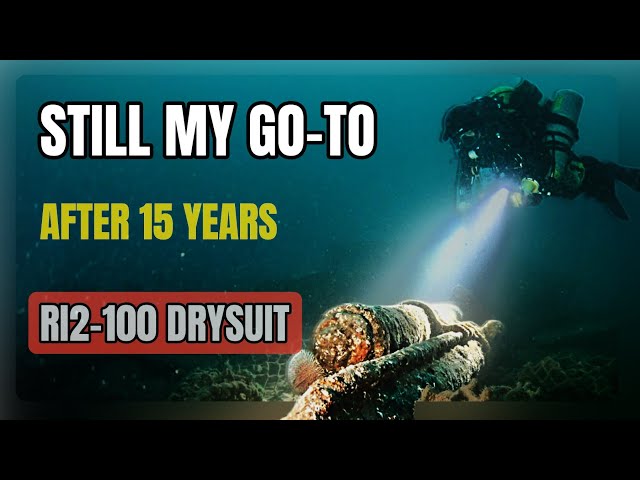
trust. The last 15 years, that suit has
1:06
been the 03 RI2 100. Not because it's
1:11
the lightest or the most fashionable
1:13
suit on the market. Arguably, it isn't,
1:16
but because when the water is cold, the
1:19
wreck is deep and the decompression is
1:21
long. I'm still warm and still dry and I
1:25
don't even have to think about my suit.
1:28
Now, before getting into why I like it
1:30
so much, I think it's briefly worth
1:33
explaining what this suit actually is
1:35
because that's where a lot of the
1:36
inherent warmth comes from. It's made
1:39
from 2.1 mm resin impregnated compressed
1:44
neoprene. That's a tough material. It's
1:47
compressed neoprene, not crushed
1:49
neoprene. So it retains the thermal
1:52
properties of neoprene.
1:55
This material has been taken to over 300
1:57
meters and it doesn't compress any
2:00
further. That means that when you're
2:02
diving, you've got a dense material that
2:05
provides insulation in its own right.
2:08
Its buoyancy isn't going to change. And
2:11
for you as a diver, that's great because
2:13
it means you get consistent warmth and
2:16
consistent buoyancy, which is absolutely
2:19
what you want. Instead of a thin
2:22
triaminate shell that relies almost
2:24
entirely on a massive undersuit, you've
2:27
got a dense material that provides real
2:30
insulation in its own right. It traps a
2:34
thin layer of gas close to the body. And
2:37
because the suit is relatively close
2:39
fitting that minimizes internal gas
2:43
Quickly on undersuits because the dry
2:45
suit and undersuit should be considered
2:47
as a system. I use the 03 PBB Plus
2:52
undersuit which is relatively snug and
2:56
That's fine due to the integral warmth
3:00
It's constructed from fleece with
3:03
primoloft insulation in the core and
3:05
thighs. So adds warmth where you
3:07
actually need it without any extra bulk.
3:11
It also handles moisture well. On long
3:14
dives, you're going to sweat probably
3:16
quite a bit and the PBB+ wicks that away
3:20
instead of keeping it close to your skin
3:23
where it will turn cold later on. And
3:26
just like the suit itself, the undersuit
3:28
is fairly forgiving if things aren't
3:30
perfect. A bit of dampness or a small
3:34
leak doesn't instantly turn the dive
3:36
into a misery exercise.
3:39
I also really like the neck seal on this
3:41
suit. It's neoprene, so it doesn't just
3:45
keep the water out. It adds warmth of
3:50
On long cold decompression, I find
3:52
having a warm, snug seal around your
3:55
neck makes a noticeable difference
3:58
compared with a thin latex seal that has
4:01
no thermal properties. The wrists also
4:04
have neoprene seals that have similar
4:08
Should you wish, you can also run Kooby
4:11
dry gloves with the added benefit of
4:14
removable neoprene seals. These are
4:16
trivially easy to change. There are also
4:19
other options for boots, pockets, P
4:22
valves, and Pzips to accommodate
4:25
whatever your needs are. Now, that's a
4:27
brief outline of the suit. In the rest
4:30
of the video, I'm going to discuss the
4:32
key reasons why I've dived the RARI200
4:36
for so long, but also flag some of the
4:38
compromises that you're going to get
4:39
with a suit like this. Let's start with
4:42
the main reason I still dive it after
4:44
all these years, and that's warmth. Most
4:47
of the dives I use it on are deep wreck
4:50
dives with long periods of decompression
4:53
in cold water, which means multiple
4:58
I really feel the cold, so a suit that
5:01
keeps me warm is incredibly important.
5:04
The RRI 2100 isn't just cozy on the boat
5:08
or the surface. It stays warm when it
5:11
really counts. When I'm not moving much
5:14
and I'm hanging on a line trying to keep
5:16
my head in the game while the long deco
5:18
ticks down, that's when I need to be
5:20
warm. Now, I've tried lighter, more
5:23
flexible suits that feels great until
5:26
you start getting cold. At that point,
5:29
my mind becomes totally focused on how
5:32
cold I am. I don't want to be doing
5:34
that. I want to be thinking about the
5:36
wreck, the conditions, the team, not my
5:40
core temperature. The other thing that
5:42
matters to me is how a suit behaves when
5:44
things go wrong. Specifically, when it
5:47
floods. No one plans to flood a dry
5:50
suit, but if you dive long enough, it's
5:52
probably going to happen. A damaged
5:55
seal, a zip issue, a neck seal folded
5:58
over. With very thin suits, once they
6:01
flood, it feels like you're in a bag of
6:03
cold water. I saw exactly this happen to
6:07
a good friend of mine last year who
6:09
became so cold he couldn't keep his loop
6:11
in his mouth and had to bail out to open
6:14
circuits. Even having completed all his
6:16
decompression, he still required
6:18
recompression treatment because he
6:20
started showing the signs of
6:22
decompression sickness. Now that's an
6:25
awful situation to be in and frankly not
6:28
where I want to be. The RRI200,
6:32
even with a significant leak, there's
6:35
still a load of integral warmth. It
6:38
starts to behave more like a wet suit,
6:40
so you don't instantly go to miserable
6:42
and shivering. Now, that's it's not
6:45
ideal, obviously, but it buys you time
6:47
and comfort to finish the dive and the
6:50
deco without it turning into a survival
6:53
exercise. Now, that forgiveness is a big
6:56
part of why I use this suit for serious
6:59
dives. It's not just about how warm it
7:02
is when everything goes right, but also
7:04
how it behaves when things don't.
7:07
Durability is the other major strength.
7:10
I don't baby my suits. They get dragged
7:13
through engine rooms, thrown around on
7:15
boats. They go over hole plates, into
7:18
holes, and squeezed through hatchways.
7:22
Cosmetically, it's scratched and
7:24
scuffed, but structurally it is still
7:27
super solid. the kind of suit where you
7:30
stop worrying about brushing against
7:32
something sharp on a wreck. If you're
7:34
doing wreck penetration, loads of
7:36
training, or just regular cold water
7:38
diving, not having to constantly send a
7:41
suit away for repairs is a huge
7:45
Even when something goes wrong, repairs
7:47
are straightforward. I fixed issues
7:50
myself in the field without needing to
7:52
send the suit away. And in fact, one of
7:55
my suits still has the repair that I did
7:58
on it, I've it's been so effective, I've
8:00
not needed to consider sending it away.
8:03
So, what are the compromises? Because no
8:05
suit is perfect. Firstly, weight and
8:13
is noticeably heavier than a modern
8:15
triaminate suit, which makes it less
8:17
travel friendly. If baggage weight or
8:20
long carries are something that concern
8:22
you, then lighter options are probably
8:24
going to make sense. Second is
8:27
flexibility. I can do all the usual
8:30
technical skills in this suit, but it's
8:32
definitely stiffer than a triaminate
8:35
one. On the surface, especially, it
8:38
feels very different. If you're used to
8:40
a flexible suit, you will definitely
8:43
notice it. The bottom line is you're
8:46
trading convenience, lightness, and
8:48
flexibility for warmth and durability.
8:52
Now, for my kind of diving, that's not a
8:54
difficult decision to make. For yours,
8:57
it might be, and you may feel
8:59
differently. So, who is this suit
9:01
actually for? Well, if you're a deep
9:04
wreck diver doing TRIX, CCR, long
9:08
decompression in genuinely cold water, I
9:11
cannot think of a better suit. It's
9:14
exactly what it's built for. If you're a
9:17
cold water recreational diver, you may
9:20
feel that it's more suit than you need,
9:22
but trust me, you'll definitely
9:24
appreciate the warmth and security,
9:27
especially if you feel the cold like I
9:29
do or are planning to do multiple dives
9:32
a day or dive in one of those horrible
9:35
nasty quaries where it's freezing cold.
9:38
If most of your diving is in travel or
9:41
warm water, or you simply want a suit
9:43
that packs small and does everything,
9:46
then this probably isn't the suit for
9:48
you. To sum up, the 03 RRI1200
9:52
is warm, tough, and built to be used
9:55
hard in cold water over a long period of
9:58
time. That's why after 15 years, it's
10:01
still the suit I reach for when the
10:03
dives are serious. deep wrecks, long
10:06
decompression, and any dive where I
10:09
really don't want to be thinking about
10:12
I've traded weight, bulk, and some
10:15
flexibility for that performance, but it
10:17
wasn't a difficult decision at all. If
10:20
warmth and durability matter, then this
10:22
is the obvious choice. Now, if you've
10:25
got questions about sizing, then you
10:27
probably want to push them to 03. If you
10:30
want to talk about undersuits or
10:32
comparisons with other suits, drop them
10:34
in the comments and I'll pick them up
10:36
with you. Thanks very much for watching.
10:39
I hope you've enjoyed this video. I've
10:41
got a load more videos on similar topics
10:43
and I hope one of those will take your
10:45
fancy. But for now, I'm Dom Robinson,
10:48
Deep Wreck Diver, and I look forward to
10:50
seeing you on the next one.