Up next in 10



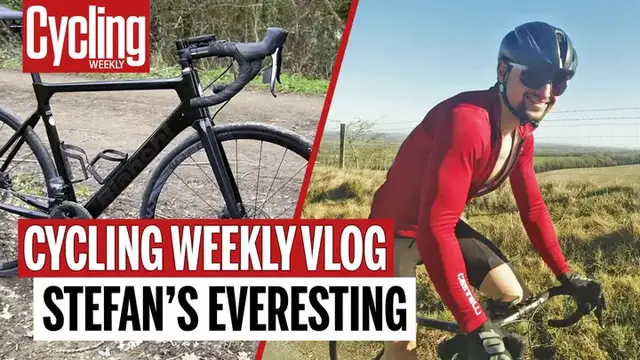
Stefan successfully completed a sub-12 hour Everest attempt and here's what he learnt.
Show More Show Less View Video Transcript
0:00
Hi, my name's Stefan Abraham. I joined the Cycling Weekly Tech Team last year, and towards the tail end of the winter just being, I decided to have a go at Everesting up one of my local climbs
0:08
Having managed to successfully complete it, I thought that I'd share a little bit about what goes into choosing the climb and pacing the effort and, yeah, much else besides
0:22
I was going through a sub-12 hour time. It has a nice room to it. It's half day out on the bike, and with six factors, it's easily divisible
0:29
you can break it down into thirds, into quarters, into halves, lots of milestones to check off on the way
0:34
But obviously pleasing arithmetic isn't the only consideration when it comes to setting a target
0:38
and I went out to the climb a few weeks previous. And the data that I got showed that 12 hours was certainly possible but the margin for error was really quite small
0:46
So one thing that's really been underlined to me is really the importance of a hill
0:50
It's much more important than the bike or any prior training, you can be as fit as you like with as fancy a bike
0:55
but if you're on a rubbish hill then it's going to be difficult to get a good time or even complete it at all
1:00
And equally, if your fitness isn't quite where you want it to be and your bike isn't the lightest
1:04
a well-chosen hill can help provide a much more flattering time. So there are three factors I think that are most important regarding the hill
1:11
The first is the gradient, and then the road condition, and then the traffic. With the gradient, I think it's well accepted now
1:16
that the steeper the hill, the better. I think that a while ago, there were some that would argue that a more moderate gradient would be friendly on the legs
1:22
and therefore better suited to an endurance effort. But ultimately, it is a climbing challenge
1:26
so if you can maximise the metres gained and minimise the kilometres travelled
1:30
you're going to end up with a faster time. With the road condition this can be split into two different areas
1:34
one is the actual surface of the road and the other is bends, and so obviously the smoother the road is, the less rolling resistance you're going to have to overcome
1:42
but also when you're descending, the less jarring it will feel on your hands
1:45
which can make a significant difference towards the end of the effort. When it comes to the route that the road takes down the hill
1:51
it's good to have one which doesn't have any particularly nasty bends, like 90 degree hairpins or anything particularly narrow
1:57
Those looking for the very fastest times will be looking for a road which is arrow straight
2:01
and doesn't require touching the brakes at all on the way down. So with regards to my hill, I wouldn't say it was the perfect one, but I think it hit
2:08
each of the criteria well enough that it definitely wasn't a bad choice to use. The gradient averaged 10%, which by today's standards isn't a particularly steep hill
2:15
to every stop, people are going on 15 or 20%. However, we're talking about the average gradient can hide the true nature of a hill
2:22
Mine wasn't particularly consistent. There are some sections which were quite flat and other sections which really ramped up
2:28
But to be honest, although that might not make it the most efficient climb, I find that the changes in gradient made it
2:32
a lot more enjoyable to ascend time after time. The need to change gear and go in and out the saddle made it a lot more interesting and engaging than just slogging for 10 minutes in a single gear straight up and straight down and not having to think at all Regarding the road condition that kind of a story of two halves On the top part of the climb
2:48
the tarmac is completely smooth and couldn't really be better but down near the bottom there
2:52
are some fairly large potholes and the surface itself is just very washboardy and rough
2:57
I had 20mm tyres on which did go some way to smoothing out the surface but by the end I was
3:02
really feeling it in my hands. Regarding the traffic it isn't a through road, there's a car
3:07
park at the top and maybe a farmhouse just along the path a little bit and so you wouldn't expect
3:11
there to be too many cars but I found when I suckled down that it was quite a bit busier than
3:15
I would like. Fortunately though I have the flexibility to do the attempt on a Friday and
3:20
that went a long way to cutting down the number of cars. And so in all I was pretty happy with the
3:24
climb, the gradient and the road surface weren't too bad and nor was the traffic but although I do
3:28
have local hills that are best for each one of these criteria I think Phil Boster was the best
3:32
for all of them overall. So a little bit about the bike. Well the first thing to point out is it wasn't
3:37
so much the challenge dictating the bike but the bike dictating the challenge. I had the 2021 Bianchi
3:43
sprint on test and when I noticed that the bottom gear was a one-to-one ratio with a 33 tooth
3:47
chainring and a 33 tooth sprocket on the cassette I thought the opportunity for an everesting was
3:52
too good to pass up. As this is just a completely stock setup there are some aspects of the bike
3:57
which aren't ideal for an everesting so starting with the heart of the bike the frame it's got a
4:02
full carbon construction the frame and the fork but as the name sprint might suggest there's a
4:06
lot more of a focus on aerodynamics and power transfer than there is on minimizing the weight
4:11
and altogether this bike comes in at just over eight kilos which isn't exactly feathery but then
4:15
it's not so heavy that it was going to make or break the attempt coming now to the group set we've
4:19
got the stram force axis 2x12 i think that hydraulic disc brakes really lend themselves to an everesting
4:25
attempt. Rim brakes might be lighter but with the disc brakes the lighter lever
4:29
action. With the amount of braking that an Everesting requires being able to just
4:33
pull yourself to a stop with a single finger is a lot less fatiguing when you're deep into the effort. For me I think the most important thing when it
4:40
comes to bike setup for an Everesting has got to be the gearing. As steep
4:44
climbs are so much more efficient for completing the challenge in as quicker time as possible you need to have gears that will allow you to turn a reasonable
4:50
cadence while at a sustainable wattage. And for me on my hill that meant it was
4:54
absolutely imperative that I did have at least a 1-to-1 bottom gear. And even that
4:59
was treading a little bit of a tightrope. At the top of a hill when the gradient ramps up for a final time I was finding that I'd either have to push a little
5:05
bit too high of a wattage or grind a little bit more than I'd want to. And so
5:10
there's lots of one-tooth jumps between the smaller sprockets but as you move out
5:14
to the easier gears the jumps between the gears get a little bit larger Now ordinarily I think that this is great You got those small jumps when you in the bigger gears and working hard and when it comes to the steep climbs you got the range and it doesn
5:26
really matter so much about having a bigger jump because at that point you kind of want an easier gear whatever it is. If I was speccing the
5:33
bike myself I probably would have gone for Shimano's GRX groupset and an 11-32 cassette
5:39
Not only would that have given me a lower bottom gear but for the final three sprockets it goes 25-28-32
5:45
and those smaller jumps really would have made I think a pretty big difference
5:49
Coming now to the tyres they were the Toria Rubino model in a size 28mm and I have to say I was very happy with them
5:55
They're not as lightweight or as fast as the Corsa model, they're by no means bad in either department
6:00
and the extra robustness they have as a consequence meant that I didn't get any punctures for the entire effort
6:06
I'm also running inner tubes rather than tubeless and I think that if I was to do it again I'd definitely change to tubeless
6:11
Particularly on that hill with the rough section down at the bottom, being able to drop a few psi and have a bit of a smoother ride would have made a very large difference towards the end
6:20
So coming to my training, it wasn't too specific. I didn't know that I was going to be doing an Everesting until a couple of weeks before when I happened to have a bike that was well suited to the challenge
6:28
Over Christmas I had completed the Festa 500 and so that put a fair bit of volume into my legs
6:32
And through January and February I've been combining Zwift racing with some long endurance rides
6:37
And I think that combination of intensity and longer steady efforts had a good effect to my fitness leading up to it
6:42
Climbing hills with a similar gradient to Phil Bostol would have really helped. But pedaling kinematics when you're going up something so steep at an endurance all day pace are quite different to any of the other riding I was doing
6:52
And so although I had the base fitness I found that it was my joints that really started to suffer by the end of the effort
6:58
With the nutrition I was keeping things simple. I had just three different fuels. I had an SIS energy powder for my water bottles along with some chocolate mini rolls for that fast release energy
7:08
And the final food I had was that staple of long distance effort, the sausage roll
7:12
I got most of my calories from the powder. I found that I couldn't really eat while going up the climb
7:17
It was just a bit too steep and to be honest my appetite for solid food wasn't the greatest
7:21
But even so I made sure that every two hours I'd have a quick stop at the top and grab a sausage roll and a mini roll just to keep my stomach settled
7:27
as I find that I can start to suffer from cramps if I'm on an odling liquid diet
7:32
I think that I did get the fueling spot on. I couldn't have consumed anymore. I was on the verge of being too full throughout the whole thing
7:38
But even then, I'd only taken on about 4,300 calories through the duration of the effort
7:43
whilst Strava reckons that I'd burnt 8,000 calories. Coming now to the weather, another reason for wanting to get sub-12 hours
7:49
was because I wanted to minimise the amount of time that I would be riding at night
7:53
Doing the Everest thing at the end of the winter meant that I would have to do some laps in the dark With weather conditions it obviously really helps for it to be dry on the day Rain just adds all sorts of complications with coronary traction braking and more difficulties with layering and keeping warm and comfortable Fortunately the weather was stunning on the day
8:09
with bright blue skies and the sun shining. As the winter still hadn't quite yet gone I was wearing
8:14
bib shorts with leg warmers and a thick winter jacket when I first set off. The temperature at
8:18
the beginning was around about one degree and descending down the hill with the cold air
8:21
slamming into you, you can get cold really quite quickly on the way down. But I was expecting
8:26
the day to warm up and so I did bring a light away to long sleeve jersey. However what I hadn't
8:30
considered is that this would be the warmest day since the autumn and even a long sleeve jersey
8:34
proved to be far too hot by even as early as 10 30 in the morning. The pacing I think is one of the
8:39
most important parts of being able to complete an Everest thing. It's very tempting to go out far
8:43
too hard on a hill and just end up burning yourself out before you complete the effort
8:47
From my recu runs I found that I could do a full lap so up the hill and back down in about
8:51
9 minutes 50 seconds. This was right at the top of my zone 2. Although it would be hard work
8:57
it suggested that the effort was certainly doable. In the first six hours I went out perhaps a little
9:02
bit hard. My lap times were around about 9 minutes 30, which was a bit faster than I really needed
9:07
And the average watts I was putting out on the climb itself was about 250, which was just nudging
9:12
into my zone 3, and so a little bit too intense for an all-day effort. And so perhaps doing more
9:17
a negative split rather than a positive split if I'd gone out slightly easier and ramped up the pace
9:22
at the end I could maybe have gotten a better time but to be honest I'm not convinced it was the wrong
9:27
decision to go out as hard as I did for the first half of the effort. Mentally it really helped
9:31
feeling like I was ahead of time and I wasn't plagued with anxiety about mechanicals because I
9:35
knew I had a bit of buffer to play with and when the effort did start to bite at the end of the
9:38
Everest thing it was quite a relief to know that it was going to be okay if I backed off the effort
9:42
a little bit. When it comes to endurance rides I tend to break things down into thirds. Before
9:47
Before the start I was a little bit worried about how I'd be feeling around about hour 9. I find that transition between the middle and the final third can really play on your mind
9:54
With the fatigue setting in but also the knowledge that you've got to do half as much as you've already done all over again
10:00
I find that in the final sixth things tend to pick up quite a bit. The end is very much in sight by that point and it's a lot easier to carry on pushing
10:08
However this time during the Everesting I didn't get that crunch point at the 2 thirds point
10:12
It actually came a lot sooner. I was about 7 and a half hours in in and it was then that I was really starting to feel the effort. It was surprising how quickly the
10:19
change did take place because just a few hours previously I was feeling as fresh as if I'd just
10:23
started. At five hours in I felt like I could keep on going all day no problem. So there you go that
10:29
was my first every sting attempt. If you enjoy this video please be sure to give it a like and
10:33
subscribe for more and if you have any questions just drop them in the comment section down below
10:37
and I'll do my best to answer them
#sports
#Extreme Sports
#Cycling