live_tv
Livestream Starting Soon
00
Hours
:
00
Minutes
:
00
Seconds
Up next in 10



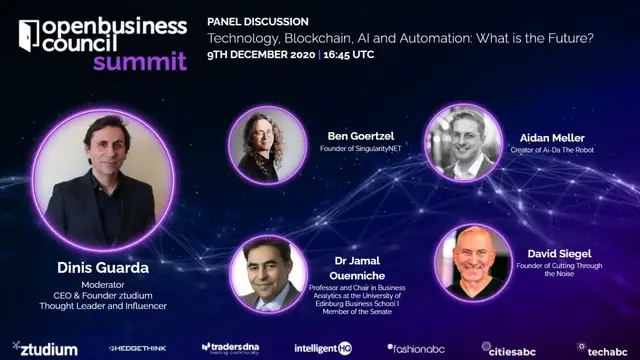
Panel Technology, Blockchain, AI and Automation: What is the Future?
Dinis Guarda | Moderator | CEO & Founder of ztudium | Thought Leader and Influencer
Ben Goertzel | Founder of SingularityNET - https://singularitynet.io/
Aidan Meller | Creator of Ai-Da The Robot - https://aidanmeller.com/
Dr Jamal Ouenniche | Professor and Chair in Business Analytics at the University of Edinburg Business School I Member of the Senate - https://www.business-school.ed.ac.uk/staff/jamal-ouenniche
David Siegel | Founder of Cutting Through the Noise - https://www.linkedin.com/in/siegelventures/
at openbusinesscouncil Summit #obcsummit
FULL PROGRAM https://openbusinesscouncil.org/summit/
JOIN THE CONVERSATION https://twitter.com/openbusinesshq
https://twitter.com/citiesabc__
Show More Show Less View Video Transcript
0:00
Hello and thank you for joining us for this one of the last panels of the day
0:08
Although the people that are joining us coming from US and Pacific probably for them is morning
0:15
So we've been going for almost 10 hours so far. And I'm looking forward for this panel and for all these great speakers that we have together
0:25
So this panel is going to be quite cutting edge. is about the future and it's about how we can actually look at the different things that is
0:35
technology, blockchain, AI, automation, what is the future. And of course, in a panel like this
0:42
we have four fantastic speakers that have a completely different background that I want to
0:49
shortly introduce. And we have one of them late, but I'll leave it in a minute
0:55
So we start by probably by alphabetic order because all of them are great
1:00
So we start by Aiden. So Aiden is, I can say, someone completely out of the box because he's a global leader, expert in art, in art markets, and as well in history and a lot of different areas related with culture
1:13
is a very famous gallerist. And in the last year, he decided to start a fantastic project
1:21
that is creating one of the first creative robots and droids. So I think it comes with all this wealth of knowledge
1:30
both in the art world, which is normally where the creativity has been going for the history
1:34
and as well now is making the bridge between ideas, money, investment, and technology
1:40
which is not easy to manage all of this. And as well with all the ethics that come attached to that
1:46
And then we have David Siegel, that is as well a recognized global expert in multiple different areas of digital assets, digital transformation
1:54
It was one of the first, it was behind one of the biggest ICOs made that reached $40 million
2:00
And it was a massive project to create a decentralized marketplace and exchange
2:05
since then has been working in multiple different projects and has been focused in all the areas
2:12
of trying to bridge, especially right now is becoming an advocate and fighter
2:15
for the privacy rights and for our human rights and data rights
2:20
which is the most important thing because the human rights and data rights are very similar and then last but not least
2:25
Professor Jamal Unish that is joining us from Scotland but as well as citizen of the world
2:30
with background from North Africa Morocco and then Canada and Scotland where he's based and one of the directors of the University
2:40
of Edinburgh Business Department of Business ytics and AI and as well leading a lot of
2:45
research in terms of business the way business ytics can be used for data and a lot of
2:51
financial predictions and different areas so it's a pleasure to have you all here and just for the
2:55
people listening to us we have Ben Gorsley joining us probably hopefully in five six minutes but we
3:01
start in the nevertheless before. So I want to welcome and thank you all
3:05
to be here. I want as well for all our audience that is listening to us in the four or five
3:09
continents. So we've been having so far I think today so far between during the
3:15
last sessions over 20,000 people joining us from all the different continents
3:20
I want to thank you all to be part of this in the Unbusiness Council Summit first initiative and
3:25
as well I would like to make sure that this event is as well an interactive event with all
3:31
people that are probably feeling the struggles of the COVID-19, but as well, all these different
3:37
things and all the technology challenges that we're facing. So I want to start this with the
3:45
questions, and then probably because we have Ben coming a bit late when he comes, we introduced him
3:49
in a context, and I'll ask some questions for him. So I'll start probably with Aiden, because you have
3:54
both a lot of different ads, and I think I'm particularly interested from a historical side
4:00
and I interviewed recently, but so as someone that has been looking at the history of art
4:06
history of ideas, because art and ideas are related, and now is working in a cutting-edge project
4:12
and I think it would be interesting for you to speak about Taida because it's a very recent project
4:15
although it's a massive success online. A lot of people never heard about it. How do you see the present and the future
4:21
So that's my question, but probably start with a small introduction about you and as well about Taida project
4:26
and as well your work in the art world, which is massive as well. I've actually got mixed feelings about the future
4:34
We've got some incredible technologies coming through in the 2020s that are highly disruptive
4:41
And that could be highly disruptive to produce a better world, or it could be highly disruptive to produce some quite ethical worries
4:49
I do believe that we're at a crossroads. And the path that we're actually going to be taking will be obviously to do with many mysterious power pressures
4:59
from organizations and governments behind it. But so I have some mixed feelings
5:05
I'm excited by some of the things that could be used to harness things like helping the environment
5:10
and better farming and questioning the way that we use meat. All these technologies that are coming through
5:16
that will actually preserve a better world. But I'm also well aware that there's, you know
5:22
with the bias in data and transparency issues, privacy issues, All of these things that actually make us very much bunnies in laboratories, which feel sometimes that the technology might be entrapping us
5:37
So I have a few feelings in both directions currently. So, Aidan, before we go more into the deep questions, a bit of background about you and especially the project Aida
5:52
because I think it's really cutting edge, but as well quite radical transformative
5:56
because normally the projects in robotics and androids are much more in terms of military, healthcare
6:04
or even automation. And what you're doing is completely different, yeah. My background is actually art and art history
6:11
and that's where my strength is. But it was actually looking at the history of art
6:16
that is actually just a mirror of society, a mirror of the way of the development of humans, that has made me consider what is it about the 2020s that is going to be so significant for humankind
6:30
And it was actually looking at the 1930s and 40s, the rise of modern British artworks and their relationship to the ground
6:39
And the St. Ives Group in particular was looking very much at how they relate to the world around them
6:46
taking ideas from the School of Paris, Picasso and Metis Chagall. And it was with that shift in emphasis that eventually led to a massive development of technology
6:57
that was then utilised to create the Second World War that made me think, actually, what's happening now
7:04
We are going through a technological revolution ourselves as a world today
7:09
and I have very little confidence in humankind to make great decisions. The
7:15
20th century has not been kind or considerate in actually the domino effect
7:21
of their actions and so it was with the very deep conceit the deep concerns that I had that um we devise the robot ada named ada love after ada lovelace the first computer programmer of all time and her goal is to raise questions debate
7:40
and consideration of the ethics and considerations of future technologies as we go into the 2020s
7:47
we are well aware that there's a groundswell of people coming into the machine learning world
7:52
with the universities doing undergraduate degrees now. And so there's going to be a lot more people involved in tech
7:59
and that's going to completely speed up what we do with technology
8:05
And so we thought Ada was a great artist. Excuse me, I've got a fog in my throat
8:10
A great artist to be able to actually independently look at these different areas
8:17
you know who is actually getting public debate about the privacy of the world about the use of
8:25
bias in data where is that coming from if we go do it purely from a government level that's going
8:33
to have an angle on itself a corporation level so we felt as an independent project to have an artist
8:39
that actually scratches at these issues in a way that is engaging and accessible it will bring a
8:46
huge amount and of course we were completely overwhelmed last year with the press in respect
8:51
that they completely took us on and really got involved with the artwork that Ada produced
8:57
that questioned all of these different areas so Ada as a robot is an exciting development in that
9:03
it really does ask us to consider where we are in the world today and what the world we want in the
9:09
future yeah it's quite amazing and uh well i i check it myself so i can say that initially i had
9:17
the some some reservations of course because i know sophia the robot and actually ben was actually
9:22
the creator so it'll be interesting to join all our both of you create two of the most advanced
9:26
robots in the world and androids but one of the things that is amazing is really that you're
9:31
building an android to create which is the most human part that distinguished from all the machines
9:37
and all the automation. And as well, someone like you that has an history of art background
9:41
an history of ideas and understands as well, like you mentioned, all the challenge of humanity and its strengths and weakness
9:47
which are a lot. So I pass to David. David, you have a philosophical background somehow
9:53
in terms of your research, and you were actually applying for being the dean of Harvard
9:57
So you have as well a lot of academic provocation part. And as well, you've been as well creating
10:04
especially in your entrepreneurial side as someone, a serial entrepreneur that has been involved in a lot of things
10:10
You were pushing a lot of projects and of course in your former project
10:13
that is probably the most well-known pillar to create a global community that was one of the most dynamic
10:18
decentralized technology, blockchain and crypto ecosystem that was made. So you have that part
10:25
and now you are in another journey to go and fight for personal data
10:30
So tell us a bit about your background and as well, how are you pushing this
10:35
Which I know that you are in an interstitial place in your career
10:39
but it's impressive as well. I know what you try to do is super necessary
10:44
Sure. Briefly, I've started about 15 companies. I was a Silicon Valley entrepreneur for many years in New York City
10:53
Entrepreneur, angel investor, starting companies. That's all I know how to do. I was a candidate to be the dean of Stanford Business School
11:00
And when that didn't happen, I raised money in an ICO to build the personal data locker in the form of a crypto wallet
11:08
And I spent a couple of years in London really as a kind of a crypto thinker and token designer involved in tokenomics
11:16
And the one thing I want to point out is that whenever there's a new technology that's really exciting and has a lot of potential, it's never about the technology
11:26
It's always about people being able to think in new ways and try something new
11:33
The technology is always the smallest part of it. So when I would have ideas for either some kind of a token or a game mechanics or a stablecoin
11:44
you know, normally in technology, the first thing you do is you go to some coders and you prototype it
11:49
But in our case, the first thing you do is you go to lawyers. and you talk to lawyers about what you can and cannot do because of regulation
11:58
And so the same is true in genetics, the same is true in any project that might have a large
12:02
footprint that requires an environmental impact study. And so more and more, I've worked my way
12:09
toward regulation and policy because you can only digitize what you're allowed to digitize without
12:14
going to jail, unfortunately. And this is a problem with Bitcoin. This is a problem with
12:19
with digital assets in general, they're getting stuffed back into the boxes that were created in the 1930s and
12:26
forties. And it's not, it's really holding back. So a couple of important things you know
12:33
you can't just self-driving cars are going to be the norm, but we don't have the insurance for them and insurance companies can't make the
12:40
insurance for them because we don't have insurance laws that let them do that
12:45
We can't do a lot of things we want to do in personal finance or in finance in general
12:51
because things like AML and KYC are completely ineffective. Banks launder money as a service
12:59
There's $3 trillion laundered successfully every year, and they only take $3 billion as a little token out because of violations
13:08
It's just business as usual to launder money. And so many of these regulations are ineffective and they hold us back and they really favor big institution companies that makes it very difficult for startups
13:20
In fact, in fact, the number of startups in the United States is cut in half since 1980
13:26
The number of startups in the United States is half as many now as there were in 1980
13:31
And the average male income in the United States on an inflation adjusted basis is less than 1973
13:42
1973 inflation adjusted income for males, salary for males was higher than it is today
13:51
So we have a lot of things that we could do better. For example, in Estonia, how long does it take the average person to file his taxes in Estonia
14:01
15 minutes. Average, 15 minutes. A lot of people do it in 10. Okay. Why? Because they have a better
14:08
framework for doing that. We had the Moderna vaccine designed by January 13th. It was made
14:16
over a weekend in January, a month before the first case was diagnosed in the United States
14:23
January 13th, it has taken 11 months to get emergency approval during which 250,000 people
14:31
have died. And so regulations, they think that they're really helping, but in fact, many times
14:37
they're hurting people. There are many smarter ways to design the system and level the playing
14:42
field so that we can have innovations. That's why I spend a lot of time on that. Another quick one
14:47
is prediction markets. Prediction markets would take the place of many, many rules and regulations
14:52
if we could just use them but we can because they considered gambling and they illegal so we have a long way to go in the thinking about innovation before we can actually do much innovation Now there a good news here The good news is that that COVID has changed things
15:11
COVID has really brought about a rethinking of what digital transformation and a true acceleration
15:18
So we may now in 2020 be coming out of about a 40 year low period of less innovation
15:27
It's actually called the great stagnation. We may finally be emerging from that and starting to really accelerate digital
15:35
And that's why things are really exciting right now. Now, what I'm spending my time doing is starting again for the second time
15:43
the personal data locker, because I want people to own their own data. If you have seen the Social Dilemma movie, you understand that big companies are now just monetizing people's behavior and people's data to sell to advertisers mostly
15:59
And that model is worth more than $200 billion. There's going to be over $100 billion in mobile ads alone next year, $100 billion just in ads on handsets
16:12
so I'm starting something called the Giordano Bruno Institute to it's a non-profit to create
16:20
the personal data locker that is open source and open for everyone so they can have control
16:25
of their personal data and that is the biggest challenge of humanity right now is is the data
16:33
but it's the data in multiple different areas there's the data the personal data the corporate
16:39
data, the government data, the healthcare data, and especially how this relates to the
16:45
machines that we created, because they are driven by data as well. So Professor Jamal is one of the global experts and as well leading one of the leading universities
16:53
Edinburgh University is in the top 20 or 10 universities in technology in the world
16:57
in multiple areas. So how do you see the challenge that we're facing in terms of data and in the research
17:03
you've been doing? I know that you've been doing from financial to government research, and you have multiple
17:08
papers and multiple reflections, both in terms of computing data and ytics, financial
17:14
and so forth. So a bit of your background and as well, how do you look at this? Hi. Well, in terms of background, I am by training an operations researcher. So all the
17:31
areas of ytics, including operations research, management science, statistics, artificial intelligence those are the areas where I'm working. In terms of applications, applications
17:44
include performance ytics of entities such as organizations both public and private banks
17:53
and so on. I'm also working on on financial aspects related to investments, to be more specific, assessing the risk profiles
18:07
of companies, for example, we see the stock exchanges, banks, and so on
18:11
I'm also working on public-private partnerships, basically designing ytics tools for public-private
18:22
partnership contracts, how to design them, how to assist them, and so on
18:27
I'm also working on things related to the design and operational management of supply chains, including transport and manufacturing
18:38
Yeah, so one last area is about risk modeling and ysis. in terms of the challenges that we face both in academia and also in some industries is
18:55
although the data nowadays we claim that the data is there but unfortunately
19:01
data is not accessible to everybody and that's a major limitation not only for
19:08
academics and for research but also for small, for the SMEs basically. Only the big corporations
19:20
can have access to and therefore they are the only ones who can harness actually the
19:28
benefits of having access to that data and extracting intelligence from it
19:36
Currently there are universities and governments that are looking into solutions for making data
19:46
available probably to be anonymized data but that's a step forward that will bring a lot of
19:57
benefit to both academia and industry. The other challenge actually is related to the cooperation
20:11
academia industry, although there are a lot of corporations going on, but they are still limited
20:22
in school. So that's another area that a lot of organizations do not seem
20:31
to realize. That's actually a win-win situation for everybody for advancing methodologies
20:40
on one hand and for these businesses actually to benefit from these
20:47
advances that are made in the academic world. With respect to some of the things that we are actually doing at the Open Council Platforms
21:03
we are working on developing a number of new methodologies for rating and ranking that
21:15
that we intend to use for ranking, for example, cities, smart cities, governments, countries, and so on
21:27
companies with small stock exchanges, and so on. You might wonder why we are doing this
21:35
since there is a large amount of literature on rating and ranking systems already
21:42
But the reason we are engaging into this is that there are a lot of flows to those methodologies on one hand, and the existing ratings and events are published not only by government, for example, not for profit organizations, but also for private organizations
22:12
The methodology is never published and that is an issue actually, an ethical issue, because
22:22
we are trusting a black box we are trusting a company that might not have the same agenda as the users of those rankings
22:37
And so these are some of the contributions that we are looking to make in this area
22:46
this is our the most important things that we are facing right now so
22:54
hey then you touch for me one of the most important questions that actually is the one
22:59
that gets me as well more nervous is that humans have been historical able to do the most wonderful
23:07
things and the most destructive things and of course if you look at the second the 20th century
23:13
we had two world wars and actually if you look at philosophy became nihilistic and cynical after
23:19
that and even art became minimal and then we went for a lot of directions on that on that way so
23:24
now that we're going to prepare machines um actually that our machines are starting to get
23:31
the quality of ray karzaki we probably are going to be singularity very near probably 10 20 years
23:37
and then a lot of ways we're starting already to have perception of machines that can understand
23:42
and looking to data, looking into these areas. And you are creating as well a robot that it's probably one of the most advanced in the world
23:50
although it's independent and is not by a government or by a military organization
23:55
which is even more interesting. So how do you see this having a background as history, art, ideas
24:03
but as well right now collaborating with cutting-edge universities, with cutting-edge technologists and machine learning and a lot of different things
24:11
because that's my main concern is precisely that and i'm a technologist myself and everything i'm
24:17
doing i think the only way we can make this is that our humanity is complex i i for my family
24:22
have five languages every day okay and welcome ben so i think this question will be for you as well
24:28
thank you for joining us um so my question is is a question that i i i will push to you ben as well
24:35
so just to finish this question and i'll pass to you ben so my question is humanity
24:40
as a duality of good and evil. Okay, let's be honest. And I think we can take it in different directions
24:46
but that's a fact, okay? And the part of our humanity is not nice, okay
24:50
You mentioned, David, the challenge of 250,000 people that die in the US with COVID
24:55
And I'm not going geopolitic, I'm not going politics, but a lot of these things could have been avoided, okay
25:01
If you just look at data and common sense. So common sense is something that unfortunately
25:06
not everyone can actually match. And actually passing us to the machines is going to be a bigger challenge as well
25:11
So, Eden, from your historical background, working with some of the biggest art collectors in the world
25:17
even with some of the artists, the biggest artists, and now creating a robot that is one of the most advanced
25:21
and as well looking and working with the University of Oxford and at least three other universities
25:26
So how are you trying to tackle this? Because that's, for me, the question we have to answer
25:30
and actually not answer, act on that. I think our biggest area as a goal for the project
25:36
is actually just awareness. what we find is we've taken ada robot around the world as you know and have been some amazing
25:46
museums and institutions where we've met the public where they can interact with ada and
25:51
what i increasingly find when chatting to people is they're just not aware of what is happening in
25:57
the technological world we're not great at actually communicating and so what i find is
26:04
these incredible niche pockets everywhere, and I love finding them, and we have great times with them
26:11
But actually, as regards to the general public, I would say that the knowledge is not as high
26:16
as we would like it to be. One of the things that the press repeatedly said to us
26:21
because I went to the press and I said, why is it you're so fascinated with Ada
26:26
Why have you come to her in such droves and caused such a sensation in the press
26:33
And their answer was this. We expected robots to be able to deliver pizzas or maybe Amazon logistics
26:42
We just didn't expect robots to be in the creative field. So taking that as a mantle that Ada is about creativity, we use Professor Bowden's definition of creativity, of having something that's new, surprising and of value
26:56
We created these algorithms that made her highly creative. But that's only part of the project
27:02
the real focus is actually to question where we are going. And you talk about decisions in the 20th century that were very unwise
27:10
but that's, again, if you go and look at the history, if you go and look at the history of Russia
27:15
you go and the history of the European nations, the population themselves were often very poorly informed
27:23
So one of the key pillars of what EIDA is about is to be able to really disseminate information
27:30
about where the world is with their tech. You know, we've got these major language models coming in next year
27:37
We've got some incredible leaps in technology. But the general public are not aware of this
27:41
The tech worlds might be, but it doesn't go much further beyond that. And so we found it really exciting that the ADA project is able to
27:49
on the arts side, bring it to a much bigger audience. And looking in light of what the press have said about ADA in a huge way
27:57
we're really pleased that we're doing that. and our goal is to get the information out about exactly Ada is a mirror and no more art great art
28:06
is no more than a mirror of humanity and so we are really excited that Ada is able to be that
28:14
mirror but also to find out about the tech worlds that are coming through so very good points um
28:22
and I think it's it's the critical point so Ben welcome to the panel hope everything is okay
28:27
all good yeah yeah sorry i'm a bit late some everyday everyday life uh logistics uh
28:34
intervened as it happens fairly often in this uh covet era but uh glad to be here
28:41
so thank you so much i know that you are as well in the different time zones so um so ben you don't
28:48
need a lot of introduction is one of the biggest authorities in ai in the world but you have as
28:52
well three heads because you are a thinker and the firewalls offer you are as well a technologist
28:57
and the person that code the ai that creates ai you are as well the one of the fathers of uh of
29:03
sofia the robot which is another robot that is one of the most advanced in the world and you are as
29:08
well behind two of the organizations that are trying to tackle the problem of the future that
29:13
is the central the decentralizing uh ai so open ai projects and as well the singularity net project
29:21
and you as well been working in multiple different solutions. So one of the questions on this panel is about all these different technologies
29:28
and about the future. The future is coded in the present if you use this
29:34
So my question for you, Ben, is someone that is in these three heads
29:38
and has been creating very concrete things that are very disruptive but as well always with the very component of a thinker as well
29:45
which is not normal because if you see, I think all the technologies that I know, you're probably the only one that has this capacity
29:52
I'm talking hardcore scientists and coders. You are one of the few ones that have this capacity as well
29:57
to be a high-profile thinker. So how do you bridge this and this part of the different areas that we key for making our future data coded
30:11
Yeah, I mean, so you mentioned a bunch of my robot friends and there's actually a new one
30:20
And there's Sophia's little sister, Grace, who's a nursing assistant robot, a collaboration with Hanson Robotics, but, you know, oriented specifically toward senior living, elder care facilities and hospitals and so forth
30:40
And so, yeah, I think that, you know, right now, more than ever, it's really clear that we need to be leveraging AI and our other advanced technologies towards, you know, compassionate goals
31:00
And that we need to be doing this in a sort of democratically guided way
31:09
I mean, this was always true. Like I've been saying for a while that the fact that selling, killing, spying and gambling are the primary applications of AI on the planet probably is probably is not a good thing, either in terms of doing good for humanity right now or in terms of paving the way toward emergence of, you know, ultimately benevolent general intelligence
31:32
But now, you know, when we're in the middle of a pandemic and we're seeing all the negative impact it's had in terms of income inequality and wealth inequality and so forth, I mean, it's all the more clear
31:45
Like, what we need is we need AI use to help, you know, the elderly
31:52
We need AI use to help diagnose diseases and discover new therapies
31:58
We need AI to help with education. Like, what if we had AI tutoring systems helping teach our kids at home now while they're not in school, right
32:09
So, and I think to apply AI in all these different domains, which are compassionate and broadly beneficial
32:19
and to incorporate, you know, diverse input so the AI is democratically guided and governed
32:26
And this requires, you know, massive creativity and imagination on the part of the AI
32:34
So, I mean, what we see with Ada as an AI artist and would say the Sophia robot who also can draw and do some art
32:43
I mean, this is creativity put out there in an immediate, you know, visually perceivable form, which is great
32:50
Now, when we have an AI that tries to discover new medical therapies and generate new hypotheses, I mean, this is also very, very creative
33:00
And when an AI nursing assistant robot needs to figure out, you know, how to cheer up some elderly person who's depressed in the hospital because they can't see any of their family
33:11
And this is also a form of creativity and imagination. And we need a lot more of that, right
33:20
creative, socially connected, democratically responsive, imaginative, compassionate technologies. And we need to be rolling those out all over instead of just the selling, killing, spying and gambling
33:36
I mean, otherwise, you know, we're in trouble now and we're in even more trouble once the singularity comes as the outgrowth
33:46
the outgrowth of all these sort of sociopathic machines. Yeah, that's a very, very powerful statement
33:54
And especially given that all of you guys are working in advanced technology
33:59
on this, in different areas, but as well. So one of the things that I'll pass to you, David
34:04
because you always make the bridge between the ideas, the technology and the financial world, and as well, the corporate
34:11
and as well, the legal world. So for me, the biggest challenge
34:15
So I'm going to use my own example. So in my family, I am Portuguese, a bit French
34:21
I lived six years in Sweden and Denmark. My wife is Azerbaijan, Russian
34:27
And my stepson is another mix of stuff. My son grew up in Sweden
34:33
So I have United Nations at home. But the point is that even me to manage all this different
34:40
actually our team that is joining us right now, we have people in Vietnam, people in Malaysia, London, Spain
34:47
and a lot of different things. So the ethics of culture, and actually, like Professor Araria
34:53
has mentioned, the operating system that we have that is our culture is actually highly pushy towards one direction
35:02
or the other. So these operating systems that we've been actually creating
35:06
for thousands of years are not going to disappear as fast as our machines are going
35:11
So obviously that, David, from the perspective of being right now, someone fighting for the private data and for the data rights as well
35:21
I'm very conscious about that. And as well, someone that has been in blockchain technology
35:24
that created massive platforms that were behind one of the biggest ICOs done
35:29
So obviously this as well, and this intercross, because in the other day, we are relationships
35:35
different cultures, different approaches, and this is not going to change. But our machines are going to change much faster than we do
35:41
So how can we talk this in that way, especially starting with data
35:46
I just I have one small answer that I'm working on. Your data is on the servers of large multinational companies, right
35:55
All of you don't have any of your data. In fact, in the United States, your all of your prescription data from any number of pharmacies gets brought together and packaged up and can be sold to any pharma company for $700
36:08
you can't buy that data it's illegal for you to own your own prescription data so my goal
36:17
is to create a platform where you own your own data you're in control of it and you know the
36:23
bots we have today these these siri and alexa and google the things you talk to that you know
36:29
eventually they're going to fire up your oven and start your car for you um i those bots those
36:36
AIs work for the shareholders of those large companies, right? They don't put you first
36:44
Okay, their job is to help make their platform sticky. And that's it. You know, the more time
36:50
you spend on their platform, the more they're going to help you. But they're not really on
36:56
your side. So my innovation is called the Personal Digital Assistant Marketplace, which Ben has
37:02
already got pretty much close to up and running, if we can apply it to personal data, then, you know
37:08
combining my idea of the personal data locker, where you have your data and Ben's idea of an
37:15
open marketplace for AI gives us choice. And that's the one thing we don't have in today's
37:24
world So to answer your question Dennis if you roll what we have forward another 20 years it just going to be 10 large companies running everything and having all the control because they have all the data
37:36
Well, yeah, if you extrapolate it further, you have the idea like there's going to be 10,000 super rich humans who are owning the shares of all these companies
37:49
And then all the robot factories and mines and everything will just be serving them with luxury goods
37:55
While everyone else is like scrambling around in the waste outside the factories, like subsistence farming in the garbage
38:02
Right. I mean, that would be the ultimate extrapolation. population. If you think a trillion dollar company is a big deal, and there's only a few of them
38:09
just wait 20 years. It's really getting more and more separated between the haves and the have
38:17
nots. And so my goal is to democratize by giving your own data and creating the personal AI
38:23
marketplace. So you keep your data, but then you would have a health advisor or even a specialist
38:31
come work with you with your data, and that would be your primary care physician. You would have a
38:35
legal advisor. That would be your primary lawyer. You'd have an insurance person who's always trying
38:41
to adjust your insurance portfolio so it's just right for your risk matrix right now. These kinds
38:47
of things are going to happen. And let me give you one concrete example, Dennis. In five to ten years
38:53
it'll be pretty easy to get your DNA, four billion base pairs of your DNA, on a thumb drive
39:00
right on a on a disk you know on a storage device somewhere right and who where is that data going
39:07
to be where do you want it to be for your kids because i can guarantee you that pfizer will be
39:11
very happy to store it to you for you for free no problem they'll they'll trip over themselves to
39:17
make it easy for you to have your personal genome on their servers and the only thing you get and
39:25
the only thing you don't get there is choice. You don't get to transfer that data to their
39:30
competitors. They will want to make your drugs for that. They'll give it to you for free. I would
39:36
rather pay a little bit. I'd rather pay $10 a year to have my genome on my server, you know
39:42
that I pay somewhere. It can be anywhere. It doesn't matter as long as I have the keys to it
39:46
And then I allow the use of it by contract with any drug company or anybody else I want
39:52
yeah this is the well the trillion dollars question let's put it that way but but i think
39:58
like you mentioned um ben has been working in open ai and i'm a huge fan and i hope it becomes the
40:05
the ultimate part so professor jamal being in one of the leading universities in the world and as
40:10
well being uh uh one of the academics that is actually making the bridge between the academic
40:15
research, financial research, data, and as well a lot of statistics that are very important
40:23
How can we bridge this from an academic and policymaking? Because we need to go right now
40:27
from the top down and really make sure that this works well. Because otherwise, like you just both
40:33
said, we have already, for instance, I'm not going to political, but Jeff Bezos did $20 billion in
40:40
one day okay 20 billion dollars because of just a jump in the stock so exactly what ben said this
40:46
is happening okay it's not in five years is now so we have a paradox like you mentioned aiden in
40:51
the sense that our robots are more advanced than us most of not us hopefully but most of the humans
40:57
and we are creating a new lay layer of slavery with the data automation in one hand we have as
41:04
well the wealth this population that probably never happened history of mankind but at the same time
41:09
from a paradox as well. I want to be positive here. I don't just go doomsayer
41:15
If you go back to the 19th century, the 19th century, it was 90% of the world population
41:23
was in extreme poverty. Okay, now is 11%. So we reverse engineer this
41:29
but at the same time, we create another paradox. So Professor Jamal, on your side
41:32
and there's also one that comes from Africa, but has all this global experience
41:36
So it's interesting as well to look at all these different things? Because Africa is the birth of civilization
41:42
but you are right now in Scotland, in one of the universities that is doing as well this research
41:49
Look, for me, technology-wise, there will always be progress made on the technology side
41:58
Whether we are talking about hard technologies or soft technologies, The bottom line is what is the rate at which these technologies are being adopted
42:12
And that's the major problem that those investing in technology are facing
42:20
because the level of adoption is rather low for very many different types of technologies
42:30
for the, in my opinion, for the very simple reason that governments are actually not on board
42:39
If the governments team up with the private sector and the technology companies
42:48
I think we will be having a completely different landscape in terms of the progress
42:58
and the benefits of that progress to society. I think the way forward, in my opinion
43:08
is that governments get actually involved in some sort of partnerships with industry to make the best out of the technology that is available
43:21
and the technology that needs to be developed or further developed. completely so so aiden so you have the historical hat and i think the historical hat is particularly
43:34
important here and i think it's more relevant in art because if you look at the art history
43:38
the art history normally reflects the society it reflects the multiple technologies that we
43:45
use in society and of course you create a robot to reflect that as well um how do you see this
43:51
part because I think this is where the things get blurred and I think
43:55
if you don't get the focus I think it's easier then to
43:59
come back to what happened for the first and second world war, you have to see that
44:02
the first world war came before of these kind of people not understanding
44:08
the first industrial revolution we are right now in the fourth industrial revolution
44:15
going to the fifth industrial revolution and people are not understanding society
44:19
but at the same time we are if in the first industrial revolution we are automating just a very tiny part of society
44:26
and creating electricity changing our cities now we're changing our bodies like ben is working in
44:32
a robot health care assistant but we right now are starting to bioengineering people this is
44:39
happening right now very few people are speaking about this but it's happening we are right now
44:44
accelerating massive like you mentioned the gambling part that you mentioned ben and the
44:49
and the things that you normally mention that I'm completely with you. So how do you look at this from a historical perspective
44:54
and present part And this is for you Aidan and then you can go to Ben No it just I think whenever there huge pivots in history this is clearly where I do believe
45:07
that the 2020s is one of those decades where rapid rapid technological change is morphing
45:13
society out of all recognition. Where we're going to be going is the decisions that we make early on
45:18
because you will find when you looked at big changes in the past right back to the industrial
45:24
revolution in the 1700s there are significant influences that make it go down a certain path
45:29
and people are too close to see to see the domino effect of where they end up
45:33
so i think it's really important that we do get that public debate because um if you just leave
45:41
it to the corporations or the governments they're just going to do it to their own view and of course we know that is not going to be a pretty result so i think if we can have a ground
45:50
of knowledge, of interest and education, we can then make those decisions. But yeah, historically
45:58
you know, mostly it's down to the powerful. What are the powerful doing? What are their interests
46:04
Where are they going with that? And just like the revolutions we've had this last two years
46:10
where people are rising up and saying, no, we don't want this. I think that's right. You know
46:16
We can't just rely on corporations and governments to make these decisions
46:20
And people are getting empowered and are wanting to get onto the street and get this knowledge known
46:26
And I think even more frightening is the digital platforms where there is, just like the social dilemma says
46:33
there's more influence and power than ever before. So I think we do need to get educated and we do need to say actually
46:39
ethically, we need to have these considerations in the public. Completely. Ben
46:46
Yeah, I mean, of course, you know, history is cyclic in a way
46:53
On the other hand, technology advance is exponential, more so than cyclic
47:00
I mean, it's multiple S-curves layered on top of each other. So we do have, you know, these generational fluctuations and, you know, historical trends
47:12
But on the other hand, I'm pretty singularitarian. And I mean, I think we're heading toward a historically unprecedented situation due to advances in technology
47:25
And I also think that changes in human consciousness have been exponential, although harder to track than the processor speed or biotechnology
47:40
biotechnology, and so forth. And I mean, I think the way we think of ourselves now
47:47
the way we perceive the world, it's probably insanely different from 100 years ago
47:52
let alone 500 or 1,000 years ago. We're just very, very bad at tracking that
47:57
And I can say my experience as a scientist or programmer is totally different than 30, 40 years ago
48:04
because everything now is, you know, go on Stack Exchange, go on forums, go into GitHub
48:09
It's all like collective processes and you're just a neuron in the global brain as opposed to like some crazy guy sitting there working for a year without any interaction from anyone else
48:20
So I think our tech is advancing fast. Our consciousness is changing fast, largely outside of our collective or individual reflection on how it's changing
48:30
And I think, you know, in order to guide the technology in the right way so we get a beneficial rather than a negative singularity and so that we're not winding up with, you know, 10,000 rich, you know, white and Chinese guys owning everything while everyone else scrambles around subsistence farming in the rubble
48:50
I mean, we need human consciousness to uplift itself concurrently with the redirection of technology toward more compassionate and beneficial aims, which can seem like a tall order
49:07
I mean, if you look at stuff like the, say, recent U.S. presidential elections, I mean, I was a Biden supporter, I was glad he won, but just the level of discourse and the amount of sort of primitive negative emotions being thrown around on all sides and the lack of self-reflection or awareness or attempts at genuine understanding of the situation
49:31
one could say these don't necessarily reflect optimistically on the possibility of rapid uplifting of human consciousness so that we can create a beneficial singularity
49:47
On the other hand, you know, the prototypical human drama is that we're supposed to undergo the hero's journey, right
49:58
And achieve the big, amazing thing while overcoming our own demons and coming to fully understand ourselves while we're doing that
50:07
So, I mean, we've got to do that as a collective of humanity in the next couple of decades and overcome our demons and upgrade ourselves to a more compassionate, benevolent, and reflective mode of consciousness
50:21
And in that way, redirect our technology toward more beneficial aims. And if we don't, then the outcome in a few decades may be quite dire, right
50:33
I mean, the whole narrative drama and the collective and individual psychology here is not that different than many times throughout history
50:42
What's different is that with advanced technology, the stakes are different because technology lets small human actions have huge, huge impacts
50:55
And now it's not just some dictator can take over his region of the world
51:00
It's like these corporate government complexes could literally assert dictatorial control over every molecule if technology advances, as it seems
51:10
So the stakes are high. The odds seem sort of long and difficult
51:16
But on the other hand, in many cases, that's where human individuals and groups thrive and just happen to pull through in the end
51:23
I think your sound disappeared Ben oh not for me
51:33
now it came I think I would probably sound okay so Ben I think
51:38
this is amazing and I want to I want to pick and I'm extending
51:42
a bit ten minutes more so I think the next panel is the last one
51:47
so there will be pension and they are the other parts is the other time zone so
51:50
I still want to hear of it this is quite powerful stuff so one of the questions i have so and i think you touch a very
51:57
let's use the example of the u.s election so u.s elections and they're not going to political okay
52:02
i'm just want to go purely in terms of data let's focus on data and present views so the united
52:07
states is still the first economy at least theoretical probably shine is already the first
52:13
economy and the first leading but the united states still has the fame so in the space of
52:18
Literally, the last four years, he lost his Germany. And now we have still a country completely divided That was divided mostly by technology and used very basic machine learning algorithms and in some cases pure social media not even machine learning
52:38
to divide people. It worked. It worked to the point that 70 million people voted on Trump
52:45
that is accused of a lot of different things. And I'm not going right now into any geopolitics
52:48
but it's a fact, there are facts. And at the moment, these 70 million people don't believe
52:54
that Biden won. It's still not consensual. So we're talking about the very, I'm not
52:59
going right now to the rest of the consequences, but this is happening as we speak. And this happened mostly because
53:05
there were close to $1 billion spent on advertisement on Facebook, which is the biggest tech
53:13
player in terms of media in the world. And Google, probably another
53:17
billion dollars that was spent close to that. So what we're talking about right now is that this is
53:21
happening very, very fast, but it's having massive implications in the case of this dividing a country to a point of meltdown
53:30
So, David, you are there in the United States, both you and Ben. How do you see this as someone that is very conscious of civic rights and, of course, right
53:38
now looking at the data and all this part? Because this is highly more complex than what we discussed, because it's very, I think Ben
53:47
mentioned a very good point. Human need to focus on our benevolence AI, which I love your concept
53:52
And as well, even the name of one of your organizations, Humanity Institute or something like that is amazing
53:59
And OpenAI and even your SingularityNet, all these names are prophetic and they're really very important
54:07
But the point is that how can we put this in practice? So I pass to you, David, and probably we'll be the last wrap up with all of you because we could go for more hours, but I want to wrap up as well on this
54:18
Thanks, Dennis. I live a 15-minute walk from the White House. I pay no attention to the nonsense. I think that Trump is a symptom and that the volatility and the discord and the bifurcation will continue
54:32
And we have a pretty dysfunctional government here. That's dysfunctional governments around the world
54:39
I think that free market allocate resources very well. If only we had free markets
54:46
I'm actually a big fan of bottom-up solutions and letting, you know, letting movements take hold and letting people adopt and choose by spending, you know, what they want
54:57
But we have these two platforms, you know, for that. We have two platforms
55:02
We have Apple and we have Android. And that's where, you know, we spend our teenagers spending seven hours a day
55:09
And these are extractive. You know, they're designed to use us, to manipulate us and use us as their tool
55:17
And they're designed to get what their shareholders benefit, the shareholders of those companies
55:22
And what we really are running out of in this century is choice
55:27
And whether it's Amazon or Twitter or any other thing that, you know, we're just gravitating toward these monster things that take away our choices
55:35
And I think the only way to do that is to try to to create to fix the problem is to create create many new possible alternatives and hope some of them win and do some lobbying and some some arguing for free markets to let the market participants figure it out rather than regulators favoring and pushing their thumb on the table and sliding things toward bigger and bigger
56:05
and bigger institutions. And that's where the innovation comes from. It comes from the bottom
56:23
So, I think I'll pass the word to all of you. I think there was a delay for my side or stuff like that
56:28
So, I'd probably let you finish, Ben, because you were the last to as well coming
56:35
So, Eden, how do you see this? Because I think this is probably the biggest challenge
56:38
and I think this event is precisely to look at how can we tackle this. But we can only do this from the top-bottom to really the top and the bottom
56:48
and working together. So we need to work on this very, very strongly. Is that true
56:55
Yeah. What do we need to do? We're doing what this forum is doing
57:01
We need to get it in the digital economy, get it into the digital networks, on social media
57:07
And actually, from the grassroots, as you said, David, grassroots, let's get involved with this
57:12
Let's get it talked about. Let's disseminate. And with that, we will forge a better world and not just think that the corporations and governments have got our best interests, because they clearly haven't
57:28
Jamal? yeah well it's true we need a dialogue between all the all the stakeholders uh public is one of
57:37
them and uh most of the time the voice of the public is completely ignored
57:42
and the government we know to what extent they they are actually there to work for the for the
57:51
benefit of the public. And just one question on you, Jamal. So on the university side, because you are as well an academic and you are in a big university
58:02
as well with a huge weight. So what do you think on that level
58:08
Well, I think that from an academic perspective, research continues to propose all sorts of
58:21
solutions whether software has a technology oriented. Again, the rate of adoption is not
58:31
always one that we want to see on one hand, and on the other hand, I think that there
58:39
is a major issue with the availability of data, well, actually, accessibility of data
58:45
And there is a lack of regulatory framework
58:56
So that's another side that we should be working on. So Ben, I think as a wrap up, I would like you to do the final honor
59:08
So give us a bit of your input. And I know that you've been, well, talking about this
59:13
but as well on what you're doing. because what I love about what you're doing is that you have the theory
59:17
and the practice all working together, and I think that is key. And I think probably you can mention some of your projects
59:22
and the things you've been trying to do. Yeah, I mean, I think, you know, at the higher level
59:29
there's two trends happening right now in our whole sort of emerging global brain
59:36
I mean, one is this trend of centralization and concentration of power
59:42
in a few small companies and government agencies and databases and narrow AI systems, right
59:50
And another is the advent of decentralized peer-to-peer networks of which the internet is an example, right
59:59
Iran is still on the internet. We have a lot of powerful decentralization there
1:00:06
I mean, Linux is an example of that peer-to-peer file sharing. So many of the projects I've been working on, ultimately, they're aimed at getting more and more of AI as we advance from narrow AI on toward AGI
1:00:24
getting more and more AI to synergize with this peer-to-peer democratic self-organizing dynamic
1:00:32
trend rather than this centralization and oligopolization trend. And so the Singularity
1:00:40
Net platform, I'm CEO of Singularity Net Foundation. We're using blockchain to create
1:00:46
a decentralized platform for AIs, no matter where they live and whoever may own them, to
1:00:52
to cooperate, to achieve sort of emergent AI functionality. I mean, this is a tool that needs to be leveraged for good
1:01:00
but at least we're putting that tool out there. So I'm working on a specific general intelligence
1:01:06
cognitive architecture called Hyperon, which is the newest version of the OpenCog architecture
1:01:12
And this integrates deep neural nets with logical reasoning, evolutionary learning, and a bunch of other methods
1:01:18
and we want to deploy this on top of this distributed sort of decentralized AI network
1:01:24
So if our approach to AGI in the Hyperion project works, I mean, then we're rolling that out in a democratic and decentralized way
1:01:31
rather than within a big company's proprietary servers. Then for practical applications I mean I think you know AI is going to apply in every single area And you know we doing some decentralized finance stuff with a project called Singularity DAO
1:01:53
I mean, I think while I joke about gambling and crooked gambling, which is what I think Wall Street is
1:01:59
it's also the case people need financing to get their projects going. And decentralized finance is an interesting space where blockchain and AI come together
1:02:08
And again, you want to sort of democratize the financing of projects and the provision of liquidity rather than having it be controlled by a few entities
1:02:19
But then medical space I've been spending a lot of attention on. So, I mean, using both AI for discovering new therapeutics, for personalizing medicine to individuals based on their DNA, AI to evaluate possible COVID-19 management policies using AI-driven agent-based modeling, which we've talked about a bit
1:02:44
And then the nursing assistant robots through awakening.health. And I mean, all in all, you know, it's an amazing time in terms of what's possible with our technologies and frustrating in terms of getting these things rolled out
1:03:02
Right. So when you look in decentralized finance, I mean, you're sort of navigating weird regulations all over the place in terms of, well, can ordinary people do this or that thing that accredited investors are allowed to do
1:03:15
There are ways of making money that are just by law forbidden to anyone who's not rich, which is kind of insane
1:03:24
I mean in medicine as pointed out getting your own medical records is insanely difficult to extract your medical records from all the organizations that own them
1:03:37
And so because of this, as a researcher, getting medical data is hard, too
1:03:41
Like if you want to do research on personalized medicine, like to figure out, say, given someone's medical records and their DNA, you know, which drug or which cocktail of drugs will work for them if they have this or that problem
1:03:52
Like getting the data to drive, to feed your AI, to drive this research is insanely hard if you're not inside some pharmaceutical company
1:04:01
And with COVID-19 policy, I mean, all around the world, like we're all living under ridiculous, stupidly designed policies about lockdowns
1:04:09
Or is this school open or is that school open or are restaurants open 25%, 50% capacity
1:04:15
Where do these policies come from? These policies are, I mean, pardon me, like they're pulled out of the butt of some politician, right
1:04:21
I mean, they're made often with good intentions in mind, but the specifics are just plain made up, right
1:04:28
And yet we have agent-based modeling. We have scientific methodologies that at least could be used to try to scientifically evaluate which policy might work in which case
1:04:41
But these are never deployed, right? So, I mean, on the one hand, things are progressing exponentially towards singularity
1:04:50
singularity. On the other hand, a lot of stuff that's possible now with technology is not widely
1:04:57
deployed. This comes back to William Gibson's statement that the future is here, but it's just
1:05:01
not evenly distributed. And what we're seeing is the uneven distribution of the future itself
1:05:09
guides the direction and type of advance toward the future which is one of the problems that we up against But I mean the bright side of it is you know there
1:05:20
people like the five of us gathered in this panel here who
1:05:24
actually see this problem, who understand some of the technologies and the socioeconomic dynamics and
1:05:30
are trying sort of to nudge things in a more beneficial direction
1:05:37
Very wise words and I think it's a great way to wrap up this panel. So I thank you all
1:05:43
It's fantastic. Thank you for your time. Very busy people doing fantastic things
1:05:48
It's been a privilege. I think everyone listening to us, I just would like everyone to look at Ben's projects
1:05:55
Ben's interviews on YouTube, David, Aidan, Professor Jamal, because these projects are really changing the world
1:06:01
but as well are very practical and very benevolent, let's put it that way, which I think we need that
1:06:07
We need as well to assume that practical. So thank you all for making the time
1:06:12
And I hope we can continue to change the world and make it a better place as well
1:06:17
Making sure that we have singularity, not stupidity age, which I think is important as well, more than ever
1:06:24
Okay. Thank you so much. Thank you. Bye-bye. Bye-bye. good good job yes thank you okay we're going to we're going to the next one now last one of the
1:06:47
day thank you david you have to speak with them yes thank you
#Business & Industrial