
Standard size of staircase | Components of staircase | How to calculate number of risers |civil tuto
Nov 23, 2024

Download our android app for job oriented courses
https://clpsheldon.page.link/x3kb In ancient times, people used to construct only single-story houses and shelters. Later on, they realized that the space above the ground level could be utilized to increase the amount of space a structure could offer. Which led to the thought of constructing multi-storied houses. Although it was difficult to access the upper floors which gave rise to the invention of “Stairs” which enabled the users of these buildings to access the upper levels with the addition of multiple floors. In today’s world, stairs can be made even more accessible to people with all levels of physical ability through the installation of stairlifts and ramps.
quantity surveying topics compiled PDFs 👇🏻👇🏻
http://store.civiltutorofficial.com/
SFD & BMD PDF
http://store.civiltutorofficial.com/product/shear-force-and-bending-moment/
2nd channel 👇🏻
https://www.youtube.com/Civiltutorofficial
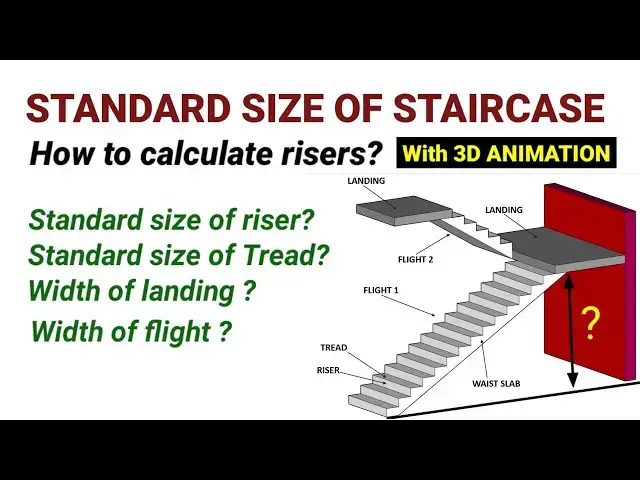
In this lecture, I’m going to discuss some important details regarding staircases, in which I will discuss, what should be the standard size of a staircase, the maximum and minimum standard sizes of risers and treads, the maximum and minimum size of flight width, and landing. I’m also going to discuss, how to calculate the number of risers and what should be the minimum spacing between 2 flights in a staircase. Before proceeding further, let me introduce you to the main components of a staircase
1) Tread: The top horizontal surface of a step over which foot is placed while ascending or descending a stairway is known as “Tread”
2) Riser: The vertical member of a step is known as “Riser”. It provides support and connection between successive treads.
3) Rise: The vertical height between two consecutive treads is known as rise.
4) Landing: The horizontal platform which is provided between two successive flights in a staircase is known as landing.
5) Flight: Flight is a continuous series of steps without any break between landings or between landing and flooring.
6) Waist slab: The thickness of the slab which is provided to support the steps is known as the waist slab.
Show More Show Less