live_tv
Livestream Starting Soon
00
Hours
:
00
Minutes
:
00
Seconds
Up next in 10


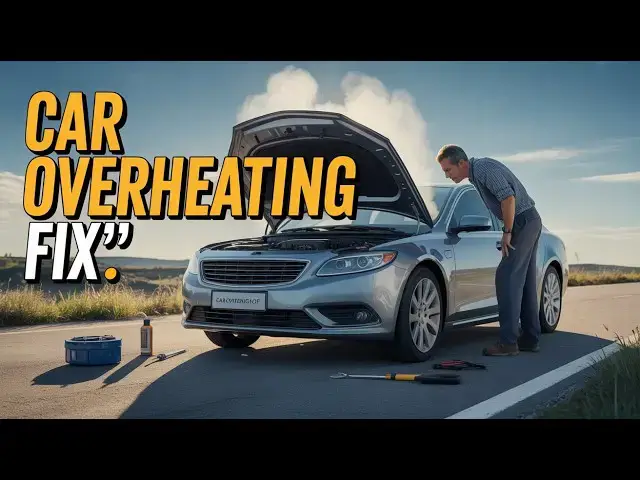
Dealing with your car overheating after a quick drive? We cover the usual suspects and straightforward fixes to get you back on the road without drama. Handy for everyday drivers and garage tinkerers! Hit subscribe for more no-nonsense car advice. #CarOverheating #EngineDiagnosis #AutoRepair #CarFix
Show More Show Less View Video Transcript
0:00
So, you just drove 10 minutes, barely
0:02
made it across town, and your car is
0:03
already running hotter than a July
0:05
barbecue. That's never a good sign. Hey
0:07
folks, Tom here from Car Justify. And if
0:09
your car overheats that fast, we've got
0:11
a few prime suspects to talk about.
0:14
First thing, let's clear up what
0:15
overheating means. That's when your
0:17
temperature gauge climbs way past
0:19
normal, you get a warning light, or you
0:21
see steam under the hood. Sometimes it's
0:23
subtle, sometimes it's like a fog
0:25
machine just kicked in. Either way, shut
0:28
it down right away. Driving hot is one
0:30
of the quickest ways to ruin an engine.
0:32
Now, overheating after just a short
0:34
drive usually means the coolant isn't
0:36
circulating like it should. Number one
0:38
culprit, low coolant level. If there's
0:41
not enough in there, the system can't
0:43
carry heat away from the engine and
0:45
it'll spike quick. Pop the hood once the
0:48
engine's fully cooled. I mean,
0:50
completely cool. And check the overflow
0:52
tank. If it's low, you've either got a
0:54
leak or you've been losing coolant
0:56
slowly over time. If the coolant's
0:58
topped up, next thing to check is your
1:00
thermostat. That's a little valve that
1:01
opens when the engine warms up to let
1:03
coolant flow through the radiator. If
1:05
it's stuck closed, coolant just sits in
1:07
the engine, getting hotter and hotter.
1:10
I've seen brand new thermostats fail
1:12
right out of the box. It happens.
1:14
Another big one is the water pump.
1:16
That's the part that actually pushes
1:17
coolant through the system. If it's got
1:19
a broken impeller, a bad belt, or the
1:21
bearing's gone, coolant won't move. A
1:23
quick check. With the engine cool,
1:25
squeeze the upper radiator hose. Start
1:27
the car and watch for it to get firm as
1:28
the pump moves coolant. No pressure
1:30
buildup. Pump might be the problem.
1:33
Don't forget the radiator fans. At low
1:35
speeds, you rely on those fans to pull
1:37
air through the radiator. If a fan
1:38
motor's dead, a fuse is blown, or the
1:40
temperature sensor is not telling the
1:42
fan to kick on, your car can overheat in
1:44
your driveway. Seen it a 100 times. Car
1:46
runs fine on the highway, cooks itself
1:48
in traffic, and of course, you could
1:50
have a clogged radiator. Inside gets
1:52
gummed up with rust or gunk. outside
1:54
gets packed with bugs, dirt, or leaves.
1:56
Both cut cooling power. Shine a
1:58
flashlight through the fins. You should
1:59
see light on the other side. If you
2:01
can't, give it a gentle clean. Here's my
2:04
quick checklist. Coolant level,
2:06
thermostat, water pump, radiator fans,
2:08
and radiator condition. Check them in
2:10
that order because you want to start
2:12
with the easiest and cheapest before
2:13
tearing into the big stuff. So, to
2:16
recap, overheating after a short drive
2:18
means something stopping coolant from
2:19
moving or heat from leaving the system.
2:22
Don't ignore it and don't keep driving
2:24
hoping it'll just cool off. Engines
2:26
don't work like that. Trust me, I've
2:28
seen folks cook theirs beyond saving.
2:30
All right, that's it for today. If this
2:32
walkthrough saved you from an overheated
2:34
headache, hit that like button and
2:35
subscribe for more driveway friendly car
2:37
help. And tell me in the comments,
2:39
what's the weirdest overheat cause
2:41
you've ever had? Mine was a squirrel's
2:43
nest in the radiator. Yep, that was a
2:46
new
#Autos & Vehicles
#Vehicle Parts & Services
#Vehicle Repair & Maintenance