Up next in 10

What is Lice? - Explained A Comprehensive Guide
Website: https://biologynotesonline.com/
Facebook: https://www.facebook.com/biologynotesonline
Instagram: https://www.instagram.com/biologynotesonline/?hl=en
Show More Show Less View Video Transcript
0:00
Hey everyone.
0:01
Today we're diving into the fascinating
0:04
world of lice. Those tiny parasitic
0:07
insects that can cause a whole lot of
0:09
itching and discomfort. Don't worry,
0:11
we'll learn everything you need to know
0:13
about these remarkable little creatures.
0:15
First, let's understand what lice
0:17
actually are. Lice are parasitic
0:19
insects, which means they live on or in
0:21
another organism called a host, and
0:24
depend on that host for survival. They
0:26
feed on blood, skin, or other body
0:28
fluids. Now let's look at some real
0:30
lice. This vintage scientific
0:33
illustration shows the incredible
0:34
diversity of lice species. Each one is
0:37
perfectly adapted to its specific host
0:39
and lifestyle. Lice belong to the
0:41
scientific order called therapa. This
0:44
order contains over 550 different
0:47
species of lice found worldwide. That's
0:50
a lot of different types of these tiny
0:52
creatures. While lice can infest many
0:54
different animals, from birds to
0:56
mammals, we're focusing specifically on
0:59
the species that affect humans, there
1:01
are three main types that we need to
1:03
know about. Here's what a headlouse
1:05
looks like up close on human hair.
1:07
Notice how it grips the hair strands
1:09
with its specialized claws. This is a
1:12
perfect example of how lice are adapted
1:14
for their parasitic lifestyle. Lice have
1:17
some amazing physical adaptations that
1:19
make them perfect parasites. They are
1:22
dorso ventrally flattened, meaning
1:24
they're flattened from top to bottom,
1:26
which helps them stay close to the skin
1:28
and hair. They're also completely
1:30
wingless because they don't need to fly.
1:32
They spend their entire lives on their
1:34
host. Their strong curved claws are
1:37
perfectly designed for gripping onto
1:39
hair shafts and skin. So, why do these
1:42
tiny creatures have such a big impact?
1:45
Despite being only 2 to 4 millime long,
1:48
lice can cause intense itching,
1:50
discomfort, and social stigma, they
1:52
spread easily in close contact
1:54
situations and can be surprisingly
1:56
difficult to eliminate completely.
1:58
Understanding lice is the first step in
2:01
dealing with them effectively. In the
2:03
following sections, we'll explore the
2:04
different types of lice, their life
2:06
cycles, and most importantly, how to
2:08
manage and prevent infestations.
2:11
Knowledge is power when it comes to
2:13
these tiny but impactful parasites. Lice
2:17
are fascinating parasites that fall into
2:19
two distinct groups based on how they
2:21
feed. Understanding these groups helps
2:23
us better comprehend the biology and
2:25
behavior of these tiny creatures.
2:37
The first group is called malafaga which
2:40
means chewing lice. These lice have
2:42
strong mandibles designed for chewing
2:44
and scraping. They primarily feed on
2:46
feathers, dead skin cells, and other
2:48
surface materials from their hosts. The
2:51
second group is anoplura or sucking
2:54
lice. These parasites have specialized
2:56
piercing mouth parts that allow them to
2:58
penetrate skin and feed directly on
3:00
their host's blood.
3:02
All lice that affect humans belong to
3:04
this group. Let's compare these two
3:06
groups side by side to see their key
3:08
differences.
3:10
Notice how the head shape, mouth parts,
3:12
and feeding behavior distinguish chewing
3:14
lice from sucking lice. Here's the
3:16
crucial takeaway. Every single species
3:19
that infests humans belongs to the
3:21
anapura group. Whether it's head lice,
3:24
body lice, or pubic lice, they are all
3:26
bloodfeeding sucking lice with
3:28
specialized mouth parts designed to
3:30
pierce human skin. There are three main
3:32
types of lice that specifically target
3:35
humans as their host. Each type has
3:38
evolved to thrive in different areas of
3:40
the human body and understanding these
3:42
differences is essential for proper
3:44
identification and treatment.
3:47
Let's start with head lice
3:49
scientifically known as pediculous
3:51
humanis capitus. These are the most
3:53
common type of lice affecting humans
3:55
particularly children. Head lice live
3:58
exclusively on the scalp and hair where
4:01
they feed on blood from the scalp. Body
4:03
lice or piculous human corporus are
4:07
closely related to head lice but have
4:09
adapted to live in clothing rather than
4:11
directly on the body. They hide in the
4:13
seams and folds of clothing particularly
4:15
underwear and only come onto the skin to
4:18
feed.
4:19
The third type is pubic lice known as
4:22
thyrus pubis or commonly called crab
4:24
lice due to their crablike appearance.
4:27
These lice are quite different from the
4:29
other two types being shorter and wider
4:31
with strong claws for gripping coarse
4:33
hair.
4:35
Proper identification of the lice type
4:37
is crucial because each requires
4:39
different treatment approaches. Head
4:41
lice treatments focus on the scalp. Body
4:44
lice require clothing treatment and
4:46
improved hygiene. While pubic lice need
4:49
specialized medications for sensitive
4:51
areas.
4:53
Understanding how scientists classes
4:55
classify lice helps us see where these
4:57
tiny parasites fit in the grand tree of
4:59
life. Let's explore their taxonomic
5:02
classification step by step. Starting
5:04
from the broadest category and working
5:06
our way down to the specific genus
5:08
level. First, let's look at the phylm
5:11
arthropoda. This is a massive group that
5:13
includes insects, spiders, crabs, and
5:16
many other creatures. What unites all
5:18
arthropods is their jointed legs,
5:20
segmented bodies, and external skeleton
5:23
made of kitan. Within the arthropods,
5:25
lice belong to class insecta, the
5:27
insects. All insects share key features.
5:30
They have exactly six legs, three main
5:32
body segments called head, thorax, and
5:34
abdomen. And most have wings at some
5:37
stage of their life cycle. Now we get
5:39
more specific. lice belong to order
5:42
thyrapara which means louse wing in
5:44
Greek. This order includes all the
5:47
parasitic lice that live on birds and
5:49
mammals. Their wingless insects that
5:51
have evolved specifically for a
5:53
parasitic lifestyle. Within this order,
5:55
human lice belong to suborder anoplura,
5:58
the sucking lice. These lice have
6:01
piercing mouth parts that allow them to
6:03
suck blood from their hosts. This
6:05
distinguishes them from chewing lice,
6:06
which feed on skin debris and feathers.
6:09
At the family level, we have two
6:11
important groups. Most human lice belong
6:14
to family pedicul, which includes head
6:16
lice and body lice. However, pubic lice
6:19
belong to a different family called the
6:22
reflecting their distinct evolutionary
6:24
path and specialized adaptations.
6:26
Finally, at the genus level, we have
6:28
genus pediculus for head and body lice
6:31
and genus thyus for pubic lice. The crab
6:34
louse gets its name from its crablike
6:36
appearance with its broad body and
6:38
strong claws for gripping coarse hair.
6:41
Understanding this classification system
6:43
helps us see how lice evolved and why
6:45
they have specific characteristics. Each
6:48
level tells us something important about
6:50
their biology, behavior, and
6:52
relationships to other organisms. This
6:55
knowledge is crucial for developing
6:56
effective treatments and understanding
6:59
how these parasites have adapted to
7:00
their human hosts.
7:03
Understanding the life cycle of lice is
7:05
crucial for effective treatment and
7:07
prevention.
7:09
Lice have a relatively simple but
7:11
efficient three-stage life cycle that
7:13
allows them to reproduce quickly and
7:15
maintain their populations on human
7:17
hosts. The first stage begins with eggs,
7:20
commonly called knits. Female adult lice
7:23
lay these tiny oval-shaped eggs directly
7:25
on hair shafts, positioning them very
7:28
close to the scalp, where warmth and
7:30
humidity provide ideal conditions for
7:32
development. After about 1 week, the
7:34
eggs hatch into nymphs, which represent
7:37
the second stage of development. Nymphs
7:39
look very similar to adult lice, but are
7:41
much smaller in size. They immediately
7:44
begin feeding on blood from the scalp
7:46
and must mol their outer shell multiple
7:48
times as they grow. The final stage is
7:52
the adult louse which is fully mature
7:54
and capable of reproduction. Adult lice
7:57
are larger than nymphs with females
7:59
being slightly bigger than males. They
8:01
can live for about 30 days on a human
8:03
head during which time they mate and lay
8:06
new eggs to continue the cycle. Now
8:08
let's see how this complete life cycle
8:10
works together. This circular diagram
8:13
shows the continuous nature of lice
8:15
reproduction from egg to adult and back
8:18
to egg laying. Understanding this cycle
8:20
helps explain why lice infestations can
8:23
persist and grow rapidly if left
8:25
untreated. The key takeaway is that this
8:28
rapid life cycle completing in just 2
8:30
weeks explains why lice populations can
8:32
explode quickly. Each female can lay up
8:35
to 150 eggs in her lifetime, making
8:39
early detection and proper treatment
8:41
essential for controlling infestations.
8:44
Understanding how lice spread between
8:46
people is crucial for prevention and
8:48
control.
8:49
Different types of lice have different
8:51
transmission methods, and knowing these
8:53
patterns helps us protect ourselves and
8:56
others. Head lice spread primarily
8:59
through direct head-to-head contact.
9:01
This happens most commonly when children
9:03
play together, take selfies, or engage
9:06
in activities where their heads touch.
9:08
Head lice can also spread through
9:10
sharing personal items, though this is
9:12
much less common. Items like combs,
9:14
brushes, hats, and pillows can
9:16
temporarily harbor lice. Here we can see
9:19
what a head lice infestation looks like
9:21
in real life. The small oval objects
9:24
attached to the hair strands are knits
9:26
or lice eggs which are firmly cemented
9:29
to the hair shaft. Body lice
9:31
transmission occurs differently. These
9:33
lice live in clothing and bedding, not
9:36
on the body itself. They spread through
9:38
direct contact with infested people or
9:40
by sharing contaminated clothing and
9:42
bedding. Pubic lice, also known as crab
9:45
lice, are primarily transmitted through
9:48
sexual contact. They can occasionally
9:50
spread through sharing bedding or
9:52
clothing, but this is much less common.
9:54
Remember these key points about lice
9:56
transmission. Head lice spread mainly
9:59
through direct contact. Body lice live
10:01
in clothing and spread in crowded
10:03
conditions. And pubic lice are
10:05
transmitted primarily through sexual
10:07
contact. Understanding these patterns
10:10
helps in both prevention and treatment.
10:12
Headlights are fascinating microscopic
10:15
parasites with highly specialized
10:17
anatomy perfectly adapted for life on
10:19
the human scalp. Understanding their
10:22
morphology is crucial for proper
10:24
identification and treatment. Head lice
10:27
scientifically known as pediculous
10:29
humanis capitus are remarkably small
10:31
insects measuring only 2 to 3 millime in
10:34
length. To put this in perspective,
10:37
they're about the size of a sesame seed.
10:39
The body of a headlouse has a
10:41
distinctive grayish white coloration and
10:43
is dorso ventrally flattened, meaning
10:45
it's compressed from top to bottom. This
10:48
flattened shape allows them to move
10:50
easily through hair strands.
10:52
Head lice are wingless insects, which
10:54
means they cannot fly or jump. Instead,
10:57
they rely on their six powerful legs for
11:00
movement. Each leg is equipped with a
11:02
specialized claw that allows them to
11:04
grasp and cling tightly to hair shafts.
11:07
The head of a louse contains piercing
11:09
sucking mouth parts specifically
11:11
designed for feeding on human blood.
11:14
These needle-ike structures allow them
11:15
to penetrate the scalp and extract blood
11:18
meals multiple times per day. Female
11:21
head lice lay eggs called knits which
11:24
are ovalshaped and firmly cemented to
11:26
individual hair shafts. These knits are
11:29
positioned close to the scalp where the
11:31
temperature and humidity are optimal for
11:33
development. Understanding the
11:35
morphology of head lice helps in proper
11:37
identification and explains why they are
11:39
such successful parasites. Their
11:42
flattened bodies, powerful claws, and
11:44
specialized mouth parts make them
11:46
perfectly adapted for life on the human
11:48
scalp. Body lice, scientifically known
11:51
as pediculous humanis corpus, are
11:54
fascinating parasites with unique
11:56
morphological adaptations that
11:58
distinguish them from their close
11:59
relatives, head lice. The first notable
12:02
characteristic of body lice is their
12:04
size. They are slightly larger than head
12:06
lice, measuring between 2.5 to 3.5 mm in
12:11
length, making them more visible to the
12:13
naked eye. Let's examine the detailed
12:15
anatomy of a body louse. Notice the
12:17
elongated body divided into three
12:19
distinct segments, the six legs, each
12:22
equipped with specialized claws, and the
12:25
short five segment antenna. Unlike head
12:27
lice, body lice have a unique lifestyle.
12:30
They live and lay their eggs on clothing
12:32
and bedding, only moving to human skin
12:35
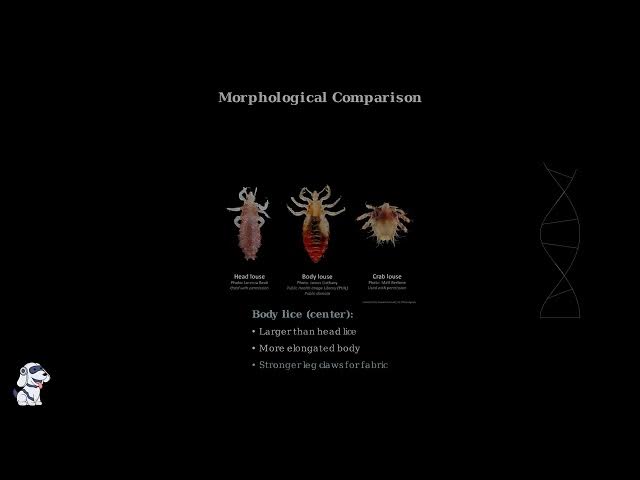
when they need to feed on blood. Here we
12:37
can see the morphological differences
12:39
between all three human lice species.
12:42
Body lice are in the middle, showing
12:44
their intermediate size and elongated
12:46
shape compared to head lice and the
12:48
distinctly different crab lice. Body
12:51
lice infestations are typically
12:53
associated with poor hygiene and crowded
12:55
living conditions. The lice cling to
12:58
clothing fibers and move to the skin
12:59
surface to feed as shown in this
13:02
microscopic view. To summarize the key
13:04
morphological features of body lice,
13:06
they are larger than head lice, have
13:08
specialized adaptations for gripping
13:10
fabric, live primarily on clothing
13:13
rather than directly on the host, and
13:15
their infestations indicate specific
13:17
environmental and hygiene conditions.
13:20
Pubic lice, scientifically known as
13:22
thyrus pubis, have a very distinctive
13:25
morphology that sets them apart from
13:27
head and body lice. These tiny parasites
13:30
are commonly called crab lice due to
13:32
their unique crablike appearance. Pubic
13:35
lice are notably smaller than their head
13:37
and body lice relatives, measuring only
13:40
1 to 2 mm in length. This compact size
13:44
allows them to navigate through coarse
13:46
body hair more effectively. This
13:48
anatomical diagram shows the basic body
13:50
structure of pubic lice. Like all lice,
13:53
they have a distinct head, chest, or
13:55
thorax, and abdomen along with antenna
13:57
and specialized walking limbs. The most
14:00
striking feature of pubic lice is their
14:03
crablike appearance. They have a much
14:05
broader and flattened body compared to
14:07
head and body lice. Notice the large,
14:10
prominent claws on their front legs,
14:12
which give them their characteristic
14:14
crablike look.
14:16
The claws of pubic lice are specially
14:18
adapted for gripping coarse hair. Unlike
14:21
head lice, which have smaller claws
14:23
suited for fine hair, pubic lice have
14:26
large, powerful claws on all six legs
14:28
that allow them to maintain a strong
14:30
grip on thicker body hair. While pubic
14:33
lice primarily infest the pubic area,
14:35
their specialized claws allow them to
14:37
inhabit other areas with coarse hair.
14:40
They can be found in armpits, beards,
14:42
and in rare cases even on eyelashes.
14:45
Their morphology is perfectly adapted
14:47
for these coarser hair environments.
14:50
To summarize the key morphological
14:52
features of pubic lice, they are the
14:54
smallest of the human lice at only 1 to
14:57
2 millm long, have a distinctive
14:59
crablike appearance with a broader
15:01
flattened body, and possess large
15:04
specialized claws that allow them to
15:06
grip coarse body hair effectively.
15:08
Understanding these morphological
15:11
differences is crucial for proper
15:13
identification and treatment as pubic
15:15
lice require different management
15:17
approaches compared to head and body
15:19
lice.
15:23
Topical insecticides are the first line
15:26
treatment for lice infestations. These
15:28
medications are applied directly to the
15:30
affected area to kill both adult lice
15:32
and their eggs called nits. There are
15:35
five main types of topical insecticides
15:38
commonly used for lice treatment. Let's
15:40
examine each one and understand how they
15:42
work against lice infestations. First is
15:45
peromethine, a synthetic pythoid that's
15:48
available over the counter. It's often
15:50
the first choice for treatment because
15:52
it's effective and relatively safe.
15:54
Peromethine works by attacking the
15:56
nervous system of lice. Malathen is an
15:59
organo phosphate insecticide that's very
16:01
effective against lice. It requires a
16:04
prescription and works by inhibiting
16:06
enzymes essential for lice survival.
16:08
It's particularly useful for resistant
16:11
cases. Spinosad is a newer treatment
16:13
derived from soil bacteria. It's highly
16:16
effective and works by causing paralysis
16:18
in lice. This prescription medication is
16:21
particularly good at killing both lice
16:23
and their eggs. Pythine are natural
16:26
insecticides extracted from
16:28
chrosanthemum flowers. They're often
16:30
combined with other ingredients to boost
16:32
effectiveness. Benzel alcohol works
16:34
differently by suffocating lice rather
16:37
than poisoning them. Proper application
16:39
is crucial for treatment success. The
16:42
medication must be applied to dry hair,
16:44
covering all areas from the scalp to the
16:47
hair tips. Special attention should be
16:49
paid to areas behind the ears and at the
16:51
nape of the neck. These treatments
16:54
target lice at different stages of their
16:56
life cycle. While they're very effective
16:58
against adult lice, some eggs may
17:01
survive the initial treatment. This is
17:03
why repeat applications are often
17:06
necessary. Here are the key takeaways
17:08
for successful lice treatment with
17:10
topical insecticides.
17:12
Always follow the product instructions
17:14
exactly. Complete the full treatment
17:16
course and check for treatment success
17:19
by examining for live lice after
17:21
treatment.
17:23
Effective lice treatment requires
17:25
following specific step-by-step regimens
17:27
for each type of lice. The approach
17:30
differs significantly between head lice,
17:32
body lice, and pubic lice, and timing is
17:35
crucial for success. We'll examine the
17:37
specific treatment protocols for each
17:39
type of lice, focusing on proper
17:41
application techniques, timing, and
17:44
follow-up procedures. Head lice
17:46
treatment follows a precise five-step
17:48
process. First, apply the topical
17:51
insecticide to completely dry hair. Wet
17:54
hair dilutes the medication and reduces
17:56
effectiveness. Step two requires
17:58
thorough saturation of both the scalp
18:00
and all hair shafts. The medication must
18:03
reach every area where lice and knits
18:05
might be present. Leave the medication
18:07
on for exactly the recommended time,
18:10
typically 10 minutes. This contact time
18:13
is essential for killing adult lice and
18:15
nymphs. Rinse thoroughly with warm water
18:17
to remove all medication residue. Then
18:20
use a fine tothed knit comb to
18:22
physically remove dead lice and knits
18:24
from the hair. The treatment must be
18:26
repeated in 7 to 10 days to kill any
18:29
newly hatched lice. This timing targets
18:32
lice that were in the egg stage during
18:34
the first treatment. Body lice treatment
18:37
focuses primarily on hygiene and
18:39
clothing management rather than topical
18:41
medications. Body lice live in clothing
18:44
seams and only move to skin to feed.
18:47
Remove all clothing immediately and wash
18:49
in hot water at least 130° F. The high
18:53
temperature kills both lice and eggs in
18:55
the fabric.
18:56
Dry clothing on high heat for at least
18:59
40 minutes. The combination of hot
19:01
washing and drying ensures complete
19:03
elimination of lice from clothing and
19:05
bedding.
19:07
Pubic lice treatment requires careful
19:09
application to all affected areas. These
19:12
lice can infest any coarse body hair,
19:15
not just pubic regions. Apply the
19:17
medication to all affected areas,
19:19
including pubic hair, underarm hair,
19:21
chest hair, and even eyelashes if
19:23
infested. Follow timing instructions
19:25
precisely. Wash the treated area
19:28
thoroughly after the recommended contact
19:30
time. Then repeat the entire treatment
19:33
in 7 to 10 days to ensure complete
19:35
elimination.
19:37
Treatment success depends on following
19:39
these critical factors. Precise timing
19:42
prevents resistance development. And the
19:44
second treatment is absolutely essential
19:46
for complete elimination. Check all
19:49
household members for infestation and
19:51
use hot water washing for all clothing,
19:53
bedding, and washable items to prevent
19:56
reinfestation and spread. Following
19:58
these step-by-step treatment regimens
20:00
ensures the highest success rate in
20:02
eliminating lice infestations while
20:05
preventing resistance and reinfestation.
20:08
Traditional insecticides are becoming
20:10
less effective against lice due to
20:12
growing resistance. This has led to the
20:14
development of alternative non-pesticide
20:17
treatment options that work through
20:19
different mechanisms. The challenge we
20:21
face today is significant. Many lice
20:24
populations have developed resistance to
20:26
common insecticides like peromethine.
20:29
This creates a need for safer, more
20:31
effective alternatives that don't rely
20:33
on chemical pesticides.
20:36
Damethicone is a siliconebased compound
20:38
that works by physically clogging the
20:40
respiratory spirals of lice.
20:43
These tiny breathing holes become
20:45
blocked, causing the lice to suffocate.
20:48
Since this is a physical rather than
20:49
chemical action, lice cannot develop
20:52
resistance to this treatment method.
20:55
Several essential oils have shown
20:57
promising bioactivity against lice,
20:59
including tea tree oil, lavender oil,
21:02
and eucalyptus oil. These natural
21:04
compounds can disrupt lice behavior and
21:06
survival, offering a gentler alternative
21:09
to synthetic pesticides.
21:11
Wet combing is a mechanical removal
21:13
method that can be highly effective when
21:15
done properly. Using a fine-tuned metal
21:18
comb on wet, conditioned hair, you
21:20
systematically work through small
21:21
sections to physically remove lice and
21:24
knits. This method requires patience and
21:27
repetition, but avoids all chemical
21:29
treatments.
21:31
These alternative treatments offer
21:33
valuable options when traditional
21:34
insecticides fail. Dimethone provides
21:38
reliable physical action. Essential oils
21:40
offer natural solutions and wet combing
21:43
gives complete chemical avoidance. Often
21:46
combining these approaches yields the
21:48
best results for stubborn infestations.
21:50
When topical treatments fail to
21:52
eliminate lice infestations, health care
21:54
providers may consider systemic
21:56
therapies, oral medications that work
21:59
from inside the body rather than applied
22:01
directly to the hair and scalp. There
22:04
are two main approaches to treating lice
22:05
infestations. Topical treatments are
22:08
applied directly to the hair and scalp
22:10
and represent the first line therapy.
22:13
Systemic treatments are oral medications
22:15
that work throughout the body and are
22:17
reserved for more challenging cases.
22:21
Systemic therapies are considered when
22:23
topical treatments have failed after
22:25
multiple attempts when dealing with
22:27
severe or widespread infestations or
22:30
when patients cannot tolerate topical
22:32
applications. These are truly reserved
22:34
for refractory cases.
22:37
Oral Ivormekin is the primary systemic
22:40
therapy considered for lice treatment.
22:43
However, it's important to note that
22:44
Ivormectin is not FDA approved
22:47
specifically for treating pediculosis.
22:49
Healthcare providers may use it off
22:51
label, typically as a single or double
22:53
dose, but this requires careful medical
22:55
supervision.
22:57
This table shows the standard topical
22:59
treatment options for pediculosis.
23:02
Notice that systemic therapies like oral
23:04
Ivormectin are not included in these
23:06
standard protocols, highlighting their
23:08
specialized use only when conventional
23:11
treatments fail. The key takeaways about
23:14
systemic therapies are clear. They are
23:17
last resort options. Oral Ivormectin is
23:20
not FDA approved for lice treatment.
23:22
They should only be considered after
23:24
topical treatments have failed. They
23:26
always require health care professional
23:28
guidance and they are reserved for
23:30
severe or refractory cases. Remember
23:33
systemic therapies for lice treatment
23:35
should never be self-administered.
23:37
Always consult with a health care
23:39
provider who can properly evaluate the
23:41
situation and determine if systemic
23:44
therapy is appropriate for the specific
23:46
case.
23:48
Body lice represent a serious public
23:51
health concern because unlike head lice,
23:53
they can transmit dangerous diseases to
23:55
humans. Understanding this transmission
23:58
is crucial for prevention and control.
24:01
Body lice are different from head lice
24:03
in a critical way. While headlights are
24:05
primarily a nuisance, body lice can
24:08
transmit three serious bacterial
24:10
diseases that have historically caused
24:12
major epidemics.
24:14
Body lice transmit three serious
24:16
diseases. Epidemic typhus causes high
24:19
fever and can be fatal. Trench fever,
24:21
named after World War I trenches, causes
24:24
recurring fever and bone pain. Relapsing
24:26
fever creates cycles of illness and
24:28
recovery.
24:30
These diseases cause serious symptoms,
24:32
including high fever, severe headaches,
24:34
bodyaches, and characteristic rashes.
24:37
Early recognition and treatment are
24:39
essential for patient survival. Body
24:42
lice thrive in conditions of poor
24:44
hygiene and overcrowding. They are
24:46
particularly problematic in war zones,
24:48
refugee camps, and among homeless
24:50
populations where regular bathing and
24:52
clothing changes are difficult.
24:56
Prevention focuses on breaking the
24:58
transmission cycle. Regular bathing,
25:00
daily clothing changes, and washing
25:02
clothes in hot water above 60° are
25:05
essential. High heat drying also kills
25:08
lice and their eggs.
25:11
Remember these key points. Body lice are
25:14
serious disease vectors that transmit
25:16
three dangerous bacterial infections.
25:18
They thrive in conditions of poor
25:20
hygiene and overcrowding. Prevention
25:23
through proper hygiene and hot water
25:24
washing is essential for controlling
25:26
both the lice and preventing disease
25:29
transmission.
25:30
Crowded conditions create the perfect
25:32
storm for lice infestations. When people
25:35
are in close proximity and share spaces
25:38
regularly, the risk of lice transmission
25:40
increases dramatically. Schools and
25:42
daycare centers are prime locations for
25:45
lice outbreaks. Children sit close
25:47
together, play in groups, and often
25:50
share personal items like hats, brushes,
25:52
and hair accessories. In extreme cases,
25:54
refugee camps, and overcrowded living
25:56
conditions present the highest risk.
25:59
Poor sanitation, limited resources, and
26:01
extremely close living quarters create
26:04
ideal conditions for rapid lice spread.
26:06
Understanding how lice spread in crowded
26:09
conditions helps us see why prevention
26:11
is so challenging.
26:13
Direct head-to-head contact is the
26:15
primary route, but shared items also
26:17
play a significant role. In crowded
26:19
environments, the lice life cycle
26:21
accelerates the problem. A single
26:24
infested individual can quickly spread
26:26
lice to multiple people, and the rapid
26:28
reproduction cycle means populations
26:30
explode within weeks. Prevention in
26:33
crowded settings requires a
26:34
multi-layered approach.
26:36
Regular screening, education, and strict
26:39
policies about sharing personal items
26:41
are essential for controlling outbreaks.
26:43
The key takeaway is that crowded
26:45
conditions amplify every aspect of lice
26:48
transmission. Prevention requires
26:50
vigilance, education, and coordinated
26:53
efforts from everyone in the community
26:55
to break the cycle of infestation.
26:57
Proper identification of lice species is
27:00
absolutely crucial for effective
27:01
treatment.
27:03
Each type of louse requires a different
27:05
management approach, making accurate
27:07
identification the first step toward
27:09
successful treatment. There are three
27:12
distinct species of lice that infest
27:14
humans. Head lice, body lice, and pubic
27:17
lice. Each has unique morphological
27:20
characteristics that help us identify
27:21
them correctly. Head lice are elongated
27:24
and grayish white in color. Body lice
27:27
look very similar to head lice, but are
27:28
slightly larger. Pubic lice, also called
27:32
crab lice, have a distinctive crablike
27:34
appearance. They are broader and shorter
27:36
than the other two species.
27:39
Under microscopic examination, we can
27:41
observe key anatomical features that
27:43
help distinguish between species. Look
27:46
at the body shape and proportions, leg
27:48
structure, headto body ratio, and
27:50
overall size.
27:52
Pubic lice are easily distinguished by
27:54
their crablike appearance with prominent
27:57
claws. They are broader than head or
27:59
body lice and are typically found in
28:01
pubic and other coarse body hair. They
28:04
are also less mobile than other lice
28:06
species.
28:08
For proper identification, use a
28:10
microscope with 10 to 40 times
28:12
magnification or a high quality
28:14
magnifying glass. Ensure good lighting
28:17
conditions and compare specimens with
28:19
reference images. Also consider where on
28:22
the body the lice were found as this
28:24
provides important clues.
28:26
Each lice species requires a different
28:28
treatment approach. Head lice need
28:30
topical pediculides. Body lice require
28:33
clothing treatment and improved hygiene
28:36
while pubic lice need specialized
28:38
topical treatments. Wrong identification
28:41
leads to treatment failure. So proper
28:43
identification is essential for
28:45
effective management. Remember, accurate
28:48
species identification is the foundation
28:50
of successful lice treatment. Take the
28:53
time to properly examine and identify
28:55
the species before beginning any
28:57
treatment regimen. When dealing with
28:59
lice infestations, a single treatment
29:01
approach often isn't enough. Today,
29:04
we'll explore why combining multiple
29:06
strategies is the key to successful lice
29:08
eradication. Single treatments often
29:10
fail because lice exist in multiple life
29:13
stages simultaneously. Eggs, nymphs, and
29:16
adults each require different
29:18
approaches. Additionally, missed knits,
29:20
environmental reinfection, and
29:22
incomplete coverage all contribute to
29:24
treatment failure. This is why health
29:26
care professionals recommend a
29:28
comprehensive multi-pronged approach
29:31
that addresses all aspects of lice
29:33
infestation. The most effective approach
29:35
combines four key strategies. Topical
29:38
insecticides to kill live lice,
29:40
mechanical knit removal to eliminate
29:42
eggs, proper hygiene measures, and
29:44
environmental control to prevent
29:46
reinfection. First, topical insecticides
29:49
like peromethine or malatheon target
29:51
live lice and some nymphs. These
29:53
medications disrupt the nervous system
29:55
of the parasites causing paralysis and
29:58
death. Second, mechanical knit removal
30:00
using fine tooth combs is essential
30:02
because insecticides may not kill all
30:04
eggs. This physical removal ensures that
30:07
viable knits don't hatch into new
30:09
infestations. Third, proper hygiene
30:12
measures include washing clothes and
30:14
bedding in hot water, avoiding sharing
30:16
personal items, and maintaining clean
30:18
living spaces to reduce transmission
30:20
risk. Finally, environmental control
30:23
involves treating the surroundings where
30:25
lice might survive temporarily,
30:27
including furniture, carpets, and shared
30:30
spaces in schools or homes. When these
30:32
four approaches work together, they
30:34
create a comprehensive defense against
30:36
lice that addresses every aspect of the
30:39
infestation cycle. Following these key
30:41
principles significantly improves
30:43
treatment success rates. Complete
30:46
treatment regimens, proper timing of
30:48
repeat applications, and combining all
30:50
four approaches simultaneously are
30:52
essential for eradication.
30:54
Remember, patience and persistence are
30:57
crucial. Most treatment failures occur
30:59
when people don't complete the full
31:01
regimen or skip follow-up treatments. A
31:04
combined strategy approach gives you the
31:06
best chance of completely eliminating
31:08
lice infestations. Prevention is the
31:10
most effective way to stop lice from
31:13
spreading by following simple
31:15
environmental control measures. We can
31:17
significantly reduce the risk of
31:19
infestation and protect ourselves and
31:22
our families. The first line of defense
31:24
is avoiding the sharing of personal
31:26
items. Combs, brushes, hats, scarves,
31:29
and towels can all harbor lice and
31:31
knits. When these items are shared, lice
31:33
can easily transfer from one person to
31:35
another. Regular checking is crucial for
31:38
early detection. Examine hair weekly,
31:41
especially in children who are at higher
31:42
risk. Look for small oval-shaped knits
31:46
attached to hair strands close to the
31:47
scalp. Pay special attention to areas
31:50
behind the ears and at the nape of the
31:52
neck where lice prefer to lay eggs.
31:55
Proper laundering is essential for
31:57
eliminating lice from clothing and
31:59
bedding. Wash all items in hot water at
32:02
least 130° F for a full cycle. Then dry
32:06
on high heat for at least 40 minutes.
32:08
The combination of hot water and high
32:10
heat will kill both lice and knits
32:12
effectively.
32:14
Environmental cleaning removes any lice
32:16
or knits that may have fallen from
32:18
infested hair. Vacuum all carpets, rugs,
32:21
and upholstered furniture thoroughly.
32:23
Pay special attention to areas where the
32:25
infested person spent time, including
32:27
car seats and headrests. For items that
32:30
cannot be washed, seal them in plastic
32:33
bags for 2 weeks to starve any remaining
32:35
lice. Remember these key prevention
32:38
strategies. Never share personal items
32:40
like combs and hats. Check hair weekly
32:43
for early detection. Use hot water and
32:46
high heat when laundering. And vacuum
32:48
your environment thoroughly. Following
32:51
these simple steps will significantly
32:53
reduce the risk of lice infestation and
32:55
help stop the spread. Good hygiene is
32:58
your first and most effective line of
33:00
defense against lice infestations. While
33:03
treatment is important, prevention
33:05
through proper hygiene practices can
33:07
stop lice before they become a problem.
33:09
Regular bathing is essential, especially
33:12
for preventing body lice. Body lice live
33:14
in clothing and bedding, not on the body
33:17
itself, but they feed on human blood.
33:20
Daily bathing removes any lice that may
33:22
have transferred to your skin and
33:24
maintains overall cleanliness. Proper
33:26
hand washing is a crucial hygiene
33:28
practice that helps prevent the spread
33:30
of lice and other parasites. Here are
33:34
the essential steps for effective
33:35
handwashing that everyone should follow.
33:38
Frequent clothing changes and proper
33:40
laundering are critical for lice
33:41
control. Body lice live in the seams of
33:44
clothing and bedding. So, regular
33:46
washing in hot water at least 130° F
33:50
will kill both lice and their eggs.
33:53
Understanding the lice life cycle helps
33:55
us see how hygiene practices disrupt
33:57
their reproduction.
33:59
Regular washing removes eggs before they
34:01
hatch, and clean clothing prevents adult
34:04
lice from finding suitable breeding
34:06
grounds. In schools and communities,
34:09
promoting good hygiene practices helps
34:11
prevent lice outbreaks. Education about
34:14
proper hygiene, providing handwashing
34:16
facilities, and encouraging regular
34:18
clothing changes can significantly
34:20
reduce transmission rates. Remember
34:23
these key hygiene practices. Bathe
34:25
daily, change clothes frequently, wash
34:28
everything in hot water, and maintain
34:30
clean living spaces. Good hygiene is not
34:33
just about personal cleanliness. It's a
34:35
powerful tool for preventing lice
34:37
infestations and protecting your
34:39
community's health. Insecticide
34:41
resistance has become one of the most
34:42
significant challenges in managing lice
34:45
infestations.
34:47
Understanding how this resistance
34:49
develops is crucial for effective
34:51
treatment strategies. Insecticide
34:54
resistance occurs when lice populations
34:56
develop the ability to survive
34:58
treatments that previously killed them
35:00
effectively. This happens through
35:02
natural selection and genetic changes.
35:05
This diagram shows how resistance
35:07
develops in insect populations.
35:09
Initially, most individuals are
35:11
susceptible to pesticides shown in
35:13
white. After treatment, only resistant
35:15
individuals shown in red survive. Over
35:18
generations, the resistant population
35:20
grows and dominates. In lice
35:23
populations, resistance to pythroidids,
35:26
the most common class of lice
35:27
treatments, is now widespread.
35:30
Resistance genes are passed from parent
35:32
lice to their offspring through each
35:34
generation of the life cycle. Some lice
35:36
populations now show resistance rates of
35:39
over 90%.
35:41
Lice develop resistance through several
35:43
mechanisms. Genetic mutations can alter
35:46
sodium channels, making pythroidids less
35:48
effective. Enhanced enzyme production
35:50
helps lice break down insecticides
35:52
faster. Some lice even develop
35:55
behavioral changes to avoid treated
35:57
areas. To address insecticide
35:59
resistance, researchers and health care
36:01
providers are implementing several
36:03
strategies.
36:05
These include rotating between different
36:07
classes of insecticides, using
36:09
combination treatments, and developing
36:11
non-chemical methods. Current research
36:14
focuses on essential oils, physical
36:16
removal techniques, and identifying
36:18
novel targets for new insecticides.
36:21
The key takeaways are that insecticide
36:24
resistance is a natural evolutionary
36:26
response that cannot be completely
36:28
prevented. However, overuse of single
36:31
treatments accelerates its development.
36:34
Multiple strategies combining different
36:36
approaches are essential for effective
36:37
lice control and ongoing research
36:40
continues to develop new solutions to
36:42
stay ahead of resistance.
36:46
Pediculosis represents one of the most
36:48
widespread parasitic infestations
36:50
affecting humanity. The global scale of
36:53
this problem is truly staggering and
36:55
affects every corner of our world. Every
36:58
single year, hundreds of millions of
37:00
people worldwide are affected by lice
37:02
infestations. This makes pediculosis one
37:05
of the most common parasitic conditions
37:07
affecting humans globally. Lice
37:09
infestations have been reported in every
37:11
single country around the world. No
37:14
region is immune from developed nations
37:16
in North America and Europe to
37:18
developing countries in Africa, Asia,
37:20
and South America. Importantly, lice do
37:23
not discriminate based on socioeconomic
37:25
status. They affect people from all
37:28
social classes, wealthy families,
37:30
middle-class households, and lowincome
37:32
communities alike. No one is immune to
37:34
infestation. To understand the global
37:37
impact, we must remember what we're
37:38
dealing with. Here's the life cycle of
37:41
head lice that affects hundreds of
37:43
millions worldwide. While lice affect
37:46
all countries, the impact is
37:47
particularly severe in developing
37:49
nations. Limited healthcare access,
37:52
overcrowded living conditions, poor
37:53
sanitation, and treatment cost barriers
37:55
make prediculosis a significant public
37:58
health issue in these regions.
38:00
Addressing this global challenge
38:02
requires coordinated efforts in
38:04
education and awareness, improve
38:06
treatment access, comprehensive
38:08
prevention programs, and international
38:10
cooperation.
38:12
The ultimate goal is is to improve the
38:14
health and well-being of affected
38:16
populations worldwide. The key takeaway
38:18
is clear. Pediculosis represents a truly
38:21
global health challenge that transcends
38:24
borders and social boundaries. With
38:26
hundreds of millions affected annually,
38:29
coordinated worldwide prevention and
38:31
treatment efforts are essential for
38:32
reducing this burden on human health and
38:35
well-being.
38:37
Managing lice infestations effectively
38:39
requires a comprehensive multifaceted
38:42
approach. Throughout this series, we've
38:44
explored the complex world of these tiny
38:47
parasites and the strategies needed to
38:49
combat them successfully. Effective lice
38:52
management rests on four essential
38:54
pillars. First, proper identification of
38:57
the lice species is crucial as different
38:59
types require different approaches.
39:02
Second, appropriate treatment must be
39:04
selected based on the species
39:05
identified, the severity of infestation,
39:08
and any resistance patterns in the local
39:10
population. Third, prevention measures
39:13
help stop the spread of lice through
39:15
education, regular screening, and proper
39:17
hygiene practices. Finally,
39:19
environmental control addresses the
39:21
surroundings where lice might survive,
39:23
including proper cleaning of clothing,
39:26
bedding, and personal items.
39:28
Understanding the biology of lice is
39:30
fundamental to successful management.
39:32
Their life cycles, feeding habits, and
39:35
transmission methods all inform our
39:38
treatment strategies. By implementing
39:39
these comprehensive strategies, we can
39:42
significantly minimize the impact of
39:44
these tiny parasites on human health and
39:47
well-being. Lice management is an
39:49
ongoing challenge that requires
39:51
vigilance, knowledge, and coordinated
39:54
effort. Thank you for joining us on this
39:57
comprehensive journey through the world
39:58
of human lice. Together, we can make a
40:01
difference in controlling these
40:03
persistent parasites.
#Health
#Health Conditions
#Public Health