Up next in 10


What are Mites? A Comprehensive Guide
Website: https://biologynotesonline.com/
Facebook: https://www.facebook.com/biologynotesonline
Instagram: https://www.instagram.com/biologynotesonline/?hl=en
Show More Show Less View Video Transcript
0:00
Welcome to the fascinating world of
0:01
mites. These incredible tiny creatures
0:04
are some of the most abundant and
0:06
diverse animals on Earth. Yet, most
0:08
people have never really seen one up
0:10
close.
0:12
Just how tiny are mites?
0:18
Most mites are less than 1 millm in
0:21
size, so small you need a magnifying
0:23
glass to see their details.
0:25
Despite their tiny size, mites are
0:27
arachnids. They're actually more closely
0:29
related to spiders and scorpions than to
0:32
insects. Like all arachnids, mites have
0:35
eight legs, not six like insects do. The
0:38
diversity of mites is absolutely
0:40
staggering. There are over 50,000 known
0:43
species. And scientists estimate there
0:46
could be up to 1 million species in
0:48
total. Here you can see just a few
0:50
examples of different might types.
0:54
Let's take a quick look at might
0:55
anatomy. This detailed diagram shows the
0:58
main body parts of a mite. Notice the
1:00
nthosoma containing the mouth parts and
1:03
the idioos which is the main body with
1:05
eight legs attached.
1:08
Why do we call these tiny creatures
1:09
titans? Because despite their
1:11
microscopic size, mites have an enormous
1:14
impact on our world. They affect
1:16
agriculture, human health, and play
1:18
crucial roles in ecosystems everywhere.
1:21
In the upcoming sections, we'll explore
1:23
might taxonomy, morphology, life cycles,
1:26
and discover both the beneficial and
1:28
harmful roles these tiny titans play in
1:31
our world. Get ready for an amazing
1:33
journey into the microscopic realm of
1:35
mites. Mites are fascinating creatures
1:37
that belong to a specific place in the
1:40
animal kingdom. To understand what they
1:43
are, we need to look at their scientific
1:44
classification.
1:46
Mites belong to the subclass Accari
1:49
which is part of the larger class
1:50
arachnida. This makes them close
1:52
relatives of spiders, scorpions, and
1:55
ticks.
1:56
One of the most remarkable things about
1:58
mites is their incredibly small size.
2:01
Most mites are less than 1 millm long.
2:04
That's the tip of a pencil.
2:08
Despite their tiny size, mites have
2:10
complex body structures. Like all
2:12
arachnids, they have eight legs and
2:14
their body is divided into two main
2:16
parts. The nathosoma which contains the
2:18
mouth parts and the idioos which is the
2:21
main body.
2:23
Mites are divided into two major groups
2:25
based on their evolutionary history and
2:27
body structure. These are aerapformms
2:30
and paracetapiforms each with distinct
2:32
characteristics and lifestyles.
2:35
To summarize, mites are tiny arachnids
2:38
in the subclass aari with eight legs and
2:41
complex body structures despite their
2:42
microscopic size. They're divided into
2:45
two main evolutionary groups, each
2:47
adapted to different lifestyles and
2:49
environments.
2:51
Mites are truly remarkable creatures
2:53
when it comes to their ability to
2:54
colonize diverse habitats.
2:57
These tiny arachnids have successfully
2:59
adapted to live in virtually every
3:01
environment on Earth. Mites have
3:03
achieved global distribution, colonizing
3:06
every continent except Antarctica. Their
3:09
small size and adaptability have allowed
3:12
them to spread across the world through
3:14
various means of dispersal.
3:16
Soil represents one of the richest
3:18
habitats for mites. Soil mites play
3:21
crucial ecological roles as decomposers,
3:24
breaking down organic matter and
3:25
controlling other soil dwelling pests.
3:28
They can be found in all soil types from
3:30
forest floors to agricultural fields.
3:34
Many mites have adapted to live directly
3:36
on plants. These plant-design
3:47
damage to their hosts.
3:50
Some mites have evolved as parasites
3:52
living directly on animal hosts. These
3:55
parasitic mites feed on blood, skin
3:57
cells, or other body fluids. They can be
4:00
found on mammals, birds, and other
4:02
animals. And some species are capable of
4:04
transmitting diseases.
4:07
Mites have also colonized many other
4:08
environments. They live in our homes,
4:11
feeding on dust and organic debris. Some
4:14
species have adapted to aquatic
4:16
habitats, while others survive in
4:18
extreme environments like deserts and
4:20
high altitudes. They're also common in
4:23
stored products like grains and dried
4:25
foods. The remarkable distribution of
4:28
mites across diverse habitats
4:30
demonstrates their incredible
4:31
adaptability. From soil ecosystems to
4:34
plant surfaces, from animal hosts to our
4:37
own homes, mites have successfully
4:39
colonized nearly every environment on
4:41
Earth, making them one of the most
4:44
successful groups of arthropods.
4:46
Understanding might morphology helps us
4:48
appreciate how these tiny arachnids are
4:50
perfectly adapted for their diverse
4:52
lifestyles. A might's body structure
4:55
tells the story of millions of years of
4:57
evolution. Every m's body is divided
5:00
into two distinct regions. The front
5:03
section is called the nathosoma, which
5:05
contains the mouth parts. The larger
5:07
back section is the idioos, which houses
5:09
most of the m's internal organs. Let's
5:12
examine a detailed anatomical diagram to
5:15
see these structures more clearly. This
5:18
vententral view shows us the underside
5:20
of a mite with all its important parts
5:22
labeled. The nathosoma is a marvel of
5:24
miniature engineering. It contains the
5:27
chellisser which are like tiny scissors
5:29
or needles for cutting or piercing. The
5:31
palps act as sensory organs helping the
5:34
mite navigate and identify food sources.
5:37
The hypos provides attachment during
5:39
feeding. Now, let's examine the idioos,
5:42
the main body section that houses the
5:44
mite's vital organs and provides
5:46
structural support. The idioos is where
5:49
most of the mit's life processes occur.
5:51
It houses the digestive system,
5:53
reproductive organs, and provides
5:55
attachment points for all eight legs.
5:57
Various plates and hairlike structures
6:00
called seti protect and support the
6:02
body. The external covering of mites,
6:04
called the integimement, varies
6:06
dramatically between species and
6:08
reflects their different lifestyles and
6:10
environments.
6:12
Mite integimements come in many forms.
6:14
Plant feeding mites often have soft,
6:16
flexible coverings that allow their
6:18
bodies to expand when they're full of
6:20
plant juices. Predatory mites typically
6:23
have harder, more armored integments for
6:26
protection during hunting and combat.
6:28
Understanding might morphology reveals
6:31
how form follows function in these
6:33
remarkable creatures. Their specialized
6:35
body parts make them incredibly
6:37
successful in diverse environments.
6:40
These key points help us understand why
6:42
mites are so successful.
6:44
Their morphology is perfectly matched to
6:46
their ecological roles. Whether as plant
6:48
feeders, predators, or parasites, mites
6:51
undergo a fascinating process called
6:53
metamorphosis, which means they
6:56
completely change their form and
6:57
appearance as they grow from tiny eggs
7:00
into fully developed adults. The might
7:03
life cycle consists of five distinct
7:05
stages. Each stage looks completely
7:08
different from the others and serves a
7:10
specific purpose in the mite's
7:12
development.
7:13
Here we see a real example of a red
7:15
might life cycle. Notice how the might
7:17
progresses through larvae, protymph,
7:20
dutinymphymph, and adult stages. Each
7:22
stage takes a specific amount of time,
7:24
and the might looks quite different at
7:26
each phase.
7:28
Let's examine each stage more closely to
7:31
understand what happens during might
7:32
development. The egg stage is where life
7:35
begins. Mite eggs are incredibly tiny,
7:38
usually ovalshaped, and protected by a
7:40
tough shell. Inside this protective
7:43
casing, the young might begin its
7:45
development. The larvae is the first
7:47
active stage after hatching.
7:49
Interestingly, larae have only six legs
7:51
unlike adult mites which have eight.
7:53
During this stage, they feed actively
7:55
and grow rapidly.
7:58
The nymph stages are where major
7:59
development occurs. There are usually
8:02
two nymph stages, protonymph and
8:04
dutinymph. Though some species have a
8:06
third called tritonymph. At this point,
8:09
they develop their full eight legs like
8:11
adult arachnids.
8:13
Finally, the adult stage represents the
8:16
fully developed mite capable of
8:18
reproduction. Male and female adults
8:21
often look different from each other,
8:22
and once they mate, the cycle begins all
8:25
over again with new eggs. This diagram
8:28
shows the house dustmite life cycle
8:30
stages clearly. You can see how the
8:32
larvae has six legs, while all the nymph
8:34
stages and adults have eight legs.
8:37
Notice the gradual increase in size and
8:39
body complexity through each stage.
8:42
Understanding the might life cycle is
8:44
crucial for effective might management.
8:46
By knowing when mites are most
8:48
vulnerable during their development, we
8:50
can target control measures more
8:52
effectively. Each stage has its own
8:55
characteristics and vulnerabilities that
8:57
can be exploited for pest control.
9:00
Not all mits. In fact, many mites are
9:03
incredibly beneficial to agriculture and
9:06
ecosystems. These tiny heroes work as
9:08
nature's own pest control experts,
9:11
helping farmers and gardeners manage
9:12
harmful insects naturally. Predatory
9:15
mites are among the most important
9:16
beneficial mites in agriculture. These
9:19
tiny hunters actively search for and
9:22
consume harmful pest mites, thris, and
9:24
other small insects that damage crops.
9:27
Here we can see a beneficial mite in
9:29
action, feeding on a smaller pest
9:31
insect. These predatory mites have
9:33
voracious appetites and can consume
9:36
multiple pest mites per day, making them
9:38
incredibly effective biological control
9:40
agents. Farmers around the world are
9:43
increasingly using beneficial mites like
9:45
these as part of integrated pest
9:47
management programs. They help reduce
9:49
the need for chemical pesticides, save
9:53
money, and protect the environment while
9:55
maintaining healthy crop yields. This
9:58
diagram shows the fascinating battle
9:59
strategies between beneficial predatory
10:02
mites and harmful spidermitites.
10:05
Predatory mites use web invasion
10:07
techniques and active hunting to control
10:08
spidermite populations, while
10:11
spidermitites have developed various
10:12
defensive strategies in response. The
10:15
key takeaway is that beneficial mites
10:17
are nature's pest control experts. They
10:20
naturally control harmful pest
10:22
populations, reduce our dependence on
10:24
chemical pesticides, and play an
10:26
essential role in sustainable
10:27
agriculture. These tiny allies prove
10:30
that not all mites are enemies. Many are
10:33
valuable partners in maintaining healthy
10:35
ecosystems. Unfortunately, not all mites
10:38
are beneficial. Some species cause
10:40
significant damage to crops and can even
10:43
transmit diseases to humans and animals.
10:46
These harmful mites represent the darker
10:48
side of the might world. Spider mites
10:50
are among the most destructive
10:51
agricultural pests. These tiny arachnids
10:55
feed by piercing plant cells and sucking
10:57
out the contents causing characteristic
10:59
stippling damage that appears as tiny
11:01
yellow or white spots on leaves. Here we
11:05
can see the characteristic damage caused
11:07
by mites on plant leaves. The white and
11:10
brown patches you see are the result of
11:12
mites feeding on plant cells. literally
11:15
sucking the life out of the leaf tissue.
11:18
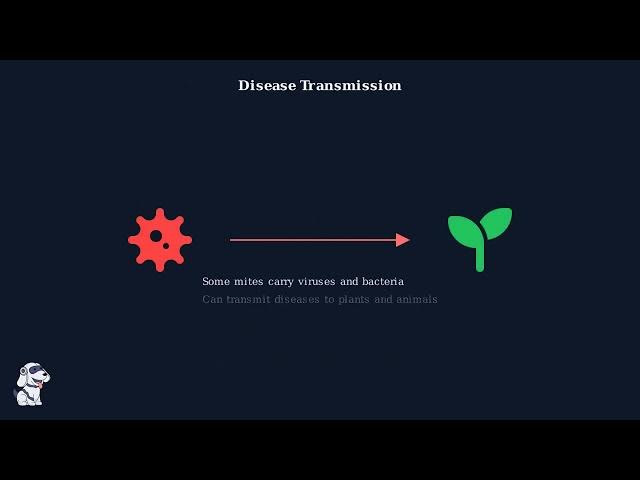
Beyond direct feeding damage, some might
11:20
serve as vectors for plant and animal
11:22
diseases. They can carry viruses,
11:25
bacteria, and other pathogens from
11:27
infected hosts to healthy ones,
11:29
spreading disease throughout crops and
11:31
ecosystems.
11:33
This image shows more severe might
11:35
damage with extensive white spotting
11:37
across the leaf surface. Such
11:39
infestations can devastate entire crops,
11:42
leading to billions of dollars in
11:44
agricultural losses worldwide each year.
11:48
The key takeaway is that harmful mites
11:50
represent a significant threat to
11:52
agriculture and human welfare. Spider
11:55
mites alone cause billions in crop
11:57
losses each year through direct feeding
11:59
damage and disease transmission.
12:02
Understanding these threats is the first
12:04
step toward effective management and
12:06
control. Mites may be tiny, but their
12:09
impact on agriculture and our economy is
12:11
enormous. Understanding why these small
12:14
creatures matter so much to farmers and
12:16
consumers worldwide is crucial for
12:19
appreciating their true significance.
12:21
Harmful mites cause devastating economic
12:24
losses in agriculture. Plantfeeding
12:26
mites like spidermitites damage crops by
12:29
sucking plant juices, causing yellowing,
12:31
stunted growth, and reduced yields. The
12:34
global meticides market alone is worth
12:36
$1.6 billion annually, reflecting the
12:39
massive scale of this problem. This
12:42
dramatic field comparison shows the real
12:44
world impact of spidermitites. The
12:47
healthy green rows were treated with
12:49
mitoides while the devastated center row
12:51
was left untreated. This single example
12:54
demonstrates how mites can destroy over
12:57
30% of a crop's yield, translating to
12:59
massive financial losses for farmers.
13:03
But mites aren't all bad news for
13:04
agriculture. Beneficial predatory mites
13:07
are economic heroes, saving farmers
13:10
millions of dollars annually. These
13:12
natural pest controllers can reduce
13:14
pesticide costs by 40 to 60% while
13:17
maintaining or even improving crop
13:19
yields. The North American beneficial
13:22
insect market alone exceeds $300
13:24
million.
13:26
Spider deserve special attention as one
13:29
of agricultur's most costly pests. These
13:32
tiny arachnids attack over 200 different
13:35
crop species from fruits and vegetables
13:37
to field crops. Their rapid reproduction
13:40
rate means populations can explode
13:42
quickly causing severe economic damage
13:45
before farmers even notice the problem.
13:48
The economic importance of mites cannot
13:50
be overstated. While harmful mites cost
13:53
agriculture billions of dollars annually
13:55
through crop losses and control
13:57
measures, beneficial mites provide
13:59
valuable ecosystem services that save
14:02
farmers money and reduce environmental
14:04
impact. Understanding this dual nature
14:07
of mites is essential for making
14:09
informed agricultural decisions and
14:12
ensuring global food security. Managing
14:14
harmful mites is essential for
14:16
protecting our crops and health. These
14:18
tiny creatures may be small, but they
14:21
can cause enormous problems if left
14:23
unchecked.
14:24
There are four main strategies for
14:26
managing mites. Biological control using
14:29
natural enemies, cultural practices like
14:31
crop rotation, physical removal methods,
14:34
and chemical control with mitoides.
14:37
Biological control uses nature's own
14:40
predators. Predatory mites are excellent
14:42
hunters that feed on harmful pest mites,
14:45
providing natural population control
14:47
without chemicals.
14:49
Cultural practices focus on prevention.
14:52
Crop rotation disrupts might life
14:54
cycles, while good sanitation removes
14:56
their hiding places. These simple
14:58
practices can dramatically reduce might.
15:02
Chemical control uses mitoicides to kill
15:05
harmful mites. While effective,
15:07
chemicals should be used as a last
15:09
resort and always according to label
15:11
instructions to prevent resistance and
15:14
protect beneficial insects.
15:16
Integrated pest management combines all
15:18
control methods in a strategic
15:20
hierarchy. Start with prevention and
15:22
cultural practices. Add biological
15:25
control when needed and use chemicals
15:27
only as a last resort. This approach is
15:30
most effective and sustainable.
15:33
Remember these key points. Prevention is
15:35
your best defense. Biological control
15:38
offers sustainable solutions. Integrated
15:41
pest management combines all methods
15:43
effectively. And chemical control should
15:45
be used responsibly to prevent
15:47
resistance. With these strategies, you
15:49
can successfully manage harmful mites
15:52
while protecting beneficial ones.
15:54
Biological control is nature's own pest
15:57
management system. Instead of using
15:59
chemicals, we harness the power of
16:01
natural enemies to control harmful
16:03
might.
16:05
The idea is simple. We introduce
16:07
beneficial predatory mites that
16:09
naturally hunt and feed on the harmful
16:11
pest mites. It's like having a
16:13
biological security team protecting our
16:16
crops.
16:17
Here we can see predatory mites up
16:19
close. These tiny hunters are incredibly
16:22
effective at controlling pest
16:23
populations. They're fastmoving,
16:26
specialized for hunting, completely safe
16:28
for the environment, and can establish
16:30
self-sustaining populations.
16:33
This image shows biological control of
16:35
spidermitites in action. The major
16:37
benefits include dramatically reducing
16:40
chemical pesticide use, providing an
16:42
environmentally sustainable solution,
16:45
offering cost-effective long-term
16:47
control, and eliminating pesticide
16:49
resistance problems.
16:52
Two of the most successful biological
16:54
control agents are phytoceulus pimileus
16:57
which specifically targets spidermitites
16:59
and is widely used commercially and
17:01
neoilus calapernicus which thrives in
17:04
hot climates and can control multiple
17:06
pest species while being drought
17:08
tolerant.
17:10
The key takeaways are that biological
17:13
control harnesses natural enemies to
17:15
manage pests, provides an eco-friendly
17:17
alternative to chemical pesticides, and
17:20
offers sustainable long-term control
17:22
that works with nature rather than
17:23
against it.
17:27
Cultural control represents one of the
17:29
most coste effective and sustainable
17:31
approaches to might prevention. These
17:34
are simple farming practices that create
17:36
unfavorable conditions for mites while
17:39
promoting healthy crop growth. Cultural
17:41
control focuses on prevention rather
17:43
than treatment. It's cost effective,
17:46
reduces the need for chemical
17:48
interventions, improves overall crop
17:50
health, and is environmentally friendly.
17:53
Crop rotation is one of the most
17:55
effective cultural control methods. By
17:58
changing the types of crops grown in a
17:59
field, we disrupt might life cycles and
18:02
remove their preferred food sources.
18:05
This diagram shows how crop rotation
18:07
effectiveness increases when dealing
18:08
with host specific non-mobile pests.
18:12
Proper irrigation management is crucial
18:14
for might prevention. Both largecale
18:17
systems like center pivot irrigation and
18:20
manual watering methods can be optimized
18:22
to reduce might friendly conditions. Key
18:25
irrigation practices include avoiding
18:27
overhead watering when possible,
18:29
watering in early morning to reduce
18:31
humidity buildup, ensuring proper
18:33
drainage, and monitoring soil moisture
18:35
levels to prevent both drought stress
18:37
and water logging.
18:40
Field sanitation is essential for
18:42
breaking might reproduction cycles. A
18:45
clean field environment removes hiding
18:47
places and breeding sites for mites,
18:50
while neglected fields provide ideal
18:52
conditions for mite populations to
18:53
thrive. Key sanitation practices include
18:56
removing crop debris after harvest,
18:59
controlling weeds that can harbor mites,
19:02
cleaning equipment when moving between
19:03
fields, and properly destroying any
19:06
infested plant material.
19:08
Cultural control offers three key
19:10
advantages. Prevention is always better
19:13
than treatment. Simple farming practices
19:15
can make significant differences in
19:17
might populations and these methods
19:19
provide a cost-effective and sustainable
19:22
approach to pest management. Remember,
19:25
cultural control methods work best when
19:27
combined with other integrated pest
19:29
management strategies for comprehensive
19:32
and effective might control. Chemical
19:35
control using mitoicides represents the
19:37
most direct approach to might
19:38
management, but it should always be
19:40
considered a last resort in integrated
19:43
pest management strategies.
19:45
Chemical control involves using
19:47
specialized pesticides called mitoides
19:50
to kill or control might. When might
19:53
infestations become severe and cause
19:55
significant crop damage, chemical
19:56
intervention may become necessary.
20:00
Chemical control should always be the
20:02
last resort in might management. The
20:05
preferred approach follows a hierarchy.
20:07
First prevention and cultural control,
20:10
then biological control. And only when
20:12
these methods fail should chemical
20:14
control be considered.
20:17
Chemical control carries significant
20:18
risks. Mitoices can kill beneficial
20:21
predatory mites and harm pollinators and
20:24
other natural enemies. Overuse can lead
20:26
to might resistance, making future
20:28
control more difficult and may cause
20:30
secondary pest outbreaks when natural
20:32
predators are eliminated.
20:36
Responsible use of mitoides is crucial
20:38
for effective and sustainable control.
20:41
Always read and follow label
20:43
instructions carefully. Apply at the
20:45
right time and rate. Rotate between
20:47
different mitoide classes to prevent
20:49
resistance and monitor for both
20:52
effectiveness and signs of resistance
20:54
development.
20:56
New mitoide technologies are being
20:57
developed for 2025. Vakenda insecticide
21:01
featuring plenazzin technology with the
21:03
active ingredient isocycloseram offers
21:06
broadspectctrum control of mites, thris
21:08
and other pests. Other new products
21:11
expected include shuttle mitoide,
21:13
fluoromite mitoicide, and hexel ew,
21:15
providing more options for resistance
21:17
management.
21:19
Remember these key takeaways about
21:21
chemical control. Use mitoicides only as
21:24
a last resort. Always follow label
21:26
instructions carefully. Rotate between
21:29
different mitoicide classes to prevent
21:31
resistance. Protect beneficial insects
21:33
and natural enemies. And take advantage
21:35
of new technologies for improved control
21:38
options. Responsible use protects both
21:40
crops and ecosystems. Mites are
21:43
incredibly small creatures, but they're
21:45
remarkably good at getting around.
21:48
Understanding how mites spread from
21:50
place to place is essential for
21:52
preventing infestations and managing
21:54
these tiny arachnids effectively. There
21:57
are three main natural ways that might
21:59
spread through the environment. Wind,
22:01
water, and animals. Each method allows
22:04
these tiny creatures to colonize new
22:06
areas and find fresh resources. Wind
22:08
dispersal is the most common way mites
22:11
travel long distances. These lightweight
22:14
creatures can be carried by air currents
22:15
for miles, allowing them to reach new
22:18
host plants or suitable habitats far
22:20
from their original location. Water
22:23
dispersal occurs when mites are carried
22:25
by rain, irrigation water, or flooding.
22:28
This method is particularly important
22:30
for soil dwelling mites and those living
22:32
on plants that get watered regularly.
22:34
Animal dispersal, also called forcy,
22:37
happens when mites attach themselves to
22:39
larger animals like birds, insects, or
22:41
mammals. The mites hitchhike to new
22:43
locations, then drop off when they find
22:46
suitable conditions. Humans also play a
22:48
major role in might transmission. Mites
22:51
can attach to our clothing, tools, and
22:53
equipment, allowing them to travel much
22:55
farther than they could naturally. This
22:57
is how many agricultural pests spread
23:00
between farms. Plant material is another
23:03
major pathway for might transmission.
23:05
When we move plants, seeds or plant
23:07
products from one location to another,
23:10
we can accidentally transport mites
23:12
along with them. This is why quarantine
23:14
procedures are so important in
23:16
agriculture. Understanding might
23:18
transmission is crucial for prevention.
23:21
By knowing how might spread, we can take
23:23
steps to break the transmission cycle.
23:26
This includes quarantining new plants,
23:28
cleaning equipment between uses, and
23:30
monitoring for early signs of
23:32
infestation. Key takeaway: MIT are
23:35
excellent travelers despite their tiny
23:37
size. They use wind, water, animals, and
23:40
human activities to spread to new
23:42
locations. By understanding these
23:44
transmission pathways, we can better
23:46
prevent and control might infestations
23:48
in agriculture and other settings. Mites
23:51
may be tiny, but they play enormous
23:53
roles in ecosystems around the world.
23:55
These microscopic arachnids serve as
23:57
decomposers, predators, and parasites,
24:00
making them integral components of
24:02
environmental food webs. Mites fulfill
24:05
three primary ecological roles in their
24:08
environments. They act as decomposers,
24:10
breaking down organic matter. They serve
24:12
as predators, controlling populations of
24:14
other small organisms, and they function
24:17
as parasites, feeding on larger host
24:19
animals.
24:22
As decomposers, mites are nature's
24:25
recycling crew. They break down leaf
24:27
litter, dead plant material, and organic
24:29
debris, processing this matter and
24:32
releasing essential nutrients back into
24:34
the soil. This nutrient cycling is
24:36
fundamental to healthy ecosystems.
24:39
Predatory mites are skilled hunters that
24:41
feed on smaller insects, other mites,
24:44
and tiny arthropods. They help control
24:46
pest populations naturally, maintaining
24:49
ecological balance. Many predatory mites
24:52
are so effective that they're used as
24:53
biological control agents in
24:55
agriculture.
24:57
Parasitic mites live on or inside host
25:00
animals, feeding on blood, skin, or
25:02
other tissues. While they can affect
25:04
their host's health and behavior, they
25:06
also serve as a form of natural
25:08
population control, preventing any
25:10
single species from becoming too
25:12
dominant in an ecosystem.
25:15
Mites are integral to food webs,
25:17
connecting multiple trophic levels and
25:20
facilitating energy transfer throughout
25:22
ecosystems. They support biodiversity by
25:25
providing food for larger predators
25:27
while controlling populations of their
25:29
own prey species, helping maintain
25:31
overall ecosystem stability.
25:34
Despite their tiny size, mites are
25:36
ecological powerhouses. Whether breaking
25:39
down organic matter, controlling pest
25:41
populations, or regulating host species,
25:44
mites demonstrate that even the smallest
25:46
creatures can have enormous
25:47
environmental impact. Understanding
25:50
their roles helps us appreciate the
25:51
intricate balance of natural ecosystems.
25:55
Stored products like grains, flour, and
25:58
dried fruits provide essential nutrition
26:00
for billions of people worldwide.
26:02
However, these valuable food supplies
26:04
face a hidden threat that can cause
26:06
significant economic losses and food
26:08
spoilage. Mites are microscopic
26:10
arachnids that can infest stored food
26:13
products, causing contamination,
26:15
spoilage, and significant economic
26:17
losses. These tiny creatures are often
26:20
invisible to the naked eye, but can
26:22
multiply rapidly under the right
26:24
conditions. Common stored product mites
26:26
include flower mites, grain mites, and
26:29
cheese mites. These species thrive in
26:31
environments with high moisture content,
26:33
warm temperatures, and abundant food
26:35
sources like cereals, nuts, and
26:37
processed foods. Mites reproduce rapidly
26:40
in stored products, going through their
26:42
complete life cycle from egg to adult in
26:45
just 2 to 4 weeks under optimal
26:47
conditions. A single female can lay
26:50
dozens of eggs, leading to explosive
26:52
population growth. Signs of might
26:54
infestation include a sweet musty odor,
26:57
fine webbing on product surfaces, and
27:00
visible movement of tiny specks in the
27:02
stored food. Infested products may also
27:04
show clumping, discoloration, and
27:06
reduced nutritional quality. Proper
27:08
storage practices are essential for
27:10
preventing might infestations. This
27:12
includes maintaining low moisture
27:14
levels, controlling temperature,
27:16
ensuring proper ventilation, and using
27:19
appropriate storage containers with
27:21
tight fitting lids. Sanitation is
27:24
equally important in preventing might
27:26
infestations. Regular cleaning of
27:28
storage areas, proper handling
27:30
procedures, and maintaining hygiene
27:32
standards help eliminate conditions that
27:34
favor might development and
27:36
reproduction. The economic impact of
27:39
stored product mites is substantial with
27:41
losses reaching millions of dollars
27:43
annually in the food industry.
27:45
Prevention through proper storage and
27:47
sanitation is far more cost-effective
27:50
than dealing with contaminated products
27:52
after infestation occurs. Key takeaways
27:55
for protecting stored products from
27:57
mites include maintaining proper storage
28:00
conditions, implementing regular
28:02
sanitation practices, conducting
28:04
frequent inspections, and taking
28:06
immediate action when signs of
28:08
infestation are detected. Prevention is
28:11
always better than treatment. Spider
28:13
mites are among the most common and
28:15
destructive agricultural pests
28:17
worldwide. Despite being incredibly
28:19
tiny, these arachnids can cause
28:21
devastating damage to crops and plants.
28:24
Spidermites are incredibly small,
28:27
measuring only about half a millimeter
28:29
in length. To put this in perspective,
28:31
they're much smaller than the width of a
28:33
human hair and nearly invisible to the
28:36
naked eye. Here we can see what
28:38
spidermitites actually look like on a
28:40
plant leaf. They appear as tiny white
28:42
and orange specks scattered across the
28:45
leaf surface. Individual mites are
28:47
barely visible, but they often gather in
28:50
large colonies that become more
28:51
noticeable. This image shows the
28:54
characteristic webbing that
28:55
spidermitites produce.
28:57
These fine silken webs
29:00
are often the first sign that alerts
29:02
farmers and gardeners to a spidermite
29:04
infestation. When you see webbing like
29:07
this, it usually indicates a heavy
29:09
infestation. Spider mites damage plants
29:12
by feeding on plant sap. They use their
29:14
needle-like mouth parts to pierce
29:16
individual leaf cells and suck out the
29:18
contents, including chlorophyll. This
29:21
feeding creates characteristic yellow or
29:23
brown stippled spots on leaves. As the
29:26
infestation progresses, the cumulative
29:28
damage from thousands of feeding sites
29:31
causes leaves to turn yellow, bronze, or
29:33
brown. Severely damaged leaves may drop
29:36
prematurely, reducing the plant's
29:38
ability to photosynthesize and
29:40
ultimately affecting crop yields. Here
29:42
are the key takeaways about
29:43
spidermitites. First, always look for
29:46
fine webbing as the primary sign of
29:48
infestation. Second, watch for yellow
29:51
stippling and bronzing on leaves, which
29:53
indicates feeding damage. Third, their
29:56
small size makes early detection
29:58
challenging but absolutely crucial for
30:00
effective management. Finally, remember
30:03
that spidermitites can cause significant
30:05
crop yield losses if left untreated,
30:08
making them one of agricultur's most
30:10
important pest concerns. Veroa mites
30:12
represent one of the most serious
30:14
threats facing honeybee colonies
30:16
worldwide. These tiny parasites have
30:18
devastated bee populations and continue
30:21
to challenge beekeepers and researchers
30:23
alike.
30:25
Veroa destructor is a reddish brown
30:27
oval-shaped might about 1 to 2 mm in
30:29
size. Originally parasites of Asian
30:32
honeybees, they jump to European
30:34
honeybees and spread globally, becoming
30:37
external parasites that attach to adult
30:39
bees and their developing larve.
30:42
Veroamites have a complex life cycle
30:45
that takes place within honeybee
30:47
colonies. Adult female mites enter brood
30:50
cells just before they are sealed where
30:53
they feed on developing bee larvae and
30:55
reproduce. The mites emerge with the
30:57
adult bees and can spread to other parts
30:59
of the colony or even other colonies.
31:03
Beyond just feeding on bee larve, veroa
31:05
act as vectors for several deadly
31:07
viruses. They transmit deformed wing
31:10
virus, Israeli acute paralysis virus and
31:12
black queen cell virus. These diseases
31:16
weaken immune systems, cause physical
31:18
deformities, and can lead to complete
31:20
colony collapse disorder.
31:23
Traditional control methods include
31:24
chemical mitoides like amitra and
31:27
organic acids, but mites are developing
31:29
resistance. New research focuses on
31:32
resistance breaking compounds, pheromone
31:34
traps, breeding naturally resistant bee
31:37
lines, and even RNA interference
31:39
technology to target might genes without
31:42
harming bees.
31:44
Veroa mites represent the number one
31:46
threat to honeybee colonies worldwide.
31:49
They transmit deadly viruses that cause
31:51
colony collapse disorder, but new
31:54
research offers hope for better control
31:56
methods. Integrated management
31:58
approaches combining multiple strategies
32:00
are essential for protecting bee health
32:03
and ensuring pollination services for
32:05
our food systems. Mites don't just
32:07
affect plants and animals. They can also
32:09
impact human health in significant ways.
32:12
Some mites cause allergies while others
32:15
can transmit diseases or cause skin
32:17
conditions. House dust mites are
32:19
microscopic creatures that live in our
32:21
homes and are one of the most common
32:23
causes of indoor allergies. These tiny
32:26
mites feed on dead skin cells that
32:29
humans naturally shed every day. When
32:31
people are allergic to dust mites, they
32:33
experience a range of symptoms including
32:35
sneezing, runny nose, itchy eyes,
32:38
coughing, and even asthma attacks. These
32:41
reactions occur when the immune system
32:43
overreacts to mite proteins. House dust
32:45
mites thrive in warm, humid environments
32:48
and are commonly found in bedding,
32:50
carpets, and upholstered furniture where
32:53
they have access to their food source,
32:55
our dead skin cells. To understand how
32:57
mites affect human health, we need to
32:59
look at human skin structure. Our skin
33:02
has multiple layers, including the
33:04
epidermis, dermis, hair follicles, and
33:07
sebaceous glands. Some mites can
33:09
penetrate the skin through hair
33:10
follicles or create burrows in the outer
33:13
skin layer. They may feed on skin cells,
33:16
oils from sebaceous glands, or even
33:18
blood from small vessels in the dermis.
33:21
Scabes is a skin condition cause caused
33:23
by the sarcoptus scabite. These
33:25
microscopic mites burrow into the skin
33:28
causing intense itching and a
33:29
characteristic rash with red ring-shaped
33:32
lesions. Scabies is transmitted through
33:34
direct prolonged skin-to-skin contact
33:37
with an infected person. The condition
33:40
causes severe itching, especially at
33:42
night, and requires prescription
33:44
medication for treatment. Scabies is
33:46
highly contagious and can spread rapidly
33:49
in close contact environments like
33:50
nursing homes or schools. Anyone
33:53
experiencing persistent itching and skin
33:55
rashes should seek medical attention
33:58
promptly. For dustmite allergies,
34:00
Aarisax is a breakthrough treatment that
34:02
has recently been approved for use in
34:04
children as young as 5 years old. This
34:07
sublingual imunotherapy tablet is placed
34:10
under the tongue. Aizex works by
34:12
gradually exposing the immune system to
34:15
small amounts of dustmite allergens,
34:17
helping the body build tolerance over
34:19
time. This can significantly reduce
34:22
allergy symptoms and improve quality of
34:24
life. It's important to remember that
34:26
any might related health condition
34:28
should be properly diagnosed and treated
34:30
by health care professionals. Never
34:33
attempt to self-dagnose or self-t treat
34:35
these conditions.
34:37
Prevention is the best approach for
34:39
avoiding might related health problems.
34:42
Good hygiene and proper sanitation
34:44
practices can significantly reduce your
34:46
exposure to harmful mites. Wash bedding
34:49
weekly in hot water at least 130° F to
34:52
kill dust mites. Vacuum carpets and
34:55
upholstered furniture regularly using a
34:57
HEPA filter if possible. Keep indoor
35:00
humidity below 50% as mites thrive in
35:03
humid conditions.
35:05
Practice good personal hygiene,
35:07
including regular handashing, especially
35:09
after contact with potentially
35:10
contaminated surfaces. Understanding the
35:13
relationship between mites and human
35:15
health, helps us protect ourselves and
35:18
our families. While some mites cause
35:20
allergies and diseases, proper
35:22
prevention and treatment can effectively
35:25
manage these health risks. Different
35:27
might species have evolved to specialize
35:29
in attacking specific crops.
35:32
Understanding which mites affect which
35:33
plants is essential for effective
35:36
agricultural management. Citrus crops
35:38
face attacks from several specialized
35:41
might species. The citrus red might and
35:43
citrus rustmite are particularly
35:46
problematic causing leaf stippling,
35:48
fruit scarring, and significant quality
35:50
reduction in oranges, lemons, and other
35:52
citrus fruits. Sugar cane faces
35:54
significant threats from broad mites and
35:56
spidermitites. These tiny pests cause
35:59
leaf curling, distortion, and can
36:01
dramatically reduce the sugar content of
36:03
the cane, directly impacting the
36:06
economic value of the crop. Coffee
36:08
plants are vulnerable to several might
36:10
species, including the coffee berry
36:12
might, which directly attacks the coffee
36:14
berries. These pests can cause berry
36:17
deformation, reduce bean quality, and
36:19
significantly impact coffee yields and
36:22
flavor profiles. Tea plants suffer from
36:25
attacks by tea red spidermitites and
36:27
purple mites. These pests cause leaf
36:29
bronzing, reduce the quality of tea
36:32
leaves, and can alter the delicate
36:34
flavor compounds that make highquality
36:36
tea so valuable. Understanding crop
36:38
specific might problems is crucial for
36:41
effective management. Each crop requires
36:44
tailored monitoring and control
36:45
strategies based on the specific might
36:47
species that attack it. This knowledge
36:50
helps farmers protect their crops more
36:53
efficiently and economically. The field
36:55
of might control is rapidly evolving
36:57
with exciting new developments in 2024
37:00
and 2025.
37:02
Scientists and researchers are
37:04
introducing innovative solutions that
37:06
are more effective, sustainable, and
37:08
environmentally friendly than ever
37:10
before.
37:12
New chemical solutions are leading the
37:14
charge in might control innovation.
37:16
Plenazylin technology marketed as vica
37:19
insecticide offers broadspectctrum
37:21
control against mites and thris.
37:24
Plant-based mitoicides using essential
37:26
oils like peppermint and rosemary are
37:28
gaining popularity for their safety and
37:31
effectiveness.
37:33
Biological control is experiencing
37:35
remarkable breakthroughs. Scientists
37:37
have discovered elicitor proteins called
37:39
TET 3 and TET 4 in spidermite saliva
37:42
that can enhance plant defense
37:44
responses. Meanwhile, Phytolus
37:47
represents an innovative breeding system
37:49
for predatory mites that provides faster
37:51
and more effective pest control.
37:54
Technology integration is
37:56
revolutionizing might management.
37:59
Internet of Things devices and smart
38:01
sensors enable realtime monitoring,
38:03
while satellite detection systems can
38:06
identify might infestations early.
38:08
Artificial intelligence and precision
38:09
agriculture techniques allow for
38:11
targeted treatments that reduce chemical
38:13
usage while improving effectiveness.
38:18
The might control market is experiencing
38:20
significant growth valued at $1.6
38:22
billion in 2024 with a projected annual
38:26
growth rate of 4.2%.
38:28
Future trends include nanotechnology
38:31
applications, climate change adaptation
38:33
strategies, and increasingly sustainable
38:36
integrated pest management approaches.
38:40
Recent advances in might control
38:42
represent a paradigm shift toward more
38:44
sustainable, effective, and intelligent
38:46
pest management. From plant-based
38:49
mitoicides to AI powered monitoring
38:51
systems, these innovations are
38:53
transforming how we protect crops and
38:55
manage might populations while
38:57
minimizing environmental impact. The
38:59
future of might management is shifting
39:01
toward sustainable and eco-friendly
39:03
approaches that protect both crops and
39:06
the environment.
39:07
Traditional heavy reliance on chemical
39:09
pesticides is giving way to smarter,
39:12
more balanced strategies. Modern might
39:14
management follows an integrated
39:16
approach that prioritizes methods based
39:19
on their environmental impact. This
39:22
pyramid shows how prevention and
39:23
cultural practices form the foundation
39:26
while chemical control is used only as a
39:28
last resort. Biological control is
39:31
experiencing remarkable advances.
39:33
Scientists are discovering new predatory
39:35
mites, improving breeding systems for
39:37
beneficial insects, and developing
39:39
innovative elicitor proteins that
39:41
enhance plant defenses naturally.
39:44
Cultural practices form the foundation
39:46
of sustainable might management. These
39:49
simple but effective methods include
39:51
using healthy transplants, avoiding
39:54
water stress, and maintaining proper
39:56
growing conditions to prevent might
39:57
outbreaks naturally. Precision
40:00
agriculture is revolutionizing might
40:02
management through smart technology.
40:05
Satellite monitoring, IoT sensors, and
40:07
AI powered systems enable early
40:09
detection and targeted treatment,
40:11
reducing pesticide use while improving
40:13
effectiveness. The future holds exciting
40:15
developments including nanotechnology
40:17
applications, climate adaptive
40:19
strategies, and circular economy
40:21
principles. These approaches will
40:24
minimize environmental impact while
40:26
maintaining effective pest control,
40:28
creating a sustainable balance between
40:30
agriculture and ecology. Integrated pest
40:34
management or IPM represents a
40:36
revolutionary approach to controlling
40:37
mites and other agricultural pests.
40:40
Rather than relying solely on chemical
40:42
pesticides, IPM combines multiple
40:45
strategies to create a sustainable
40:47
ecosystemfriendly solution. IPM follows
40:50
a clear hierarchy of control methods
40:52
visualized as a pyramid. At the
40:54
foundation is prevention, stopping pest
40:57
problems before they start. Moving up,
40:59
we have cultural and sanitation
41:01
practices, then physical and mechanical
41:04
controls, followed by biological
41:06
methods. Chemical pesticides sit at the
41:08
top, used only when other methods aren't
41:10
sufficient. IPM follows a systematic
41:13
five-step process. First, prevention
41:16
focuses on creating conditions that
41:18
discourage pest establishment. Second,
41:21
regular monitoring helps detect problems
41:23
early. Third, proper identification
41:25
ensures we target the right organisms.
41:28
Fourth, action thresholds help determine
41:30
when intervention is economically
41:32
justified.
41:33
Finally, direct control applies the most
41:36
appropriate management strategy for the
41:37
situation. IPM offers numerous
41:39
advantages over traditional pest control
41:42
approaches. It reduces the development
41:44
of pesticide resistance by using
41:46
multiple control methods. It protects
41:48
beneficial organisms like predatory
41:50
mites and parasitic wasps that naturally
41:53
control pests. IPM minimizes
41:56
environmental contamination and is more
41:58
cost effective in the long run. Most
42:00
importantly, it creates a sustainable
42:03
system that can be maintained for future
42:05
generations. The key takeaways from IPM
42:08
are clear. First, prevention is always
42:11
better than reaction. Stopping pest
42:13
problems before they develop saves time,
42:15
money, and environmental damage. Second,
42:18
regular monitoring and early detection
42:20
are essential for IPM success. Third,
42:24
using multiple complimentary methods is
42:26
more effective than relying on any
42:27
single approach. Finally, IPM preserves
42:30
ecosystem health by working with natural
42:32
processes rather than against them,
42:34
creating a truly sustainable approach to
42:37
pest management. After exploring the
42:39
fascinating world of mites, let's
42:41
summarize the key takeaways about these
42:43
remarkable tiny creatures and their
42:45
enormous impact on our world.
42:48
First, mites are incredibly diverse
42:50
arachnids with complex body structures.
42:53
Despite being smaller than a pin head,
42:55
they have sophisticated anatomy
42:57
perfectly adapted to their environments.
42:59
Second, mites play crucial roles in
43:01
ecosystems. They serve as decomposers,
43:04
breaking down organic matter, and as
43:06
predators that help control other pest
43:07
populations naturally. Third, mites have
43:10
enormous agricultural significance.
43:12
While some species cause billions of
43:14
dollars in crop damage annually, others
43:17
serve as valuable biological control
43:19
agents, protecting our food supply.
43:22
Fourth, mites significantly impact human
43:24
and animal health. They cause allergies,
43:27
skin conditions, and can transmit
43:29
diseases, making their management
43:31
essential for public health. Fifth,
43:33
effective might management requires
43:35
integrated approaches. Combining
43:37
biological control, cultural practices,
43:40
and targeted chemical treatments provide
43:42
sustainable solutions for the future.
43:44
The key message is clear. Despite their
43:46
tiny size, mites have an enormous impact
43:49
on our world. Understanding their
43:51
biology, ecology, and management is
43:53
crucial for protecting our crops,
43:55
health, and environment. Keep watching
43:57
for these tiny titans in your daily
44:00
life.
#Science
#Biological Sciences
#Ecology & Environment