Up next in 10

The Three Domains of Life Explained
In this enlightening video, we delve into the Three Domains of Life, a fundamental classification system that categorizes all living organisms into Archaea, Bacteria, and Eukarya. We will explore the unique characteristics that define each domain, their evolutionary significance, and the role they play in the ecosystem. Join us as we uncover the complexities of life on Earth and the interconnections between these domains. Whether you are a student, educator, or simply curious about biology, this video will enhance your understanding of life's diversity. Don't forget to like, share, and subscribe for more insightful content! #ThreeDomains #BiologyExplained #LifeOnEarth
Website: https://biologynotesonline.com/
Facebook: https://www.facebook.com/biologynotesonline
Instagram: https://www.instagram.com/biologynotesonline/?hl=en
three domains of life,four domains of the earth,the three domains of life,three domains of life in biology,biology - three domains of life,three domains of life proposed by,3 domains of life,three domains of life characteristics,domains of the earth,what are the domains of the earth?,3 domains of life biology,three domain system of classification,domains,domains explained,domains of life,domains and kingdoms of life,three domains of live
Show More Show Less View Video Transcript
0:00
the classification of life on Earth has
0:02
evolved dramatically over time
0:04
culminating in our modern understanding
0:06
of the three domains of
0:08
life all living organisms are now
0:10
classified into three fundamental
0:12
domains bacteria archa and
0:15
ukaria this classification system
0:18
represents a significant evolution in
0:20
our understanding of life replacing
0:22
earlier systems that sorted organisms
0:25
primarily by observable characteristics
0:28
the three domain system replaced the
0:30
previous two kingdom system which had
0:33
simply divided life into plants and
0:35
animals missing the vast diversity of
0:37
microbial
0:39
life unlike earlier systems based on
0:42
visual characteristics the three domain
0:44
classification is founded on genetic and
0:46
cellular differences primarily the
0:49
sequences in ribosomal RNA and
0:51
fundamental cellular structures
0:54
this classification system proposed by
0:56
Carl Wos and George Fox in 1977
1:00
revolutionized our understanding of life
1:02
on Earth by recognizing the distinct
1:04
nature of archa previously confused with
1:07
bacteria and revealing unexpected
1:09
evolutionary
1:12
relationships in this section we'll
1:14
explore the historical development of
1:16
the three domain system a major paradigm
1:18
shift in biological
1:20
classification before 1977 scientists
1:24
classified all living organisms into
1:26
just two categories proariots which
1:28
lacked a nucleus and ukarotes which had
1:31
a distinct
1:32
nucleus in 1977 microbiologist Carl
1:36
Richard Wos made a groundbreaking
1:38
discovery by analyzing the 16S ribosomal
1:41
RNA sequences of various microorganisms
1:44
Wos discovered that certain procarots
1:46
were fundamentally different from others
1:49
wos's molecular analysis revealed that
1:51
these unique proarots which he named
1:54
archabacteria later shortened to archa
1:57
were as different from bacteria as
1:59
bacteria were from
2:01
ukareotes this discovery led to a major
2:04
paradigm shift in how we classify life
2:06
wos proposed a new three domain system
2:09
consisting of bacteria archa and ukaria
2:12
replacing the traditional two-dain
2:14
system
2:17
initially WOS's three domain system
2:19
faced significant skepticism from the
2:21
scientific community however as more
2:24
molecular evidence accumulated
2:26
throughout the 1980s the validity of
2:28
archa as a distinct domain became
2:30
increasingly clear by 1990 the three
2:34
domain system had gained widespread
2:36
acceptance and is now considered the
2:38
standard paradigm in biological
2:40
classification
2:42
this revolutionary change in our
2:44
understanding of life's diversity stands
2:46
as one of the most significant shifts in
2:48
biological thinking of the 20th
2:52
century domain bacteria contains
2:55
proarotic organisms with simple but
2:57
efficient cellular structures bacteria
3:00
are proarotes characterized by cells
3:02
without a true nucleus or membrane bound
3:04
organels
3:06
a defining feature of bacteria is their
3:09
cell wall containing peptidoglycin a
3:12
unique polymer not found in other
3:14
domains bacterial genetic material
3:17
consists of a single circular chromosome
3:19
located in the nucleoid region without
3:21
being a nuclear
3:24
membrane many bacteria move using
3:27
fleella which are simple protein
3:29
structures that rotate like propellers
3:32
bacteria display remarkable
3:34
morphological diversity including
3:36
spherical coxy rod-shaped bacilli and
3:39
spiral sporilla
3:40
forms ecologically bacteria play vital
3:43
roles as decomposers nitrogen fixers and
3:46
both beneficial and pathogenic species
3:48
as decomposers they break down organic
3:51
matter nitrogen fixers convert
3:53
atmospheric nitrogen into forms plants
3:55
can use some species benefit our health
3:58
while others cause diseases
4:01
domain archa consists of proaryotic
4:03
organisms that often inhabit some of the
4:06
most extreme environments on Earth archa
4:09
are known as extreophiles because they
4:11
can thrive in conditions that would be
4:13
lethal to most other life
4:15
forms thermophiles are heatloving archa
4:18
that can survive in temperatures up to
4:20
122° C often found in hot springs and
4:24
hydrothermal vents halifiles thrive in
4:27
extremely salty environments with
4:29
concentrations greater than two molar
4:31
sodium chloride such as salt lakes and
4:33
the Dead Sea acidophiles can survive in
4:36
highly acidic environments with pH
4:38
values below three like acidic hot
4:40
springs and mine drainage methanogens
4:43
produce methane as a metabolic byproduct
4:46
and are often found in anorobic
4:48
environments like swamps and the
4:49
digestive tracts of animals one key
4:52
adaptation that allows archa to survive
4:55
in these extreme environments is their
4:57
unique membrane composition unlike
5:00
bacteria and ukarotes which have esester
5:02
linkages in their membrane lipids archa
5:05
have ether linkages between their lipid
5:07
and glycerol components these ether
5:10
linkages make archal cell membranes more
5:12
resistant to extreme temperatures high
5:14
salinity and acidic conditions despite
5:17
their proarotic cell structure archa
5:19
show surprising similarities to ukareots
5:22
at the molecular level one major example
5:25
is their RNA polymerase machinery
5:27
bacteria have a single RNA polymerase
5:30
while both archa and ukarotes have
5:32
multiple RNA polymerases the structure
5:34
and complexity of archal RNA polymerases
5:37
closely resembles those found in
5:39
ukarotes suggesting an evolutionary
5:42
relationship between these domains these
5:44
unique molecular features of archa have
5:46
led scientists to recognize them as a
5:49
distinct domain of life separate from
5:51
both bacteria and ukariots the domain
5:54
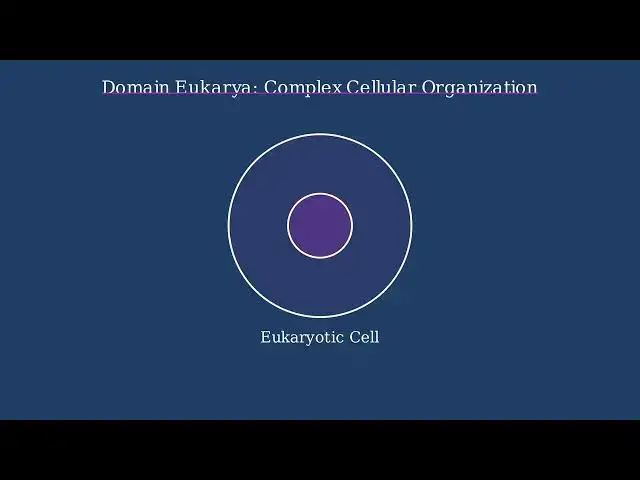
ukaria encompasses organisms with
5:56
complex cells that contain membranebound
5:59
organels ukarotic cells are defined by
6:02
their complex organization which sets
6:05
them apart from bacteria and archa the
6:08
key distinguishing features of ukarots
6:10
include a membrane bound nucleus complex
6:12
organels linear DNA organized with
6:15
histones and an elaborate
6:18
cytokeleton ukarotic cells contain
6:20
various membrane bound organels each
6:23
with specialized functions the nucleus
6:25
houses the genetic material and is
6:27
surrounded by a double membrane
6:30
mitochondria are the powerhouses of the
6:32
cell generating energy through cellular
6:34
respiration chloroplasts are found in
6:37
plants and algae and are responsible for
6:39
photosynthesis the Golgi apparatus
6:42
processes and packages proteins for
6:44
transport throughout the
6:46
cell unlike procariots ukareotic DNA is
6:49
linear and organized into chromosomes
6:52
the DNA is wrapped around histone
6:54
proteins forming structures called
6:57
nucleosomes domain ukaria encompasses
6:59
incredible diversity including four
7:01
major groups protests are mostly
7:04
single-sellled organisms like amiebas
7:06
and algae fungi include mushrooms yeasts
7:08
and molds plants are photosynthetic
7:11
multisellular organisms animals are
7:13
multisellular heterotroofs that must
7:15
consume other organisms for
7:18
energy a defining feature of ukarotes is
7:21
cellular compartmentalization which
7:23
provides many advantages
7:25
compartmentalization allows cells to
7:27
separate incompatible processes create
7:29
specialized micro environments increase
7:31
efficiency through division of labor and
7:34
enable complex multisellular
7:37
organization in summary domain ukaria is
7:40
characterized by complex cellular
7:42
organization diverse organels and
7:45
compartmentalization that enable
7:47
specialized cellular functions and the
7:49
incredible diversity of ukarotic life
7:54
cell walls and membranes are fundamental
7:56
structures that differ significantly
7:58
across the three domains of life cell
8:01
walls provide structural support protect
8:03
against osmotic pressure and create
8:05
barriers against environmental
8:08
threats bacteria possess cell walls made
8:11
of peptidoglycin a mesh of sugars and
8:13
amino acids graham positive bacteria
8:16
have a thick peptidoglycin layer while
8:19
gram negative bacteria have a thinner
8:21
layer with an outer membrane these
8:23
structures are targets for antibiotics
8:25
like
8:27
penicellin archa have either s layer
8:29
protein arrays or pseudopeptidoglycin as
8:32
their cell wall structure unlike
8:34
bacterial peptidoglycan archal cell
8:37
walls have different chemical
8:39
compositions this makes them resistant
8:41
to antibiotics that target bacterial
8:43
cell walls and allows them to adapt to
8:46
extreme environments
8:48
in the ukareotic domain cell wall
8:50
composition varies dramatically between
8:52
different kingdoms plants have cellulose
8:55
cell walls providing structural rigidity
8:58
fungi use kitan in their cell walls for
9:00
protection similar to the material in
9:02
insect
9:03
exoskeletons animal cells lack a cell
9:05
wall entirely relying solely on their
9:08
plasma
9:09
membrane cell membranes also differ
9:12
significantly across the three domains
9:14
bacterial membranes consist of
9:16
phospholipid blayers with straight chain
9:18
fatty acids and contain hoponoids
9:20
instead of steriles archal membranes
9:23
have unique ether linked lipids with
9:25
branched isoprenoid chains making them
9:28
more resistant to extreme environments
9:30
like high temperatures and acidity
9:33
ukarotic membranes contain both
9:35
phospholipids and steriles such as
9:37
cholesterol which helps regulate
9:39
membrane fluidity these structural
9:41
differences have important functional
9:43
implications cell wall composition
9:45
determines antibiotic targets membrane
9:48
structure enables environmental
9:49
adaptations and wall type affects cell
9:52
shape and
9:54
rigidity the endo symbiotic theory
9:57
explains how complex ukarotic cells
9:59
evolved from simpler proarotic
10:03
ancestors proposed by Lynn Margolus in
10:05
the 1960s the endo symbiotic theory
10:08
suggests that mitochondria and
10:10
chloroplasts originated as free-living
10:12
bacteria that were engulfed by primitive
10:14
ukareotic
10:17
cells around 1.5 billion years ago
10:20
primitive ukarotic cells existed
10:22
alongside
10:24
bacteria according to the theory the
10:27
primitive cell engulfed an aerobic
10:28
bacterium which continued to survive
10:31
inside the host cell
10:33
similarly a photosynthetic bacterium was
10:36
engulfed and became the chloroplast
10:38
enabling the cell to perform
10:42
photosynthesis this relationship
10:44
provided mutual benefits the host cell
10:46
offered protection and nutrients while
10:49
the bacteria provided specialized
10:51
functions like energy production and
10:55
photosynthesis multiple lines of
10:57
evidence support the endo symbiotic
10:59
theory let's examine them one by one
11:04
first mitochondria and chloroplast are
11:06
similar in size to bacteria ranging from
11:09
1 to 10 micrometers their structural
11:11
components are also remarkably
11:15
similar second mitochondria and
11:18
chloroplasts reproduce independently
11:20
from the host cell through binary fision
11:22
just like bacteria do
11:26
third mitochondria and chloroplasts
11:28
contain their own circular DNA and 70S
11:31
ribosomes which are distinctly different
11:33
from the linear DNA and 80S ribosomes in
11:36
the ukareotic
11:39
nucleus fourth both mitochondria and
11:42
chloroplasts possess a double membrane
11:45
structure with the inner membrane
11:46
believed to be from the original
11:48
bacterium and the outer from the host
11:50
cell fifth they share similar
11:53
biochemical processes with bacteria
11:56
including electron transport chains and
11:58
protein synthesis
12:02
mechanisms the endo symbiotic theory
12:04
provides a compelling explanation for
12:06
the evolution of complex ukarotic cells
12:09
through a cooperative relationship
12:11
between different
12:15
organisms the three domains of life each
12:17
play crucial and distinctive roles in
12:19
Earth's ecosystems
12:24
bacteria serve as essential decomposers
12:26
breaking down organic matter and
12:28
recycling nutrients cyanobacteria are
12:31
crucial primary producers generating
12:33
oxygen through photosynthesis many
12:36
bacteria fix nitrogen in soil and plant
12:38
roots making it available to other
12:40
organisms bacterial communities form
12:43
vast microbiomes in virtually all
12:45
environments
12:48
archa are famous for thriving in extreme
12:51
environments like hot springs salt lakes
12:54
and deep sea vents methanogenic archa
12:57
produce methane in anorobic habitats
12:59
such as wetlands and animal digestive
13:02
tracts they play crucial roles in global
13:04
carbon and sulfur cycles recent research
13:07
has revealed their surprising abundance
13:09
in ocean plankton communities
13:14
ukarotes form complex multisellular
13:16
ecosystems and diverse habitats from
13:19
forests to coral reefs plants and algae
13:21
are the dominant photosynthetic
13:23
organisms forming the base of most food
13:25
webs fungi serve as major decomposers
13:28
breaking down complex organic matter
13:31
animal populations regulate ecosystem
13:33
dynamics through predation and herbivy
13:39
the three domains interact in complex
13:41
biogeeochemical cycles like the carbon
13:43
and nitrogen cycles bacteria decompose
13:46
organic matter releasing nutrients used
13:48
by plants and algae archa compounds in
13:52
extreme environments that others cannot
13:55
access together they maintain the
13:57
balance of elements essential for
14:00
life together the three domains regulate
14:02
climate and maintain the balance of
14:04
gases in the atmosphere they purify
14:06
water form soil and sustain nutrient
14:09
cycles no domain exists in isolation
14:12
each depends on the others the
14:14
interactions between bacteria archa and
14:17
ukaria are essential for all life on
14:19
Earth and the functioning of every
14:21
ecosystem
#Biological Sciences
#Earth Sciences
#Ecology & Environment
#Paleontology