Up next in 10


HACCP Explained Food Safety Made Simple
Website: https://biologynotesonline.com/
Facebook: https://www.facebook.com/biologynotesonline
Instagram: https://www.instagram.com/biologynotesonline/?hl=en
In this comprehensive video, we delve into the principles of Hazard Analysis and Critical Control Points (HACCP), a systematic approach to food safety that is essential for any food business. We break down the seven core principles of HACCP, illustrating how they can be applied to ensure the safety and quality of food products. Whether you are a food industry professional, a student, or simply someone interested in food safety, this video simplifies complex concepts and provides practical examples. Join us as we explore the importance of HACCP in preventing foodborne illnesses and maintaining high standards in food production. Don't forget to like, share, and subscribe for more insightful content! #FoodSafety #HACCP #FoodQuality
food safety,safety,food safety training,haccp food safety,food safety (industry),food safety system,food safety management,food safety management system,food safety principles,food safety training video,training made simple,food safety compliance,haccp explained,the 7 principles of haccp explained,online course for food safety,safety (food),food safety and hygiene,food safety regulations,food safety test,food safety course,food safety manual
Show More Show Less View Video Transcript
0:00
hacp stands for hazard analysis critical
0:02
control
0:05
points hasp is a systematic preventive
0:08
approach to food safety that identifies
0:11
evaluates and controls hazards
0:13
throughout the food production process
0:15
it addresses three types of hazards
0:17
biological hazards like bacteria and
0:19
viruses chemical hazards like cleaners
0:22
and pesticides and physical hazards such
0:24
as glass or metal fragments
0:27
rather than inspecting finished products
0:29
ACP focuses on preventing hazards during
0:33
production this proactive system ensures
0:36
safety at each step of food handling
0:38
from raw material acquisition through
0:41
production processing distribution and
0:43
consumption in summary HICP is a
0:46
systematic approach that focuses on
0:48
prevention rather than detection of food
0:50
safety hazards
0:54
the origins of HACP trace back to the
0:56
early 1960s haccp or hazard analysis
1:00
critical control point was developed
1:02
over a period spanning from the 1960s
1:04
through the
1:06
1970s the system was originally
1:08
developed through a collaboration
1:10
between three key organizations nasa
1:13
needed to ensure absolute food safety
1:15
for astronauts in space missions where
1:18
foodborne illness could be catastrophic
1:20
the system gained wider recognition in
1:22
the 1970s when the Pillsbury Company
1:25
successfully implemented it to address a
1:27
baby food contamination incident this
1:30
practical application demonstrated
1:32
HashCP's effectiveness in preventing
1:34
foodborne hazards in commercial food
1:37
production hake CCP's origins in the
1:39
space program established a foundation
1:42
for the preventive food safety approach
1:44
that would eventually be adopted
1:46
worldwide h CCP principle one is hazard
1:49
analysis this critical first step forms
1:52
the foundation of the entire HAP
1:55
system hazard analysis is the systematic
1:58
process of identifying potential hazards
2:00
that could occur at any stage of food
2:03
production this process evaluates the
2:05
significance of each hazard based on its
2:07
severity and
2:11
likelihood hazard analysis examines
2:13
three main types of food hazards
2:15
biological chemical and
2:19
physical biological hazards include
2:21
bacteria like salmonella and ecoli
2:24
viruses such as hepatitis A and
2:26
neurovirus parasites like tchanella and
2:28
giardia as well as fungi and
2:31
molds chemical hazards include cleaning
2:34
agents and sanitizers pesticides
2:37
improperly used food additives and
2:39
important allergens such as milk eggs
2:41
and nuts
2:44
physical hazards include foreign objects
2:46
that could cause injury such as glass
2:48
fragments metal shavings plastic pieces
2:51
and even bones or fruit
2:54
pits each potential hazard must be
2:57
evaluated based on two key factors its
3:00
severity the potential harm it could
3:02
cause and its likelihood how probable it
3:04
is to
3:07
occur all findings from the hazard
3:09
analysis must be thoroughly documented
3:12
this documentation forms the foundation
3:14
upon which the remaining HCP principles
3:16
are built identifying which hazards
3:19
require specific control
3:23
measures thorough hazard analysis is
3:25
critical as it forms the foundation for
3:28
identifying critical control points it
3:30
ensures all significant hazards are
3:32
addressed while preventing wasteful
3:34
focus on insignificant risks the
3:36
analysis must be scientifically sound
3:39
and comprehensive to effectively support
3:41
the entire HAXP
3:46
system principles two and three of HSP
3:49
focus on identifying critical control
3:50
points and establishing their critical
3:53
limits principle 2 deals with critical
3:56
control points known as CCPs a critical
3:59
control point is a specific point step
4:01
or procedure where control can be
4:03
applied to prevent eliminate or reduce
4:05
food safety hazards to acceptable levels
4:08
common examples of critical control
4:10
points include cooking temperatures
4:12
cooling procedures metal detection and
4:15
pH control in a typical food production
4:18
process several steps may be identified
4:20
as critical control points here storage
4:23
cooking and cooling are designated as
4:25
CCPs where control measures must be
4:28
applied once critical control points are
4:31
identified principle 3 comes into play
4:33
establishing critical limits for each
4:36
CCP critical limits are measurable
4:38
parameters that separate acceptable from
4:40
unacceptable they establish the
4:42
boundaries of safety for each critical
4:44
control point
4:47
examples of critical limits include
4:49
minimum cooking temperatures maximum pH
4:51
levels cooling time frames and proper
4:54
storage temperatures let's visualize a
4:56
critical limit for cooking chicken the
4:58
USDA requires poultry to reach a minimum
5:01
internal temperature of 165° F to ensure
5:05
safety each critical control point must
5:08
have at least one critical limit these
5:11
limits provide the parameters that must
5:13
be met to ensure food safety critical
5:16
control points and their associated
5:18
critical limits form the foundation of
5:20
an effective HHCP system together they
5:23
establish where control is needed and
5:25
what parameters define
5:28
safety hack CCP principles six and seven
5:32
focus on verification and recordkeeping
5:35
essential components of a successful
5:36
food safety management system
5:39
principle six establishes verification
5:41
procedures to confirm the HACCCP system
5:44
is operating effectively verification
5:47
includes system reviews which examine
5:49
the entire HCCP plan to ensure it
5:52
remains scientifically valid random
5:54
sampling and testing of products
5:55
validates that critical limits are
5:57
effective at controlling identified
6:00
hazards records auditing ensures
6:02
documentation is complete accurate and
6:05
up-to-date equipment testing verifies
6:07
that monitoring instruments and control
6:09
devices are properly calibrated and
6:11
functioning as intended verification
6:14
activities occur at different
6:15
frequencies depending on the nature and
6:18
criticality of the control points once
6:21
verification confirms system
6:22
effectiveness proper documentation
6:24
becomes crucial principle 7 mandates
6:27
comprehensive documentation and
6:29
recordkeeping of all hack CCP related
6:31
activities the HICCCCP plan itself must
6:35
be documented including hazard analysis
6:37
critical control points and monitoring
6:39
procedures monitoring records capture
6:41
real-time data from critical control
6:43
points such as temperature logs and pH
6:46
measurements corrective action reports
6:48
document deviations their resolution and
6:51
measures to prevent recurrence
6:53
verification records provide evidence
6:55
that the system is being regularly
6:57
validated through calibration logs and
6:59
test results
7:02
thorough recordkeeping delivers several
7:04
critical benefits to food operations
7:07
records provide concrete evidence of
7:09
food safety compliance which is
7:11
essential during inspections and audits
7:14
well-maintained documentation helps
7:16
identify trends and recurring issues
7:18
before they become serious problems
7:20
records support continuous improvement
7:22
by providing data for analysis and
7:25
system refinement proper documentation
7:27
satisfies regulatory requirements from
7:30
food safety authorities worldwide food
7:32
businesses should establish clear record
7:35
retention policies that meet or exceed
7:37
regulatory requirements together
7:39
verification and recordkeeping form the
7:42
backbone of a sustainable haxip system
7:44
ensuring continuous improvement and
7:46
regulatory compliance
7:49
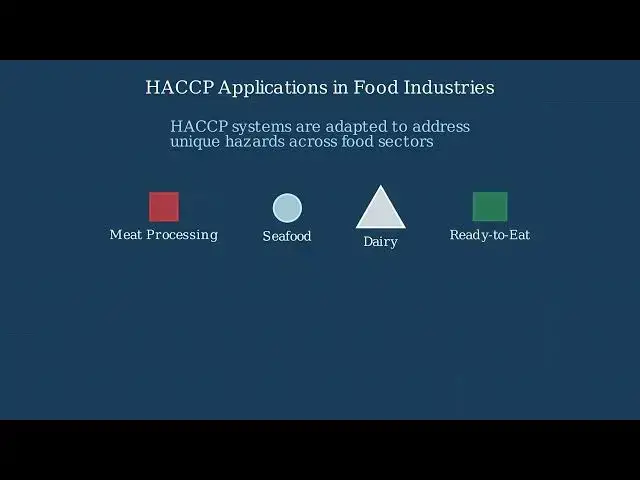
hccp systems are adapted across diverse
7:52
food sectors to address their unique
7:54
hazards and processing methods each
7:56
industry implements HASP principles with
7:59
specific modifications relevant to their
8:01
products and
8:03
processes in meat processing HACP
8:06
focuses on controlling pathogens like
8:08
E.coli017H7 and Salmonella critical
8:11
control points include cooking
8:13
temperatures chilling procedures and
8:16
preventing
8:17
crosscontamination for seafood jccp
8:20
addresses specific concerns like
8:22
histamine formation in scombro fish and
8:24
parasites in raw products time
8:26
temperature controls freezing for
8:28
parasite destruction and receiving
8:30
inspection are critical control
8:33
points in dairy operations HICCP is
8:36
centered around pasteurization as a
8:38
critical control point the process flow
8:40
includes strict temperature controls
8:42
during pasteurization to eliminate
8:44
pathogens high temperature short-time
8:47
pasteurization requires a minimum of 72°
8:50
C for 15 seconds with continuous
8:53
monitoring and
8:55
verification ready to eat foods face
8:58
unique challenges particularly with
9:00
lististeria monocytogynes and
9:02
post-processing contamination controls
9:04
include robust environmental monitoring
9:06
programs post-lethality treatments and
9:09
strict sanitation
9:11
procedures each food industry adapts
9:13
HassP to address its specific hazards
9:16
and processing methods meat processing
9:18
focuses on pathogen control through
9:21
cooking and chilling seafood addresses
9:23
histamine formation and parasites with
9:25
time temperature controls dairy
9:28
operations emphasize pasteurization and
9:30
cold chain maintenance ready to eat
9:32
foods require special controls for
9:34
lististeria and post-processing
9:37
contamination while the seven HAXP
9:39
principles remain constant their
9:41
application varies significantly across
9:43
food sectors demonstrating the systems
9:46
adaptability and
9:50
effectiveness despite its proven
9:52
benefits implementing Hackp systems
9:54
presents several significant challenges
9:56
for food businesses of all sizes let's
9:59
examine the five major challenges
10:01
organizations face when implementing
10:03
HACCP
10:05
systems challenge one HACP requires
10:09
comprehensive staff training and food
10:11
safety expertise all personnel need
10:13
proper training to identify hazards and
10:16
understand critical control points
10:18
smaller businesses often face
10:20
significant expertise gaps compared to
10:22
larger organizations with dedicated food
10:24
safety departments
10:28
challenge two initial implementation
10:30
costs can be substantial these include
10:33
expenses for staff training equipment
10:35
upgrades consultant fees and facility
10:38
modifications the financial burden is
10:40
especially challenging for smaller
10:42
businesses with limited
10:45
resources challenge three HACP demands
10:49
complex documentation and recordeping
10:52
organizations must maintain detailed
10:54
records of hazard analyses monitoring
10:56
activities corrective actions and
10:58
verification procedures documentation
11:01
often consumes 20 to 30% of the total
11:04
HACP implementation
11:06
effort challenge four HACCP is resource
11:10
intensive requiring dedicated personnel
11:12
and specialized equipment organizations
11:15
need to allocate staff specifically for
11:17
HCCP implementation and monitoring
11:20
testing equipment laboratory services
11:22
and data management systems require
11:24
significant investment and ongoing
11:28
maintenance challenge five external
11:31
factors can disrupt ath systems and
11:33
require ongoing updates supply chain
11:36
disruptions may introduce new hazards
11:38
emerging pathogens can create unforeseen
11:41
risks regulatory changes often demand
11:43
system modifications and climate change
11:46
impacts can affect food safety
11:48
conditions in unexpected
11:50
ways despite these challenges
11:53
organizations can successfully implement
11:55
HAPP with proper planning and commitment
11:59
key success factors include strong
12:01
management support a phased
12:03
implementation approach adequate
12:05
training investment expert consultation
12:07
when needed and appropriate technology
12:10
utilization overcoming these challenges
12:12
requires significant commitment and
12:15
resources but is essential for effective
12:17
food safety
12:20
management heccp has become the
12:23
cornerstone of international food safety
12:25
management
12:27
the system was officially endorsed by
12:29
the Codex Alterarius Commission in
12:32
1997 establishing it as an international
12:35
standard since then HACCCP principles
12:38
have been integrated into regulatory
12:39
frameworks worldwide becoming mandatory
12:42
in many
12:43
jurisdictions hccp facilitates
12:45
international trade by providing a
12:47
common food safety language and
12:49
standards that are recognized across
12:51
borders these principles have been
12:53
incorporated into ISO food safety
12:55
management systems like ISO 22000 as
12:59
well as various national regulations as
13:02
food supply chains become increasingly
13:03
global and complex chaspi continues to
13:06
evolve while maintaining its core
13:08
principles throughout these changes HCCP
13:11
remains the fundamental approach to
13:13
ensuring food safety from farm to fork
13:16
providing a science-based framework for
13:18
hazard control throughout the global
13:20
food chain
#Food & Drink
#Cooking & Recipes
#Food
#Toxic Substances & Poisoning