live_tv
Livestream Starting Soon
00
Hours
:
00
Minutes
:
00
Seconds
Up next in 10


Chlamydomonas The Microscopic Green Algae Explained
Dive into the fascinating world of Chlamydomonas, a microscopic green algae that plays a crucial role in aquatic ecosystems. In this video, we explore the unique characteristics, life cycle, and ecological significance of Chlamydomonas. Discover how this single-celled organism contributes to oxygen production and serves as a vital food source for various aquatic organisms. We will also discuss its potential applications in biotechnology and environmental science. Join us for an in-depth look at this remarkable organism and its impact on our planet. #Chlamydomonas #GreenAlgae #Microbiology
Website: https://biologynotesonline.com/
Facebook: https://www.facebook.com/biologynotesonline
Instagram: https://www.instagram.com/biologynotesonline/?hl=en
green algae,chlamydomonas,algae,examples of green algae – chlamydomonas,microscopic algae,chlamydomonas reinhardtii,chlamydomonas (organism classification),why do green algae appear on the surface of water,green algae for class 11 th,green algae for neet,blue green algae,green algae appear on surface on water,chlamydomonas zoospore,reproduction in chlamydomonas,#chlamydomonas,asexual reproduction in chlamydomonas,structure of chlamydomonas
Show More Show Less View Video Transcript
0:00
introduction to clidamonus a fascinating
0:02
genus of unicellular green
0:04
algae these single-sellled organisms are
0:07
found in various environments they
0:10
thrive in freshwater ponds and lakes
0:12
moist soil environments and even on damp
0:15
tree bark chidamonus has two distinctive
0:18
features that make it remarkable first
0:21
chidamonus cells have two fleella which
0:24
are whip-like structures used for
0:25
movement
0:28
second they contain chloroplasts which
0:31
allow them to photosynthesize converting
0:33
sunlight into
0:38
energy clomidamonus serves as an
0:40
important model organism in biological
0:42
research scientists use it to study
0:45
photosynthesis fleeller movement and
0:47
structure cellular responses to light
0:50
and for various genetic research and
0:52
biotechnology applications to summarize
0:55
cladomonus is a unicellular green algae
0:57
with two fleella for movement and
0:59
photosynthetic capability found in
1:01
various moist
1:05
environments now we'll examine the
1:07
external features of clidamonus a
1:09
fascinating unicellular green alga
1:11
unlike plant cells that have cellulose
1:13
cell walls clidamonus has a cell wall
1:16
made primarily of glyoproteins arranged
1:18
in seven layers
1:21
a distinctive feature of clamidamonus is
1:23
its two anterior fugella which emerge
1:26
from the apical end of the
1:28
cell these fugella move in a coordinated
1:31
breast stroke pattern during the power
1:33
stroke the fleella sweep backward to
1:35
propel the cell
1:36
forward in the recovery stroke the
1:39
fleella curl and return to their initial
1:41
position with minimal resistance through
1:43
the water
1:46
this coordinated fleeller movement
1:48
enables clidamonus to navigate through
1:50
water toward light or
1:53
nutrients to summarize clamdomonus has a
1:56
glyoprotein cell wall and two interior
1:59
fugella that enable its distinctive
2:01
movement pattern for finding optimal
2:03
light and
2:07
nutrients clidamonus contains several
2:10
specialized internal organels that
2:12
perform essential cellular functions
2:16
the most prominent organel is the
2:18
cupshaped chloroplast it contains
2:21
chlorophyll which captures light energy
2:23
for
2:24
photosynthesis the chloroplast contains
2:26
stacked membranes called philyloids
2:29
where the light dependent reactions
2:31
occur within the chloroplast is a
2:34
specialized structure called the pyonoid
2:36
the pyonoid is crucial for carbon
2:38
fixation containing high concentrations
2:40
of the enzyme rubiscoco which captures
2:43
carbon dioxide for the Calvin
2:47
cycle the nucleus contains the cell's
2:50
genetic material in the form of DNA it
2:52
directs cellular activities by
2:54
controlling gene expression within the
2:56
nucleus is a darker region called the
2:58
nucleolus where ribosomal RNA is
3:01
produced
3:04
mitochondria are the powerhouses of the
3:06
cell even though clamdomonus can
3:09
photosynthesize it still needs
3:10
mitochondria to generate ATP through
3:13
cellular respiration especially when
3:15
light is
3:17
unavailable the Golgi apparatus
3:20
processes and packages proteins and
3:22
lipids produced in the cell these
3:25
materials are then transported to other
3:26
parts of the cell or secreted outside
3:29
via small membranebound vesicles
3:33
contractile vacules are specialized
3:36
organels that regulate water balance
3:38
since chidamonus often lives in
3:40
freshwater environments water constantly
3:43
enters the cell by osmosis these vacules
3:46
collect excess water and periodically
3:48
contract to expel it from the
3:51
cell
3:53
here we can see a complete
3:56
cross-sectional view of a clidamonus
3:58
cell showing the spatial arrangement of
4:00
all internal organels note how the
4:03
cup-shaped chloroplast occupies a large
4:06
portion of the cell with the pyonoid
4:08
embedded within it the nucleus is
4:10
positioned toward the center while other
4:12
organels like mitochondria golgi
4:15
apparatus and contractile vacules are
4:18
distributed throughout the cytoplasm to
4:20
summarize each organel performs
4:22
specialized functions that contribute to
4:24
the overall survival and reproduction of
4:27
chamomonus the chloroplast enables
4:29
photosynthesis while the pyonoid
4:31
enhances carbon fixation
4:33
efficiency the nucleus directs cellular
4:36
activities mitochondria provide energy
4:38
the Golgi apparatus processes proteins
4:41
and contractile vacules maintain water
4:43
balance in freshwater environments
4:47
clidamona species are incredibly
4:49
adaptable microorganisms found in
4:52
diverse habitats across the
4:55
globe freshwater environments are the
4:58
primary habitats for most clidimonus
5:00
species they thrive in lakes ponds and
5:03
slowmoving streams they typically prefer
5:06
neutral to slightly alkaline pH and
5:08
moderate temperatures between 20 and 25°
5:12
their photosynthetic nature means
5:14
they're commonly found in well-lit
5:16
surface
5:19
waters several chlamidona species have
5:21
adapted to life in moist soil
5:23
environments they're typically found in
5:25
the top layers of nutrient-rich soils
5:29
during dry periods these soil dwelling
5:31
species can form protective cysts
5:34
allowing them to remain dormant for
5:36
extended periods until favorable
5:38
conditions return
5:41
remarkably certain chamomidonus species
5:43
have adapted to extreme environments
5:45
including snow and alpine regions
5:48
clidamonus nalis is famous for creating
5:51
the red snow phenomenon it produces
5:53
carotenoid pigments that protect against
5:55
intense UV radiation and help absorb
5:58
heat these adaptations allow survival in
6:00
freezing temperatures
6:04
while most clidamonus species prefer
6:06
fresh water several have adapted to
6:08
brackish and even saline environments
6:11
these salt tolerant species have evolved
6:13
specialized ion transporters and
6:15
mechanisms to regulate osmotic pressure
6:18
they can be found in coastal waters salt
6:20
marshes and estuaries with some species
6:23
like chlidamonus pulsatilla thriving in
6:26
fully marine environments
6:30
clidamona species have a truly global
6:33
distribution found on every continent
6:35
including Antarctica they show
6:37
remarkable adaptability across diverse
6:40
ecosystems while greatest species
6:42
diversity is observed in temperate
6:44
regions specialized species have
6:46
colonized extreme environments from sea
6:48
level to alpine regions above 4,000 m
6:54
clidamonus reproduces asexually by
6:57
forming multiple daughter cells within
6:59
the parent cell
7:00
wall the process begins with a mature
7:03
clidamonus cell that prepares for
7:09
division the asexual reproduction
7:11
process consists of several key steps
7:14
first the cell retracts its
7:16
fleella next multiple nuclear divisions
7:19
occur within the parent cell wall the
7:21
cytoplasm then divides as separate cells
7:24
begin to form finally multiple daughter
7:26
cells form within the parent cell
7:29
wall clamonus produces three main types
7:32
of asexual spores under different
7:34
environmental conditions zuspores are
7:37
motile daughter cells with fleella
7:39
formed under favorable conditions
7:41
planospores are non-motile spores that
7:44
develop when nutrients are limited
7:46
hypnospores have thick protective walls
7:49
and form during harsh environmental
7:52
conditions different environmental
7:54
factors trigger specific asexual
7:56
reproductive strategies in climatonus in
7:58
nutrient-rich water rapid cell division
8:01
produces 2 to eight zoo spores when
8:03
nitrogen is limited cells form
8:05
non-motile alanoposopores during drought
8:07
or cold conditions cells create
8:09
resistant hypnospores with thick walls
8:12
light and dark cycles can trigger
8:14
synchronized division resulting in
8:16
multiple zoo
8:18
spores the asexual cell cycle of
8:21
clamdomonus consists of distinct phases
8:24
unlike most cells that divide by binary
8:26
fision clidamonus underos multiple
8:28
fision during its cell cycle growth
8:31
occurs in G1 phase followed by DNA
8:33
synthesis in Sphase after G2 preparation
8:36
the cell undergoes multiple fishision in
8:39
Mphase producing two to eight daughter
8:41
cells at once unlike most ukarotes
8:44
clamdomonus can undergo multiple rounds
8:46
of DNA replication and nuclear division
8:49
before the cytoplasm
8:53
divides sexual reproduction in
8:55
clidamonus is triggered by environmental
8:58
stress factors these stressors include
9:00
nitrogen depletion temperature changes
9:03
and fluctuations in light
9:05
intensity clidamonus exhibits three
9:08
distinct types of sexual reproduction
9:10
isogamy occurs when two gametes of
9:12
similar size and appearance fuse
9:16
together anogamy involves gameamtes of
9:19
different sizes though both remain
9:21
motile
9:24
ugami features a large non-motile egg
9:27
cell and a small motile sperm
9:30
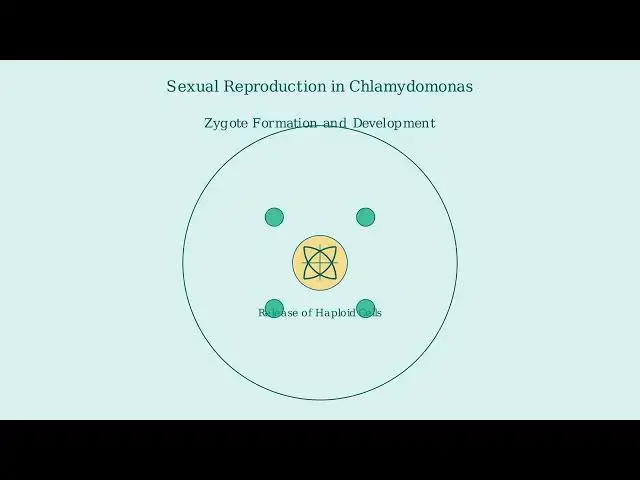
cell after fusion the resulting zygote
9:34
underos a series of developmental stages
9:36
the process begins with the formation of
9:38
a diploid zygote after gameamt fusion
9:41
the zygote develops a thick protective
9:43
wall becoming a zygospor that can
9:45
survive harsh conditions the zygospore
9:48
enters a dormant phase which can last
9:50
for extended periods during unfavorable
9:53
conditions when conditions improve
9:55
meiosis occurs within the zygospor
9:57
producing hloid cells the zygospor wall
10:00
ruptures releasing four hloid cells that
10:03
can grow into new clidamonus
10:05
individuals to summarize the sexual
10:08
reproduction cycle in clamidonus begins
10:10
with environmental stress which triggers
10:12
gameamt formation these gametes then
10:15
fuse forming a zygote that develops into
10:18
a dormant zygospore when conditions
10:20
improve meiosis occurs completing the
10:23
cycle by releasing hloid cells that grow
10:25
into new individuals clidamonus has a
10:28
tripartite genome structure meaning its
10:31
genetic material is distributed across
10:33
three distinct cellular compartments
10:36
these three locations are the nucleus
10:38
which is the main genetic control center
10:40
the chloroplast which enables
10:42
photosynthesis and the mitochondrian
10:44
which produces
10:46
energy the nuclear genome of clamdomonus
10:49
consists of 17 chromosomes with
10:52
approximately 120 million base pairs it
10:55
contains 15,000 genes
10:59
the chloroplast genome has a distinct
11:01
circular DNA structure consisting of
11:03
about 200,000 base pairs and encoding
11:06
approximately 100 genes it's maternally
11:10
inherited and contains genes essential
11:12
for
11:13
photosynthesis unlike most mitochondrial
11:16
genomes the mitochondrial DNA of
11:18
chlidamonus has a linear structure it's
11:21
relatively small with only about 15 to
11:24
20,000 base pairs encoding approximately
11:27
20 genes related to cellular
11:29
respiration the tripartite genome
11:32
structure of clamonus makes it
11:34
exceptionally valuable for research it
11:36
serves as an ideal model for studying
11:38
organel genome evolution and
11:40
understanding the coordination between
11:42
nuclear and organel genes clidamonus is
11:46
unique among model organisms because all
11:48
three of its genomes are accessible for
11:50
experimental manipulation enabling
11:53
researchers to study genetic
11:54
interactions across different cellular
11:58
compartments the three genomes differ
12:00
dramatically in size the nuclear genome
12:03
is the largest at about 120 million base
12:06
pairs while the chloroplast genome is
12:08
much smaller at around 200,000 base
12:10
pairs the mitochondrial genome is the
12:14
smallest with only about 20,000 base
12:17
pairs together these three genomes
12:20
contain all the genetic information
12:22
needed for clamonus to grow reproduce
12:24
and adapt to its
12:26
environment the genus clamonus includes
12:29
over 600 species with diverse
12:31
adaptations to varied environments
12:33
including fresh water soil and even snow
12:37
clidamonus rhinardi is the primary model
12:40
organism used in research it has a fully
12:43
sequenced 120 megabase genome can be
12:46
easily cultured in laboratories and its
12:48
hloid genetics simplifies genetic
12:51
analysis clidamonus nalis is remarkable
12:54
for containing red carotenoid pigments
12:56
that protect it from intense ultraviolet
12:59
radiation at high altitudes this species
13:02
thrives in alpine and polar snow fields
13:04
causing the phenomenon known as
13:06
watermelon snow pink or red colored snow
13:09
patches beyond the well-known species
13:12
chidamonus includes many others with
13:14
remarkable adaptations clidamonus
13:17
acidophila thrives in highly acidic
13:19
waters with specialized cell walls
13:21
clomidamonus uriel has adapted to marine
13:24
environments with salt tolerance
13:26
mechanisms
13:27
clidamonus musi is found in soil and
13:30
fresh water with efficient nutrient
13:32
uptake strategies and chidamonus
13:34
debariana survives in temporary water
13:36
bodies through rapid reproduction cycles
13:38
and resistant
13:41
zygot clidamona species have evolved
13:44
remarkable adaptations to thrive in
13:46
diverse environments their temperature
13:48
tolerance ranges fromus35 to plus 35°
13:53
different species have adapted to pH
13:56
levels from highly acidic to alkaline
13:58
conditions they show impressive light
14:00
adaptations from high UV resistance to
14:03
efficient photosynthesis in low light
14:06
their nutrient requirements vary widely
14:08
allowing them to colonize environments
14:10
from pristine snow fields to
14:12
nutrient-rich soils and waters these
14:15
diverse adaptations across chidamonus
14:17
species make them not only fascinating
14:19
research subjects but also important
14:21
components of various ecosystems
14:24
worldwide clidamonus Reinhardy serves as
14:27
an exceptional model organism in
14:29
biological research its rapid growth
14:32
cycle hloid genetics transformable
14:34
genome and fully sequenced DNA make it
14:37
an ideal subject for laboratory studies
14:39
researchers utilize clamdomonus to
14:41
investigate fundamental processes like
14:43
photosynthesis fleeller movement cell
14:46
cycle regulation and chloroplast
14:48
development in natural ecosystems
14:51
clamadomonus serves as a primary
14:52
producer generating oxygen sequestering
14:55
carbon and providing a crucial food
14:57
source for aquatic organisms beyond
15:00
basic research clamdomonus has practical
15:03
applications in bofuel production
15:05
recombinant protein expression
15:07
environmental remediation and water
15:09
quality assessment current research
15:11
continues to expand clatomonus
15:13
applications with crisper gene editing
15:16
climate change studies synthetic biology
15:18
approaches and improved bofuel
15:20
production technologies
15:22
the significance of Clamatomonus
15:24
continues to grow as new technologies
15:26
enhance our ability to study and utilize
15:29
this remarkable model organism
#Science
#Biological Sciences
#Ecology & Environment