Up next in 10


Archaea – Habitat, Structure, Characteristics, Importance, Examples
Study Note : https://biologynotesonline.com/archaea-habitat-structure-characteristics-importance-examples/
Website: https://biologynotesonline.com/
Facebook: https://www.facebook.com/biologynotesonline
Instagram: https://www.instagram.com/biologynotesonline/?hl=en
archaea,archaea characteristics,characteristics of archaea,difference between bacteria and archaea,archaea examples,structure,similarities between archaea and bacteria,archaebacteria cell structure,archaebacteria characteristics,what are characteristics of eubacteria?,characteristics of archaebacteria,characteristics of halophiles,what is the cell structure of eubacteria?,characteristics of methanogens,what is the cell wall structure of eubacteria?
Show More Show Less View Video Transcript
0:00
introduction to archa A fascinating
0:02
domain of life Archa represent one of
0:04
the three fundamental domains of life
0:06
alongside bacteria and
0:09
ukaria Archa were first discovered in
0:12
extreme environments in 1977 Initially
0:15
classified as strange bacteria they were
0:18
later recognized as a completely
0:20
separate domain Today we know they exist
0:22
in a wide range of habitats from
0:24
hydrothermal vents to
0:27
ocein the human
0:29
microbiome Archa hold a unique position
0:32
in the evolutionary tree of life Genetic
0:35
studies have revealed that archa are
0:37
more closely related to ukaria than to
0:39
bacteria This makes them crucial for
0:42
understanding the evolution of complex
0:44
life and the nature of the last
0:46
universal common ancestor or luca
0:50
Despite superficial similarities to
0:52
bacteria in appearance archa represent a
0:55
fundamentally distinct form of life They
0:57
differ in cell wall composition membrane
1:00
structure genetic mechanisms and
1:02
metabolic pathways The unique
1:05
biochemistry of archa enables them to
1:07
thrive in environments that would be
1:09
hostile to most other life forms
1:12
In summary archa represent a fundamental
1:15
and distinct domain of life that greatly
1:17
expands our understanding of life's
1:19
diversity and evolutionary history Their
1:22
unique biology continues to challenge
1:24
our assumptions about the limits and
1:26
possibilities of
1:28
life Archa have unique structural and
1:31
biochemical features that distinguish
1:33
them from both bacteria and ukarotes
1:36
Like bacteria archal cells lack a
1:38
nucleus and membrane bound organels
1:41
classifying them as proariots Their
1:43
genetic material consists of a circular
1:45
DNA molecule that floats freely in the
1:48
cytoplasm along with ribosomes for
1:50
protein synthesis What makes archal
1:53
cells truly unique is their membrane
1:55
structure Unlike bacteria and ukarotes
1:58
which have lipids with esther linkages
2:00
archa possess ether linked lipids These
2:03
ether linkages are more resistant to
2:05
extreme conditions allowing archa to
2:07
survive in harsh environments where
2:09
other organisms
2:11
cannot Archal cells exhibit diverse
2:14
morphologies including cooxy or
2:16
spherical forms rod-shaped cells and
2:18
various irregular structures Their size
2:21
typically ranges from 0.1 to 15
2:23
micrometers similar to bacteria but
2:26
generally smaller than ukarotic cells
2:29
Let's compare the key structural
2:31
features of archa with bacteria and
2:34
ukareots While archa and bacteria both
2:36
lack a nucleus archal cell walls differ
2:39
significantly from bacterial
2:41
peptidoglycin They typically contain
2:43
pseudopeptidoglycin or surface layer
2:45
proteins The most distinctive feature
2:48
remains their unique ether linked
2:49
membrane lipids which provide stability
2:52
in extreme environments Their DNA
2:54
organization is similar to bacteria but
2:57
their genetic machinery more closely
2:59
resembles ukarotes in many ways These
3:02
unique structural features help explain
3:04
how archa have adapted to thrive in
3:06
diverse environments and represent a
3:08
distinct domain of
3:10
life Despite their superficial
3:13
similarities archa and bacteria have
3:15
several key structural and molecular
3:17
differences These differences are
3:19
significant enough to classify archa as
3:21
a separate domain of life The most
3:24
striking difference is in their membrane
3:27
composition Archal membranes contain
3:29
ether linked lipids with branched
3:32
hydrocarbon chains while bacterial
3:34
membranes have esster linked lipids with
3:36
straight
3:37
chains Another key difference is in
3:40
their cell walls Bacteria contain
3:43
peptidoglycin while archa lack this
3:45
component and instead may have
3:47
pseudopeptidoglycin or other unique
3:48
polymers The ribosomal structures of
3:51
archa are more similar to those found in
3:53
ukareots with unique proteins that
3:56
distinguish them from bacterial
3:58
ribosomes Archa also have multiple RNA
4:01
polymerase types similar to ukarots
4:04
while bacteria have only a single type
4:07
These fundamental differences reflect
4:09
the separate evolutionary history of
4:11
archa and bacteria These differences led
4:14
Carl Wos to propose in 1977 that archa
4:18
represent a separate domain of life
4:20
distinct from both bacteria and ukaria
4:23
Understanding these distinguishing
4:24
features is crucial for comprehending
4:26
the diversity and evolutionary
4:28
relationships among microorganisms
4:31
Archa possess unique genetic and
4:34
molecular characteristics that set them
4:36
apart from both bacteria and ukariots
4:39
Their genetic material exists as
4:41
circular chromosomes similar to bacteria
4:43
but with some important differences
4:46
Unlike bacteria but similar to ukarots
4:48
some archal species wrap their DNA
4:51
around histone proteins Archa display an
4:53
intriguing mixture of bacterial and
4:55
ukareotic genetic features They possess
4:58
unique systems for processing their
5:00
genetic
5:02
information Archal DNA replication has
5:05
more similarities with ukarots than with
5:07
bacteria While bacteria initiate DNA
5:10
replication at a single origin archaike
5:13
ukarots can have multiple origins of
5:15
replication The proteins involved in
5:17
archal DNA replication are more similar
5:20
to those found in ukariots For example
5:23
archa use MCM hilicase to unwind DNA
5:26
during replication Just like ukarotes
5:28
rather than the DNAB helilicase found in
5:31
bacteria The transcription machinery in
5:33
archa shares features with both bacteria
5:36
and ukariots but is generally more
5:38
similar to
5:39
ukareots While bacteria have a single
5:42
RNA polymerase archa have multiple types
5:44
similar to the RNA polymerase 1 2 and
5:47
three found in ukarots In protein
5:50
synthesis archa use methionine as the
5:52
initiator amino acid Just like ukarotes
5:55
their translation factors also more
5:57
closely resemble those found in
5:59
ukareotes Even the structure of archal
6:01
ribosomes shares more similarities with
6:04
ukareotic ribosomes than with bacterial
6:07
ones One of the most striking
6:09
similarities between archa and ukarotes
6:12
is the presence of histone proteins in
6:14
many archal species These histone
6:17
proteins help package and organize the
6:19
DNA forming structures similar to the
6:21
chromatin found in ukariots
6:24
While not all archal species have
6:26
histones they are present in many archal
6:28
lineages Archal histones are
6:30
structurally similar to the core
6:32
histones found in ukarotes However they
6:35
typically form tetr rather than the
6:37
octimer seen in ukarotes Archal histones
6:41
wrap about 60 base pairs of DNA compared
6:44
to the 147 base pairs wrapped by
6:46
ukareotic nucleosomes The presence of
6:49
histones in archa supports theories
6:51
about their evolutionary relationship to
6:53
the ancestors of ukareotic
6:56
cells The genetic and molecular
6:58
characteristics of archa have
7:00
significant implications for our
7:02
understanding of
7:03
evolution The similarities between
7:06
archal and ukareotic genetic processing
7:08
machinery support the eoy hypothesis
7:11
This hypothesis suggests that ukareotes
7:14
arose from within the archal domain
7:16
specifically from a lineage related to
7:18
the tax superfile of archa These
7:21
molecular similarities challenge the
7:23
traditional three domain system of
7:25
classification and point to a closer
7:28
relationship between archa and ukarotes
7:30
than previously thought
7:33
Many archa are classified as
7:36
extreophiles organisms that thrive in
7:38
environments that would be lethal to
7:40
most life forms on Earth Archa contains
7:43
several distinct types of extreophiles
7:45
each adapted to different harsh
7:47
conditions Thermophiles are heat loving
7:53
archa and 122 degrees These remarkable
7:57
organisms are found in hot springs
7:59
hydrothermal vents and geysers
8:03
Halifiles are salt-loving archa that not
8:05
only tolerate but actually require high
8:07
salt concentrations to survive Some
8:10
species can thrive in environments with
8:12
up to 32% salinity nearly 10 times
8:15
saltier than ocean water These organisms
8:18
are found in salt lakes evaporation
8:20
ponds and salt
8:22
mines Acidophiles are archa that thrive
8:25
in highly acidic environments with pH
8:28
levels between 0 and 4 These
8:30
environments would dissolve the cellular
8:32
components of most organisms They can be
8:34
found in acid mine drainage volcanic
8:37
soils and acidic hot springs Alkali are
8:41
the opposite of acidopiles They thrive
8:44
in highly basic environments with pH
8:46
levels between 9 and 11 These archa have
8:49
been discovered in soda lakes alkaline
8:51
hot springs and alkaline soils across
8:54
the
8:55
world How do these archa survive in such
8:58
extreme conditions The answer lies in
9:00
their molecular
9:04
adaptations These extreophiles have
9:06
evolved specialized enzymes that remain
9:09
functional in extreme conditions Their
9:11
cell membranes contain unique lipid
9:14
structures that maintain stability under
9:15
high heat extreme pH or high salinity
9:19
These remarkable adaptations allow archa
9:22
to occupy ecological niches where
9:24
competition from other organisms is
9:26
minimal contributing to their
9:28
evolutionary
9:32
success Now we'll explore methanogens a
9:35
unique group of archa that produce
9:37
methane gas as a byproduct of their
9:39
metabolism Methanogens have a unique
9:42
cell structure and are strictly anorobic
9:44
meaning they can only survive in
9:46
environments without oxygen
9:49
The metabolism of methanogens is
9:51
remarkable They can convert carbon
9:53
dioxide and hydrogen into methane and
9:55
water generating energy in the process
9:58
This process involves a complex pathway
10:00
called methanogenesis which occurs in
10:02
several steps using unique co-enzymes
10:04
found only in methanogens
10:06
These archa contain enzymes and
10:09
co-enzymes that are not found in any
10:11
other organism such as co-enzyme F420
10:14
which gives methanogens their
10:15
characteristic blue green
10:18
fluorescent Methanogens thrive in
10:21
various anorobic environments They're
10:23
abundant in wetlands and marshes where
10:26
they produce the methane bubbles seen in
10:28
muddy areas They're also found in the
10:30
digestive systems of animals like cows
10:32
and termites contributing to these
10:35
animals ability to digest material In
10:38
deep sea sediments methanogens function
10:41
under high pressure in oxygen-free
10:43
conditions and in landfills They
10:45
contribute to the production of landfill
10:47
gas which is mostly
10:49
methane Methanogens have important
10:52
practical applications in several fields
10:55
In bio gas production they convert
10:57
organic waste into usable energy in
10:59
anorobic digesttors In wastewater
11:01
treatment methanogens break down organic
11:04
material in anorobic digesttors reducing
11:07
sludge volume while producing methane
11:09
that can be captured and used as fuel
11:11
These applications are becoming
11:13
increasingly important as we search for
11:15
sustainable energy sources and waste
11:18
management solutions The unique
11:20
metabolism of methanogens makes them
11:22
fascinating subjects for both basic
11:24
research and biotechnological
11:27
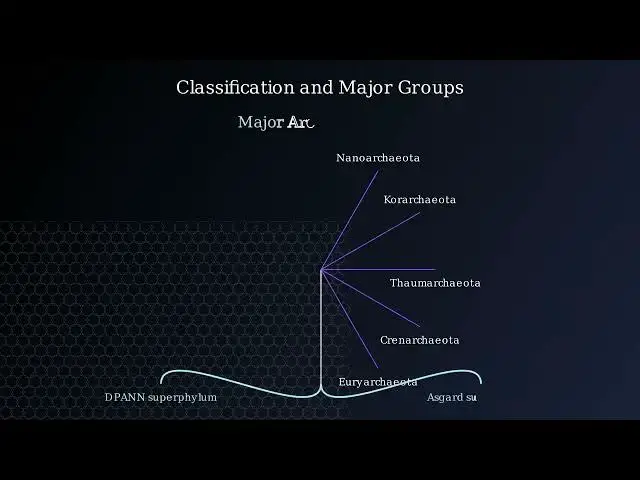
applications The classification of archa
11:29
has undergone significant revisions as
11:31
molecular techniques have
11:34
advanced Archa is divided into several
11:37
major fila based primarily on 16S
11:39
ribosomal RNA sequencing and other
11:42
molecular
11:43
markers The urarchiota film includes
11:46
includes methanogens and halophiles
11:48
Notable examples include methanosca
11:52
halobacterium The kinariota film
11:54
includes single membrane lipid type
11:56
Notable examples include sulfallus
11:59
pydictium The thararchyota filylm
12:02
includes found in marine and soil
12:04
environments Notable examples include
12:06
nitrosopumalis
12:08
nitrosphera The coracota film includes
12:11
only known from environmental samples
12:14
Notable examples include corarchium
12:17
cryptophylm The nanoarchiota film
12:19
includes obligate symbiance Notable
12:22
examples include nanoarchium
12:24
equitans Modern classification of archa
12:27
relies on molecular techniques The 16S
12:30
ribosomal RNA gene has been particularly
12:33
important along with whole genome
12:35
sequencing and protein marker analysis
12:39
New archal groups continue to be
12:41
discovered through environmental
12:42
sampling and metagenomics This process
12:45
involves collecting samples from diverse
12:47
environments extracting DNA and using
12:49
bioinformatic analysis to identify novel
12:56
lineages Archa play crucial roles in
12:59
global biogeeochemical cycles
13:01
particularly in carbon nitrogen and
13:03
sulfur cycling
13:04
In the carbon cycle methanogenic archa
13:07
are responsible for producing over 90%
13:10
of all biological methane These archa
13:13
convert carbon dioxide and hydrogen to
13:15
methane in anorobic environments like
13:17
wetlands rice patties and animal
13:20
digestive
13:21
tracts In the nitrogen cycle ammonia
13:24
oxidizing archa belonging to the film
13:27
tharota oxidize ammonia to nitrite in
13:30
oceans and soils These archa often
13:32
outnumber bacteria in marine
13:34
environments and play a dominant role in
13:35
nitrification processes Some archa also
13:39
participate in anorobic ammonia
13:41
oxidation or anomox contributing
13:43
significantly to the global nitrogen
13:46
budget In the sulfur cycle various
13:49
archal groups participate in both
13:51
oxidative and reductive processes At
13:54
hydrothermal vents thermopilic archa
13:57
reduced sulfur compounds like hydrogen
13:59
sulfide In marine sediments other archal
14:02
groups contribute to sulfate reduction
14:05
These processes are particularly
14:07
important in deep sea environments where
14:09
archa are key contributors to elemental
14:12
cycling
14:18
Archae comprise 20 to 40% of the total
14:22
microbial biomass and are found from
14:24
surface waters to the deepest trenches
14:26
In soils they inhabit virtually all
14:29
types of terrestrial environments from
14:31
agricultural fields to forests In
14:33
sediments they play critical roles in
14:35
both freshwater and marine systems
14:38
Importantly archa form complex
14:40
ecological networks with bacteria and
14:42
ukarots contributing to ecosystem
14:46
stability Despite often being overlooked
14:48
archa are critical contributors to
14:50
global biogeeochemical cycling They
14:53
regulate greenhouse gas emissions
14:55
including methane and nitrous oxide
14:58
which have significant implications for
15:00
climate change In extreme environments
15:02
archa are often the dominant
15:04
microorganisms stabilizing ecosystem
15:07
functions under harsh conditions Their
15:09
contributions to ecosystem services must
15:12
be considered in climate models and
15:14
biodiversity conservation efforts
15:18
Archa offer unique biological properties
15:21
that have enormous potential in
15:27
biotechnology Thermable enzymes from
15:30
extremilic archa are vital in molecular
15:32
biology techniques The polymerase chain
15:35
reaction or PCR relies on TAC polymerase
15:38
originally isolated from thermos
15:40
aquaticus These archal enzymes offer
15:42
numerous advantages for biotechnology
15:45
applications They maintain function at
15:48
temperatures exceeding 95° C enabling
15:51
faster more accurate DNA amplification
15:53
and can even remain active in organic
16:00
solvents Archolippids are being utilized
16:03
to create specialized liposomes called
16:05
archosomes for drug delivery systems
16:08
Unlike conventional liposomes archosomes
16:10
offer greater stability resistance to
16:13
extreme temperatures and pH controlled
16:16
drug release mechanisms and reduce
16:18
toxicity These properties make them
16:20
excellent candidates for targeted
16:22
therapeutics and vaccine
16:28
development Archa also offer numerous
16:31
other biotechnological applications
16:33
across various industries In bofuuel
16:36
production methanogenic archa convert
16:38
carbon dioxide and hydrogen to methane
16:41
providing a carbon neutral alternative
16:43
energy source for biorediation
16:46
Halophilic archa are capable of
16:48
degrading crude oil and detoxifying
16:50
heavy metals in challenging environments
16:52
where other microbes cannot survive The
16:55
unique biochemistry of archa also
16:57
presents opportunities for developing
16:59
novel antibiotics Antimicrobial
17:01
compounds from marine archa could help
17:04
address the growing challenge of
17:05
antibiotic
17:11
resistance The exploration of archal
17:13
biology continues to reveal new
17:15
opportunities for biotechnological
17:18
innovations Future applications may
17:20
include crisper systems from archa for
17:22
gene editing archal bofilms for
17:25
industrial surfaces and extremosymes for
17:27
green chemistry applications Researchers
17:30
are also investigating archal
17:31
nanoparticles for medical applications
17:34
and gas vesicles for advanced medical
17:36
imaging As our understanding of archal
17:39
biology deepens so too does their
17:41
potential in
17:47
biotechnology In summary the unique
17:49
biological properties of archa numerous
17:52
biotechnological applications
17:54
Therostable enzymes for molecular
17:56
biology specialized lipids for drug
17:59
delivery methanogenic capabilities for
18:01
biofuel production extremilic traits for
18:04
biorediation and novel compounds for
18:06
antibiotic development
#Science
#Biological Sciences
#Ecology & Environment