Up next in 10



“The messy reality of it is that all of these very smart people, including Isaac Newton, were talking to other people.”
Show More Show Less View Video Transcript
0:00
I like to say that Einstein is, if anything, underrated as a physicist
0:04
which is hard to imagine given how highly he is rated. When we tell the history of physics, we try to keep things straight
0:11
and we can't remember everything, so we kind of give a lot of credit to a relatively small number of individuals, Einstein being one of them
0:19
The messy reality of it is that all of these very smart people
0:23
including Isaac Newton, were talking to other people. So it's always interesting to see the evolution of ideas
0:31
which is not exactly lockstep with the evolution of people. Different people have different ideas
0:37
They have different ideas at different times. They get them from different sources. That's the messy human reality of doing science
0:43
I'm Sean Carroll. I am a physicist and philosopher at Johns Hopkins University
0:48
host of the Mindscape podcast, and also author of a bunch of books
0:52
most recently the biggest ideas in the universe series, including space-time and motion and quanta and fields
1:05
It's so much fun reading the history of how these ideas developed because today we're just taught the final result
1:12
but they didn't know what was going on back in the early days. The first really huge revolution in physics
1:18
was the existence of classical mechanics handed down by Isaac Newton and others
1:24
Before Newton, there was Aristotle, And Aristotle says that things have natural places they want to be, natural ways they want to move
1:32
And Newton says something completely different. He says if something is not acted on by a force, it's going to continue in a straight line at a constant velocity forever
1:42
And if it is acted on by a force, I can tell you how it will move. I have an equation to do that
1:47
One part of classical mechanics is the idea of space and time both separately existing and being absolute
1:57
There is a meaningfulness to that. There is no preferred position in the universe
2:03
You can be anywhere you want. The laws of physics work the same. There's not even a preferred velocity to the universe
2:09
This was figured out by Galileo, and Newton kind of took it on board. Turns out those assumptions are not quite right
2:17
And there was a journey to get there, as it often is. It started in the 1800s with the invention of electromagnetism
2:26
It was James Clerk Maxwell who put the whole story together after work by people like Faraday and Ampere and so forth
2:33
And what he realized is there's two fields pervading the universe, an electric field and a magnetic field
2:40
People were very happy at the existence of electromagnetism. They started thinking about what it all meant, and what they realized is that the sort of way that space and time are treated in Maxwell's theory of electromagnetism is different than the way they are apparently treated in Newton's theory
2:58
In particular, Maxwell's equations predicted a special velocity. There's no special velocity in Newtonian mechanics
3:07
Every velocity is created the same. Maxwell says there is something called the speed of light
3:12
It is the speed at which waves in the electromagnetic fields move
3:17
And naively, you look at the equations and everyone measures the same value for the speed of light
3:22
It's a constant of nature. How can it possibly be the case that everyone measures the same speed for light
3:30
even if they're moving with respect to each other? So for a long time, for decades, people, physicists, bash their heads against this problem
3:37
They came with very elaborate schemes to get rid of it. And it was Einstein, Albert Einstein, in his great paper in 1905, who first said you should
3:47
get rid of the idea of these waves traveling through a medium
3:52
You should think of the electromagnetic waves as really being the thing that exists, and
3:57
when the equations tell you everyone measures the speed of light the same, that's because
4:01
they do. Take that seriously. All you have to do is entirely rejigger your thoughts about what space and time are And in fact it wasn until two years later when Herman Minkowski who was a mathematician who had been one of Einstein professors said you know the right way to think about Einstein
4:20
theory is to say that space and time aren't separate anymore. To imagine there's one thing
4:27
called space-time and different people, different observers moving in different ways through the
4:32
universe will divide it up into space and time differently. There's no objective true fact about
4:38
when I snap my fingers now, what's happening light years away. That's going to depend on who's doing the observing and who's doing the measuring
4:47
It can all be explained very beautifully by imagining a single four-dimensional space-time
4:52
instead of separate space and time. Einstein himself was not impressed by this move
5:02
Einstein was a hilarious character because he was a physicist's physicist. He was very mathematically adept
5:08
You know, don't believe the stories that Einstein wasn't good at math in school. He was very good at it
5:13
But he wasn't in it for the math. He was in it for the physics. So he learned as much math as he needed
5:18
And when Benkovsky says, I have some new math that unifies space and time based on Einstein's theories, Einstein himself is like, I don't need that
5:25
That's like extra mathematical nonsense. He soon changed his mind because it turns out that that move from space and time being separate to being combined is super useful going forward
5:38
When Einstein put together what we now call the special theory of relativity, the idea that there's no preferred standard of rest in the universe, but also everyone thinks the speed of light is the same
5:49
All you have to do is imagine ultimately that space and time are glued together
5:54
That was a radical reworking of the framework of physics. You know, Newton's idea of separate space and separate time, absolute and agreed upon by everyone, had been there for hundreds of years
6:07
And when you do that, when you say, OK, I'm going to completely invent space and time, in part because I want to match this wonderful theory we have, Maxwell's theory of electricity and magnetism
6:18
you have to go back to everything that was a success in your previous way of doing things and say, does it still work
6:26
The biggest success of Newtonian classical mechanics was gravity, the famous inverse square law of gravity
6:33
Newton posited that if you have two objects with two different masses, they have a gravitational force that will pull them together that diminishes as one over the square of the distance between them
6:46
And that simple rule, plus the framework of Newtonian mechanics, is enough to match exactly what you see in the sky in terms of the planets moving around
6:55
It's enough to launch a rocket and get it to the moon. So Einstein comes along and says, well, okay
7:01
can I make a version of Newton's theory of gravity that is compatible with my new theory of special relativity
7:09
And after trying, he said, no, I can't. You have to do something much more dramatic
7:15
And what he realized is that gravity is not a force on top of space-time
7:21
It's a feature of space-time itself. What feature could it be? Well, my ex-professor Minkowski says that space-time has a geometry
7:30
It's one combined thing, and there are equations telling me how particles move in it
7:36
Maybe that geometry is curved. Maybe it's not like a flat tabletop like Euclidean geometry
7:42
Maybe it's warped and bent and dynamical and changes in response to the existence of mass and energy and things like that
7:50
It's a good idea to have. It takes you a lot of effort and a lot of mathematical work to figure it out
7:56
So 10 years later, in 1915, Einstein finally completes what we call the general theory of relativity
8:03
And the general theory of relativity says space-time is a four-dimensional thing
8:07
That four-dimensional thing has a geometry. It's pushed around by matter and energy, and we experience the curvature of space-time
8:17
as the force of gravity. I would put Einstein and Galileo in my pantheon of people who just felt what the universe should be like very very deeply And this let Einstein make enormous amounts of progress But the thing is once you use that intuition
8:36
Einstein used his ideas about gravity disappearing in small regions of space-time to invent general relativity
8:43
But then you have the theory. Then you have general relativity. Then you have equations
8:48
And the equations don't care what your intuition is. I like to say that the equations are smarter than we are
8:55
Once Einstein writes down his equation, anybody can solve it. And indeed, Einstein himself looked at his equation and goes
9:02
I don't know if anyone's ever going to solve this. This is too complicated looking. It's too intimidating
9:06
But a bunch of other people were not intimidated. Most famously, most quickly, Carl Schwarzschild, who was a German astronomer
9:14
who sat in on lectures that Einstein gave in Berlin. He taught himself general relativity, came back from the Eastern Front in World War I and said, Professor Einstein, I've solved your equations
9:27
I've solved them for the gravitational field around the sun. And now we can use that to predict the motions of planets and things like that
9:35
And this is brilliant. And Einstein loved it right away. He got the fact, oh, yeah, you know, I should have figured that out. You're right
9:40
So I think it's incredibly significant how the different layers of reality depend on each other
9:48
And we know one layer really, really well, the layers of particles and forces at the level of quantum field theory and atoms and things like that
9:57
We would like to do even better at that layer, but we understand it very, very well
10:01
It leads to the layer of chemistry and atoms. The stability of the chair that I'm sitting on ultimately comes down to the rules of quantum field theory
10:12
Those atoms and molecules come together with electricity and magnetism to make all of chemistry, which is a pretty big deal
10:20
Chemistry comes together to make biology and so up on the ladder. We can both appreciate that these different levels depend on each other
10:29
while appreciating also that to study them and to understand them, we need to take each level seriously for its own sake
10:37
I suspect that if William Shakespeare had never existed, Shakespeare's plays never would have been written
10:44
But I'm pretty sure that if Albert Einstein had never existed, general relativity would still have been invented
10:50
Indeed, I don't think it would have taken that much longer. It's something about the progress of physics that there are super duper smart people who are making these advances
11:01
but they're also in the right place at the right time. If you go back to the time of Isaac Newton, when Isaac Newton first understood that the inverse square law of gravity predicts the planets move in ellipses around the sun
11:16
So, number one, he's building on prior progress, right? It was Johannes Kepler who argued that planets do move in ellipses and came up with sort of some phenomenological rules about that
11:27
But the thing is that it wasn't only Isaac Newton who had this idea of the inverse square law
11:33
Christian Huygens in the Netherlands show that there's a relationship between how fast things move and the strength of the force pulling on them
11:41
Robert Hooke, who was going to become a famous British scientist and helped found the Royal Society in London
11:49
he and his friends batted around the idea that maybe gravity is described by an inverse square law
11:56
It's just that none of them were quite as mathematically adept as Isaac Newton
12:00
And indeed, one of Hooke's friends was Christopher Wren, the architect who built St. Paul's Cathedral
12:06
And another one was Halley, the astronomer who discovered Halley's Comet. And they basically cajoled Halley, who was a young striver at the time, to go up to Cambridge from London, visit Isaac Newton and say, could you please solve this math problem for us
12:22
What happens if you have a planet moving in an inverse square log gravitational force
12:27
And of course, Newton said, oh, I already did that. It's an ellipse. And so Halley said, would you please write that up
12:33
so that we can share it? And Newton eventually wrote the Principia Mathematica
12:37
the most important book in the history of physics So even the great discoveries made by individuals come about because of a social context And I think that knowing that helps us try to be a little bit more thoughtful
12:49
about creating the best possible social context for making more impressive discoveries toward the
12:55
future. We sometimes get the wrong impression about the great man theory of science or physics
13:03
because, look, Isaac Newton and Albert Einstein did a lot, and they deserve a lot of credit
13:07
But think about the difference between the development of quantum mechanics, for example, versus general relativity
13:13
General relativity was Einstein's great accomplishment, and it was really his accomplishment
13:19
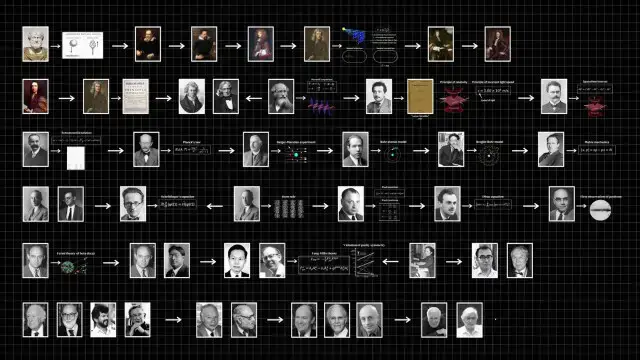
No one else was even really competing with him that much at the time. But quantum mechanics, Max Planck points out that you need to fiddle with the equations to make the right prediction for blackbody radiation
13:32
Einstein himself says, oh, I can understand why light jiggles loose electrons sometimes
13:39
Rutherford builds experiments and he detects that there are nuclei inside atoms
13:44
Niels Bohr says, I can explain the different sizes of the orbits of the electrons in the atoms
13:49
Louis de Broglie says, it's even better if you imagine that those electrons are waves rather than particles
13:57
Berner Heisenberg says, I can invent a theory using matrices that explains exactly what's going on
14:03
Max Born and Pascual Yordan say, we can improve the mathematics of Heisenberg's theory to make it more general
14:09
Erwin Schrodinger comes along and says, we can replace the matrices by waves
14:13
And then Max Born comes again and says, actually, these are useful for predicting probabilities
14:18
Wolfgang Pauli says, there's something called spin, and that affects what the electrons can do in an atom
14:24
Paul Dirac says I can invent an equation for the electron that predicts what it will do and fits it in with relativity
14:31
Dirac's equation also predicts an antiparticle of the electron. Karl Anderson goes and discovers the antiparticle of the electron and also discovers the muon
14:41
Enrico Fermi invents a theory that explains how neutrons and muons can decay, called the Fermi theory of beta decay
14:50
Fermi and Bose invent the idea of fermions and bosons. Yang and Mills generalize the idea of electromagnetism to other symmetry groups
14:59
and propose that this is an origin of the strong and weak nuclear forces
15:05
Li and Yang say that maybe there is violation of parity in the weak nuclear force
15:11
The fact that a right-handed interaction does not happen at the same speed as the left-hand interaction
15:17
CS Wu detects experimentally that this is, in fact, true. Peter Higgs and Francois Englert and Robert Brough and Philip Anderson and others
15:28
use the idea of symmetry breaking, which had been pioneered by Jeffrey Goldstone and Yoshiro Nambu
15:33
to explain why the nuclear forces are short-range. Steven Weinberg fits the final pieces of the puzzle together along with Abdus Salam
15:42
to understand the unification of the electromagnetic and weak nuclear forces. Frank Wilczek and David Gross and David Pollitzer do an ogous thing for the strong nuclear force
15:53
by understanding confinement, why quarks are stuck inside protons and neutrons. Murray Gell-Mann puts it together by inventing the idea of quarks, along with George Zweig
16:04
And that's only getting us up to 1970. So many developments in particle physics since then, due to many, many brilliant theorists and experimenters
16:14
This idea that there are many people contributing and many different parts of the pieces need to put together is actually much more characteristic of how physics is usually done than the single person inventing everything all by themselves
16:44
Want to support the channel? Join the Big Think Members community where you get access to videos early, ad-free
#Science
#Physics