Up next in 10

Seis meses en el espacio cambian tu cuerpo más de lo que imaginas: creces, se te hincha la cara, ves destellos con los ojos cerrados… y al volver, hasta soltar una taza se vuelve peligroso. 🚀
0:00 Intro
0:20 ¿Cómo lo siente tu cuerpo?
0:47 El despegue
1:19 El primer día
2:00 El mareo
2:36 Creces en el espacio
3:07 Dormir sin cama
3:52 Comer, beber y el baño
4:55 Huesos y músculos
5:45 Ojos y corazón
6:40 El hermano gemelo
7:18 La vuelta a la Tierra
8:11 Despedida
¿Qué crees que sería lo más difícil para ti allá arriba? Te leo en los comentarios 👇
Suscríbete a XtraTerrestre para el próximo despegue.
#espacio #astronautas #nasa #ciencia #estacionespacial #cuerpohumano
Show More Show Less View Video Transcript
0:00
This is extraterrestrial. Here the
0:02
universe is explained simply, without
0:03
formulas or weird words, just what you’d
0:05
see, what you’d feel, and what would
0:06
happen to you if you were there. Get
0:08
comfortable, we’re taking off.
0:21
You’ve already seen too many videos
0:22
about space—what it’s like, how it looks
0:25
, how it feels.
0:26
But have you ever wondered how your body
0:29
feels it? Think about it.
0:31
Gravity is what makes your blood flow
0:33
the way you know it.
0:35
Atmospheric pressure is what makes you
0:37
breathe the way you breathe, but out
0:39
there everything is different and we’re
0:41
going to find out.
0:43
Six months on the Space Station, from
0:45
takeoff to coming back home.
0:48
The engines ignite and everything starts
0:50
to shake.
0:51
In a few seconds, something crushes you
0:53
into your seat. It’s the force of
0:55
takeoff. At the most intense moments,
0:58
you feel three times heavier than normal
1:00
. If you weigh 70 kg, it’s like suddenly
1:03
weighing 210. It’s hard to lift an arm,
1:06
even breathing feels heavy, but it
1:08
doesn't last long.
1:10
At 9 minutes, the engines shut down and
1:12
all that weight suddenly disappears.
1:15
Whatever was in your pocket starts to
1:17
float, and you do too.
1:19
The first few hours are a party.
1:22
You push off with a finger and cross the
1:24
whole ship, but your body doesn't
1:25
understand a thing.
1:27
On Earth, your body fluids tend to
1:29
settle in your legs and your heart works
1:32
all day to pump them up.
1:34
Up there, nothing pulls down, but your
1:36
heart keeps pumping just as hard.
1:39
The result: about 2 liters of fluid move
1:42
from your legs to your chest and head.
1:44
Your face swells up and gets round. Your
1:47
legs get skinny. Astronauts even have a
1:50
name for it: moon face and chicken legs
1:53
. Your nose gets stuffed like when you
1:56
have a cold, and just like with a cold,
1:58
food doesn't taste like much.
2:01
And then the motion sickness kicks in.
2:03
Inside your ear is a small part that
2:05
tells your brain which way is up and
2:07
which way is down.
2:09
It works because things have weight. Up
2:11
there, it goes crazy. Your eyes say one
2:14
thing and your ear says another.
2:16
More than half of astronauts get sick in
2:18
the first few days.
2:20
Headaches, an upset stomach, not wanting
2:22
to move.
2:24
A trick they use is to decide that one
2:26
wall is the floor. That way they give
2:28
their brain a "down," even if it doesn't
2:30
exist. After two or three days, the
2:32
brain gets used to it and learns to live
2:34
without up or down.
2:37
By the end of the first week, something
2:39
doesn't add up. Your clothes feel too
2:41
short. You’ve grown. Your back is a
2:44
column of small bones separated by soft
2:46
cushions. On Earth, your body weight
2:49
compresses them all day long. Up there,
2:51
nothing compresses them and they stretch
2:53
out. You can grow up to 5 cm. It sounds
2:57
good, but it comes at a price. Many
2:59
astronauts have back pain for the first
3:01
few weeks. And don't get excited; when
3:03
you return to Earth, you'll be back to
3:05
your usual height in a few days.
3:07
Time to sleep.
3:09
There are no beds, pillows, or
3:11
mattresses here. You sleep in a sleeping
3:13
bag strapped to the wall, inside a room
3:16
the size of a closet. If you don't tuck
3:18
your arms into the bag, they float in
3:21
front of you like a cartoon sleepwalker
3:23
. And the sun doesn't help either. The
3:25
station orbits the Earth every hour and
3:28
a half. That means 16 sunrises and 16
3:31
sunsets every day. That's why astronauts
3:35
sleep with eye masks and on a fixed
3:36
schedule. Even then, many only sleep
3:39
about 6 hours. And there is one more
3:41
detail. Here, air doesn't move on its
3:44
own.
3:45
If you don't have a fan nearby, the air
3:47
you exhale stays floating around your
3:49
face.
3:50
That's why you always sleep next to one
3:52
.
3:53
At breakfast, you discover another rule
3:55
. There is no bread here. Crumbs don't
3:58
fall to the floor; they float and can
4:00
get into your eyes or the machines. That
4:03
is why we eat with tortillas. Since your
4:05
nose is stuffy, everything tastes
4:07
blander. That's why hot sauces run out
4:10
so quickly on the station. Drinks come
4:13
in sealed pouches with a straw for
4:15
sipping. If you open a cup, the water
4:17
floats away in little balls. And the
4:19
water you drink has a history. The
4:21
station recycles almost all the water,
4:24
the humidity in the air, sweat, and even
4:26
urine. It ends up so clean that it's
4:28
purer than the water in many homes on
4:30
Earth. Astronauts sum it up like this:
4:33
yesterday's coffee is tomorrow's coffee
4:35
. And the bathroom? Without gravity,
4:38
nothing falls, so the toilet works like
4:40
a vacuum cleaner. A stream of air takes
4:42
everything away. Using it correctly
4:44
isn't easy, so it's practiced on Earth
4:46
before going up.
4:48
And if one day you get emotional looking
4:50
at the Earth through the window, your
4:51
tears won't fall; they stay stuck to
4:53
your eye like a little bubble of water.
4:56
A month goes by, and what you can't see
4:58
begins. Your bones aren't stones; they
5:01
renew themselves all the time and get
5:03
stronger where they carry the most
5:05
weight. Up there, you don't carry
5:07
anything, and your body thinks, if I
5:09
don't use them, why maintain them? So it
5:12
starts to undo them little by little. In
5:14
just one month, hip bones lose what an
5:17
elderly person loses in an entire year.
5:20
The same thing happens with the muscles
5:21
. Your legs and back, which support you
5:25
all day on Earth, do nothing here and
5:27
shrink.
5:28
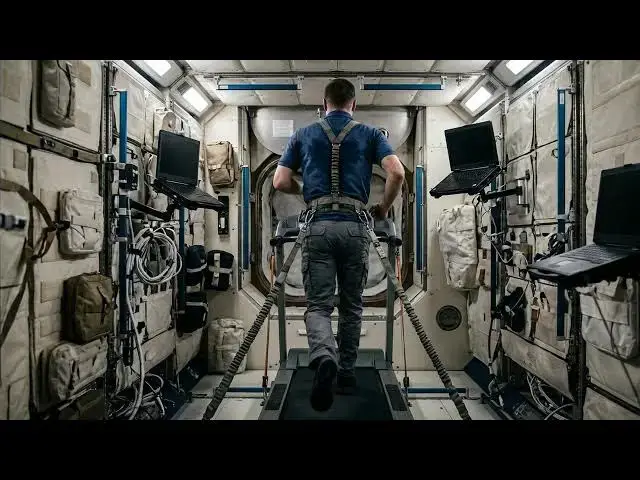
The solution is to sweat, about 2 hours
5:31
of exercise every day. You run on a
5:33
treadmill held by straps so you don't
5:35
float away. You lift weights on a
5:37
machine that mimics gravity and pedal on
5:40
a seatless bike. It's not to get in
5:42
shape, it's so you can walk when you get
5:44
back.
5:46
After 3 months, some astronauts notice
5:48
something strange.
5:50
They no longer see as well.
5:51
That fluid that went to the head on the
5:53
first day is still there and pushes on
5:55
the eyes from behind. Almost 7 out of 10
5:58
astronauts who stay months at the
6:00
station have changes in their vision.
6:02
That's why up there, there are glasses
6:04
of various strengths, just in case. The
6:06
heart changes too. Since it no longer
6:09
has to push against weight, it works
6:11
less and becomes a bit rounder.
6:14
And there is something you can see even
6:15
with your eyes closed. Every now and
6:17
then, in the darkness, flashes of light
6:20
appear, like little sparks.
6:22
It's not your imagination, they are tiny
6:24
particles from space that pass through
6:26
the ship, through your head, and light
6:29
up your eye from the inside.
6:31
The station protects you from many, but
6:33
not from all.
6:35
In one week up there, you receive about
6:37
the same radiation as in an entire year
6:39
on Earth.
6:41
What if you stayed almost a year?
6:43
One astronaut did. He spent 340 days in
6:46
a row at the station and had something
6:49
scientists couldn't pass up. An
6:51
identical twin brother, also an
6:53
astronaut, who stayed on Earth. It was
6:56
the perfect experiment: the same body,
6:58
one up there and one down here. When he
7:01
returned, the one from space was 5 cm
7:03
taller than his brother. His body had
7:06
changed in hundreds of small details:
7:08
his vision, his bones, even the way some
7:11
of his genes turned on and off.
7:14
The good news is that almost everything
7:15
returned to normal in a few months.
7:19
6 months pass, time to go home.
7:21
The capsule enters Earth's atmosphere
7:23
like a ball of fire.
7:25
It brakes suddenly, and once again, that
7:27
weight crushes you.
7:29
The parachutes open, the capsule touches
7:32
down, and the door opens. And Earth
7:34
welcomes you with something you had
7:36
already forgotten: weight.
7:39
Your head feels heavy, your arms feel
7:40
heavy, even lifting a hand is a struggle
7:42
.
7:43
That is why astronauts are carried out
7:45
of the capsule in arms and placed in a
7:47
chair.
7:48
You get dizzy, it's hard to keep your
7:50
balance and walk in a straight line.
7:52
And for a few days, your brain stays in
7:54
space mode. You let go of a cup in
7:56
mid-air expecting it to float, and it
7:59
falls. In a few weeks, you go back to
8:01
walking normally. Your face stops being
8:03
swollen and you return to your normal
8:04
height.
8:05
Bones are the slowest; they can take
8:07
years to recover and sometimes never
8:09
fully do.
8:12
You are finally home. Things fall, water
8:14
stays in the glass, and the bed doesn't
8:17
move. Your body is made for Earth, and
8:20
yet it learned how to live in space.
8:23
Thanks for traveling with me. Subscribe
8:25
to Extraterrestre, because we still have
8:27
many trips left up there. See you at the
8:30
next liftoff.
Science
Biological Sciences
Physics