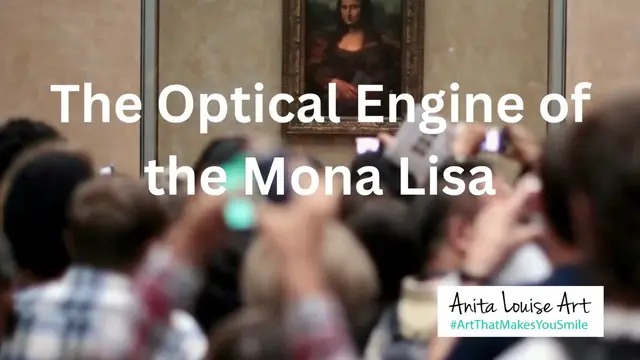

The Optical Engine of the Mona Lisa
Jul 30, 2026

How did Leonardo da Vinci paint images that feel alive? The secret lies in sfumato—a revolutionary technique meaning "to vanish like smoke." By abandoning rigid outlines in favor of delicate, smoke-like gradients, da Vinci bypassed traditional Renaissance conventions to mimic the exact way the human eye perceives light and depth.
This video breaks down the chemistry, biology, and optical physics behind da Vinci’s masterpiece method, revealing how a Renaissance genius executed an ultimate "biological hack" on human perception.
📌 Key Highlights & Timestamps
– Bypassing the Hard Line
Why natural vision doesn't see sharp outlines, and how Leonardo set out to recreate the subtle, continuous scatter of light across living skin.
– The Physics of Micro-Glazing
A close-up look at Leonardo's painstaking process: layering dozens of microscopic, semi-transparent oil glazes—some only a few micrometers thick—to completely erase visible brushstrokes.
– The "Ghostly Edge" & Neuro-Aesthetics
How da Vinci intentionally manipulated the visual cortex and peripheral retina. Discover why shifting your gaze makes the Mona Lisa’s elusive smile appear and disappear in real time.
– From Renaissance Oil Paint to Modern CGI
Connecting 15th-century glaze techniques to modern computer graphics, showing how digital ray tracing and current optical neuroscience validate da Vinci's centuries-old insights.
– Art Meets Consciousness
Why sfumato is more than just a technique—it is a bridge connecting physical optics with the subjective nature of human experience.
Read our blog https://anitalouiseart.com/sfumato-how-leonardo-da-vinci-hacked-human-perception/
Anita Louise Art is a blog and a YouTube channel about all things to do with art. Check out our blogs at https://anitalouiseart.com/
We would also love to hear from you!
Show More Show Less #Arts & Entertainment