Up next in 10


Your car AC might not be broken — you’re just using it wrong.
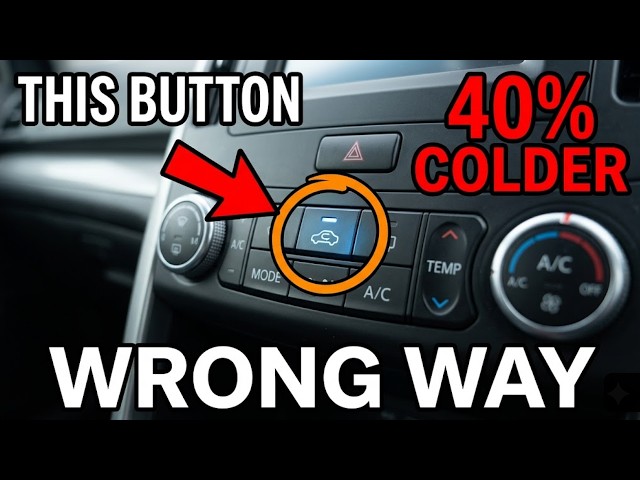
This one simple button can make your AC cool faster, feel stronger, and improve efficiency instantly.
In this video, you’ll learn the correct way to use the AC recirculation button, plus simple maintenance tricks that can restore lost cooling performance without spending money at a mechanic.
If your car AC is weak, not cold enough, or takes too long to cool — this video will show you exactly what to fix step by step.
⏱️ What you’ll learn:
00:00 Why your AC feels weak
01:10 The most misunderstood AC button
02:30 The recirculation method that actually works
05:00 Hidden airflow problems (cabin filter)
07:00 Quick condenser cleaning trick
09:00 Best AC temperature setting
11:00 When this won’t fix your AC
These tips work on almost all cars including Toyota, Honda, Nissan, Suzuki, and more.
Stop wasting money on unnecessary AC repairs — try this first.
Show More Show Less View Video Transcript
0:00
AC recharge $150 to $200 at any shop in
0:04
America. New compressor $800 to $1,500
0:07
installed. Full AC system replacement
0:09
$1,200 to $3,800 depending on your
0:12
vehicle. Here's what most shops won't
0:14
tell you. In 60 to 70% of cases where a
0:17
car AC stops blowing cold, the
0:20
refrigerant is fine, the compressor is
0:22
fine, the entire system is fine. The
0:24
problem costs nothing to fix, and it
0:27
takes under 20 minutes. Japanese
0:29
mechanics have known this for decades.
0:31
American dealerships charge you $200 to
0:34
do something you can do in your driveway
0:36
for free. I'm going to show you exactly
0:38
what it is, exactly why it works, and
0:40
exactly when it won't, because that part
0:42
matters, too. Why Japanese mechanics?
0:45
Before we get into this, let me explain
0:47
why Japanese mechanics specifically.
0:49
Japan has the highest vehicle longevity
0:51
rate in the developed world. The average
0:53
car in Japan runs for 13 years before
0:56
retirement. In the US, that number is
0:58
12.5 years. But the gap is not about the
1:01
cars. It's about the maintenance
1:02
philosophy. Japanese automotive culture
1:05
is built on one principle. Fix the
1:07
simple thing first. Always before you
1:09
spend money, before you replace parts,
1:11
before you touch a single bolt,
1:13
eliminate the free fixes. What you're
1:15
about to learn is one of those free
1:17
fixes. And it applies to virtually every
1:19
car on American roads right now. Why
1:22
your AC stopped working. Let's start
1:24
with what's actually happening inside
1:26
your AC system because understanding
1:28
this is what makes the fix make sense.
1:31
Your car's AC system has five main
1:33
components. The compressor, the
1:35
condenser, the expansion valve, the
1:37
evaporator, and the cabin air filter.
1:39
Most people know about the first four.
1:41
Almost nobody thinks about the fifth
1:43
one. And that is exactly where the
1:45
problem starts. Here is how your AC
1:47
system actually works. Your compressor
1:49
pressurizes refrigerant. That's the
1:51
cooling chemical in the system. That
1:53
pressurized refrigerant travels to the
1:55
condenser, which sits right behind your
1:56
front grill. The condenser releases heat
1:58
from the refrigerant into the outside
2:00
air. The refrigerant then passes through
2:02
the expansion valve where it rapidly
2:04
drops in pressure and temperature,
2:06
becoming extremely cold. That cold
2:08
refrigerant then passes through the
2:10
evaporator, which sits inside your
2:12
dashboard. A blower fan pushes air
2:14
across the evaporator. That air gets ice
2:17
cold and that cold air travels through
2:19
your vents, but only after it passes
2:21
through one more thing, your cabin air
2:23
filter. That filter sits between the
2:25
evaporator and your vents. Every single
2:27
cubic foot of air that comes out of your
2:29
AC has to pass through it. When that
2:31
filter is clean, air flow is
2:33
unrestricted. Cold air flows freely. AC
2:36
feels powerful. When that filter is
2:38
clogged, and in most American cars it
2:40
is, the evaporator is producing ice cold
2:43
air that has nowhere to go. It's like
2:45
trying to breathe through a wet cloth.
2:47
The AC system is working perfectly. You
2:50
just can't feel it. According to a 2019
2:52
study by the Car Care Council, in one in
2:55
five vehicles on American roads, a cabin
2:57
air filter is so clogged, it's
2:59
measurably reducing AC performance.
3:02
That's over 50 million cars right now
3:04
driving around with perfectly functional
3:06
AC systems that feel weak because of a
3:09
$15 filter. The condenser problem. The
3:12
cabin filter is problem number one.
3:13
Problem number two sits at the front of
3:15
your car and it's completely invisible
3:17
unless you know where to look. Your AC
3:20
condenser. The condenser is a thin
3:22
radiator-l like component that sits
3:24
directly behind your front grill. It
3:26
releases heat from your refrigerant into
3:28
the outside air. For this process to
3:29
work efficiently, air needs to flow
3:31
freely through it. Now, think about
3:33
where it sits. Right behind the grill.
3:35
Every bug, every piece of road debris,
3:37
every leaf, every piece of dirt that
3:39
enters through your front grill hits the
3:41
condenser. Over years of driving, the
3:43
condenser fins get packed with debris.
3:45
Air flow gets restricted. The condenser
3:47
can't release heat efficiently. The
3:49
refrigerant stays warmer than it should.
3:51
Your AC output drops. A study by the
3:53
Society of Automotive Engineers found
3:55
that a condenser operating at 80% air
3:58
flow efficiency produces approximately
4:00
15 to 20% less cooling capacity than a
4:03
clean condenser on a 95° day. That
4:06
difference is the gap between
4:07
comfortable and miserable. The Japanese
4:09
fix for this, a garden hose. 15 minutes,
4:12
zero cost. I'll show you exactly how in
4:14
a moment. But first, there's a third
4:16
factor that almost nobody talks about.
4:18
The recirculation secret. There is one
4:20
button in your car that can increase AC
4:23
efficiency by up to 30% instantly. Most
4:26
American drivers use it incorrectly
4:28
every single day. The recirculation
4:30
button. You know the one. It usually
4:32
shows a car with a circular arrow inside
4:34
it. Most people press it occasionally,
4:35
forget about it, or never use it at all.
4:37
Here's what it actually does. When
4:39
recirculation is off, your AC pulls hot
4:42
outside air into the cabin, cools it
4:45
down, and pushes it through your vents.
4:46
On a 95° summer day, your AC is
4:49
constantly fighting to cool down 95°
4:52
air. When recirculation is on, your AC
4:55
pulls air from inside the cabin, recalls
4:57
it, and pushes it back through the
4:59
vents. The air it's cooling is already
5:01
75° from the previous cycle. Cooling 75°
5:04
air is dramatically easier than cooling
5:07
95° air. A 2021 study published in the
5:10
journal Applied Thermal Engineering
5:12
measured the difference. With
5:13
recirculation on, cabin temperature
5:15
dropped to the target temperature 40%
5:17
faster. Fuel consumption from AC load
5:20
dropped by 7 to 8% and compressor
5:22
cycling became significantly more
5:24
efficient, reducing wear. 40% faster
5:27
cooling from pressing one button
5:28
correctly. The correct way to use
5:30
recirculation, and Japanese mechanics
5:32
are very specific about this, is a
5:34
two-phase approach. Phase one, windows
5:37
down, recirculation off for the first 60
5:39
to 90 seconds after you start the car.
5:42
This pushes the hot air that's been
5:43
baking inside your parked car out
5:45
through the windows. Phase two, windows
5:47
up, recirculation on. Now, your AC is
5:50
cooling already cooled cabin air and
5:52
reaches your target temperature
5:54
dramatically faster. That's it. Free,
5:56
instant. works on every car built in the
5:58
last 30 years. The temperature setting
6:00
science. Here's something that surprises
6:02
almost everyone when they first hear it.
6:04
Setting your AC to the lowest possible
6:06
temperature, maximum cold, is not the
6:09
most efficient way to cool your car.
6:11
Your AC system doesn't produce different
6:13
temperatures. It produces one
6:15
temperature, as cold as the evaporator
6:17
can get, which is typically 35 to 40° F.
6:20
What changes when you adjust the
6:22
temperature dial is how much of that
6:23
cold air gets mixed with warm air before
6:26
it reaches your vents. When you set it
6:27
to maximum cold, you get 100% cold air.
6:31
The system works at full capacity
6:33
constantly. The compressor runs
6:34
non-stop. Here's the problem. A
6:36
compressor running non-stop cycles
6:38
faster, generates more heat, and puts
6:40
more load on your engine. On a very hot
6:42
day, this can actually reduce cooling
6:45
efficiency because the system is working
6:47
so hard it can't maintain optimal
6:49
refrigerant temperatures. The Japanese
6:51
approach, and this is backed by Toyota's
6:53
own internal research published in 2018,
6:56
is to set the temperature to 72 to 74° F
7:00
rather than maximum cold. Allow the
7:02
system to reach that temperature, then
7:04
maintain it. The compressor cycles more
7:06
efficiently. The system stabilizes and
7:08
the actual cabin temperature ends up
7:10
lower and more consistent than running
7:12
on maximum cold constantly. Set it, let
7:15
it stabilize. Don't touch it. Your AC
7:17
will work harder with less effort. Now,
7:19
let's put everything together into the
7:21
complete Japanese AC optimization method
7:24
step by step. Step one, the cabin air
7:27
filter. Open your glove box. Press the
7:29
sides inward to lower it past its stops.
7:31
The filter housing is right there. Pull
7:33
it out and look at it. If it's gray,
7:35
brown, or you can't see light through
7:37
it, replace it. A cabin air filter costs
7:39
$10 to $20 at any auto parts store.
7:42
Takes five minutes to replace with zero
7:44
tools. But here is something most people
7:46
don't know. If the filter is only
7:48
moderately dirty, you can extend its
7:50
life significantly. Take it outside and
7:52
use compressed air to blow out the
7:54
debris from the clean side backward
7:56
through the filter. This won't restore a
7:58
completely dead filter, but it can add
8:00
months of life to a moderately dirty
8:02
one. Result: immediate air flow
8:04
improvement through your vents. In
8:05
severe cases, this single step can make
8:08
your AC feel 30 to 40% stronger
8:11
instantly. Step two, the condenser
8:13
clean. Park your car, pop the hood, and
8:15
look through your front grill. You'll
8:16
see the condenser, a thin grid of fins,
8:18
usually black or silver, sitting right
8:20
behind the grill. Get a garden hose with
8:22
a gentle spray setting, not a pressure
8:25
washer. Pressure washers bend the
8:26
delicate fins and cause permanent
8:28
damage. A regular garden hose only.
8:31
Spray through the grill directly at the
8:33
condenser. Work from top to bottom.
8:35
You'll see debris, bugs, and dirt
8:36
washing out from the other side. If you
8:38
can access the condenser from the engine
8:40
side, spray from the engine side outward
8:43
through the grill. This pushes debris
8:44
out in the natural direction. Take your
8:46
time, 5 to 10 minutes. Let it dry for 15
8:49
minutes before you start the car. A
8:51
clean condenser can recover 15 to 20% of
8:54
lost cooling capacity according to SAPE
8:56
research. On a hot day, that's the
8:58
difference between comfortable and
9:00
miserable. Step three, the recirculation
9:02
protocol. Exactly as described, 60 to 90
9:05
seconds, windows down, recirculation
9:07
off, then windows up, recirculation on
9:10
every single time you get in the car on
9:12
a hot day, without exception. This
9:14
alone, if you've never used
9:16
recirculation correctly, will make your
9:18
AC feel noticeably stronger within the
9:20
first drive. Step four, temperature
9:22
optimization. Set to 72°, not maximum
9:26
cold. Let the system stabilize for 5
9:28
minutes, then adjust by 1 or 2° if
9:31
needed. Don't keep changing it. Every
9:33
adjustment forces the system to
9:34
recalibrate and interrupts the cooling
9:36
cycle. Step five, the optional upgrade.
9:39
If after steps 1 through 4, your AC is
9:41
still underperforming, and only then
9:44
consider one additional step, an AC
9:46
evaporator cleaner spray. Your
9:48
evaporator can develop mold, mildew, and
9:50
bacteria buildup over time, especially
9:52
in humid climates. This buildup
9:54
restricts air flow and also causes that
9:56
musty smell when you first turn on the
9:58
AC in summer. Products like Winds AC
10:01
cleaner or Johnson's AC evaporator
10:03
cleaner, available for $10 to $20 at any
10:05
auto parts store, can be sprayed through
10:07
the cabin air filter housing directly
10:09
onto the evaporator. They kill bacteria,
10:12
dissolve buildup, and restore air flow.
10:14
Japanese mechanics recommend doing this
10:16
once a year as preventative maintenance,
10:18
particularly before summer begins. Total
10:21
cost of this entire method, $0 to $40
10:24
depending on whether you need a new
10:25
filter and evaporator spray. Dealer cost
10:28
for an AC diagnostic and recharge, $150
10:31
to $250 before they've even identified
10:34
whether there's a real problem, when
10:36
this won't work. Now, the part that
10:38
actually builds trust, when this method
10:41
won't fix your AC. Being honest about
10:43
this matters because there are
10:44
situations where no amount of filter
10:46
cleaning or condenser washing will help.
10:48
And you need to know this upfront.
10:50
Situation one, low refrigerant. If your
10:53
system has a refrigerant leak, the steps
10:55
above won't restore full cooling. Signs
10:57
of low refrigerant. AC blows cool but
11:00
not cold. System takes extremely long to
11:02
cool the cabin even with recirculation
11:04
on. You hear a faint hissing sound near
11:07
AC components. Or your AC works fine in
11:09
the morning, but loses power
11:11
progressively as the day gets hotter. A
11:13
refrigerant recharge at a certified shop
11:15
runs $100 to $200. But here's the
11:18
critical part. If you just recharge
11:20
without fixing the leak, you'll be back
11:22
in the same situation in 6 to 12 months
11:24
and you'll have paid twice. Always ask
11:26
the shop to perform a leak test before
11:28
recharging. A proper leak test costs $50
11:31
to $100 and can save you hundreds.
11:34
Situation two, compressor failure. A
11:36
failing compressor makes a distinct
11:38
noise, a grinding, rattling, or
11:40
squealing sound that appears or becomes
11:42
louder specifically when you engage the
11:44
AC. If you hear this, the steps above
11:46
won't help. But before assuming full
11:48
compressor failure, check the compressor
11:50
clutch. The clutch is the
11:52
electromagnetic mechanism that engages
11:54
the compressor. Sometimes the clutch
11:56
fails while the compressor itself is
11:58
perfectly fine. A clutch replacement
12:00
costs $200 to $400, significantly less
12:03
than a full compressor replacement at
12:05
$800 to $1,500. Situation three,
12:08
electrical issues. If your AC turns on
12:10
and off randomly, the blower fan works
12:12
intermittently, or the system simply
12:14
won't engage at all, you likely have an
12:16
electrical issue. Blown fuse, faulty
12:18
relay, or a failing blower motor
12:20
resistor. These require a proper
12:22
diagnostic, but are often inexpensive
12:24
fixes, $ 20 to $150 in most cases. Check
12:28
your fuse box first. Your owner's manual
12:30
shows the exact AC fuse location. A
12:32
blown AC fuse costs $1 to replace and
12:35
takes 2 minutes. The bottom line on when
12:37
to get professional help. If you've
12:39
completed all five steps of the Japanese
12:41
method and your AC is still not
12:43
performing adequately, get a
12:45
professional diagnostic. But now you'll
12:47
walk into that shop knowing exactly what
12:49
questions to ask, what the tests should
12:51
cost, and what a fair repair price looks
12:53
like. That knowledge alone is worth more
12:55
than the diagnostic fee. Prevention. The
12:57
Japanese approach. Japanese automotive
12:59
culture doesn't just fix problems, it
13:01
prevents them. Here is the preventative
13:03
maintenance schedule that keeps AC
13:05
systems running efficiently for the life
13:07
of the vehicle. Every 12 months or every
13:09
spring before summer begins, replace or
13:12
inspect your cabin air filter. Clean
13:14
your condenser with a garden hose. Spray
13:16
evaporator cleaner through the filter
13:17
housing. Run AC on maximum for 10
13:20
minutes to ensure all components are
13:22
cycling correctly and there are no
13:23
unusual noises. Every 2 years, have a
13:26
certified technician check refrigerant
13:28
level and system pressure. Not because
13:30
you expect a problem, but because
13:31
catching a slow refrigerant leak early
13:34
costs $50 to fix. Catching it after the
13:36
compressor has run dry from low
13:38
refrigerant costs $1,500. Every time you
13:41
use the car in summer, recirculation
13:43
protocol, 60 to 90 seconds, windows
13:45
down, then recirculation on, temperature
13:48
set to 72 every single time. One more
13:51
Japanese tip that costs absolutely
13:53
nothing. Park in shade whenever
13:54
possible. A car parked in direct
13:56
sunlight on a 90° day reaches an
13:59
interior temperature of 130 to 172° F.
14:03
Dealer diagnostic alone is $150.
14:07
Japanese mechanics have known this for
14:09
decades. The information exists. It's
14:12
just never been put together in a way
14:13
that makes it easy for the average car
14:15
owner to act on. Now you have it. If
14:18
this saved you money or if you learned
14:20
something you didn't know before, hit
14:22
the like button. It takes one second and
14:24
it helps this channel reach more people
14:26
who are overpaying for car repairs they
14:29
don't need. Subscribe to Your Motor
14:31
Care. Every week we break down exactly
14:34
this kind of information. Researched,
14:36
verified, and designed to keep money in
14:38
your pocket and your car running the way
14:40
it should. Drop a comment below right
14:42
now. Tell me what your AC is doing. Weak
14:45
air flow, not cold enough, musty smell,
14:48
works in the morning but dies by
14:49
afternoon. Whatever it is, describe it.
14:52
I read every single comment and your
14:54
questions directly shape what we cover
14:56
next on this channel.
#Autos & Vehicles