Up next in 10


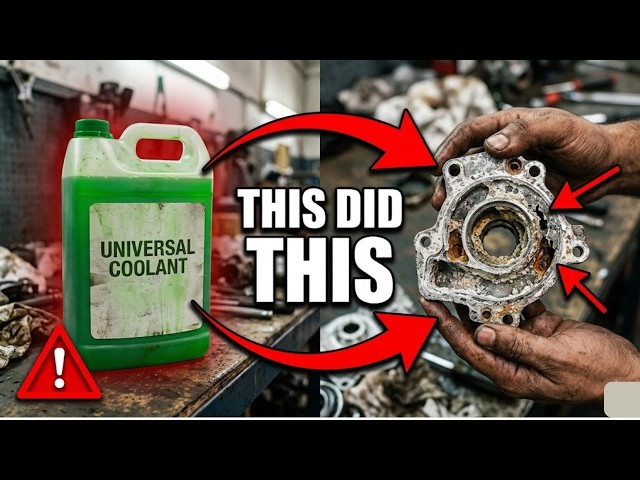
Are you using the wrong coolant in your Toyota, Honda, Nissan, or Mazda? The wrong coolant type can silently cause engine corrosion, water pump failure, and long-term damage — even if your car seems perfectly fine today.
Most car owners don’t realize that Asian vehicles require a completely different coolant chemistry (P-OAT / phosphate OAT) and that using universal or silicate-based coolant can slowly destroy aluminum engine components over time.
In this video, we break down coolant types (IAT vs OAT vs HOAT), explain why Japanese manufacturers banned silicates, and show you exactly what coolant to use for your car based on real engineering standards like JIS K2234.
▶ WHAT YOU WILL LEARN:
— Why coolant is a chemistry problem, not just temperature control
— The difference between IAT, OAT, HOAT, and P-OAT coolant
— Why universal coolant is often the wrong choice
— How the wrong coolant damages water pumps and radiators
— The correct coolant for Toyota, Honda, Nissan, Mazda, and Subaru
— Step-by-step coolant flush guide
▶ BEST COOLANT FOR JAPANESE CARS:
✅ Toyota — Zerex Asian Vehicle / PEAK OET / AISIN ACT002
✅ Honda — Honda Type 2 Blue / Zerex Asian Vehicle
✅ Nissan — Nissan Long Life Antifreeze
✅ Mazda — FL-22 Coolant
✅ Subaru — Super Coolant
Show More Show Less View Video Transcript
0:00
There's a detail in your Toyota, Honda,
0:02
Mazda, or Nissan owner manual that most
0:05
car owners have never read. It is not
0:07
buried in fine print. It's right there
0:09
in the maintenance section. And it says
0:11
that the coolant your engine was
0:13
designed to run on is chemically
0:15
different from most of what is sitting
0:16
on the shelf at your nearest auto parts
0:18
store. Not slightly different, actively
0:21
incompatible, meaning the wrong type
0:23
used over years can corrode the exact
0:25
components it's supposed to protect. And
0:28
here's what makes this story worth
0:29
understanding. It's not a conspiracy.
0:31
The chemistry is in publicly available
0:33
engineering standards. It's printed on
0:35
the correct products if you know what to
0:37
read. Most people simply never looked.
0:39
By the end of this video, you will know
0:41
what your coolant is actually doing
0:43
inside your engine. Why Japanese
0:45
manufacturers specified a completely
0:48
different formula from Western cars.
0:50
What that formula is, and exactly what
0:52
to buy today. No miracle additives, no
0:55
suppressed secrets, just verified
0:57
chemistry and what it means for your
0:59
engine right now. Subscribe so you never
1:01
miss content like this. Every video on
1:03
this channel is built on engineering
1:05
facts you can verify yourself. Why
1:07
coolant is a chemistry problem, not just
1:10
a temperature problem. Most car owners
1:12
think coolant has one job. Stop the
1:14
engine from overheating. That's true,
1:16
but it's only half the picture. And the
1:18
ignored half determines whether your
1:20
engine makes 200,000 miles or develops
1:23
expensive problems well before that.
1:25
Your cooling system is a chemical
1:27
environment. Hot liquid is constantly
1:29
circulating through aluminum cylinder
1:31
heads, metal water pump impellers,
1:33
plastic reservoir tanks, and your
1:35
radiator. In virtually every modern
1:37
Japanese vehicle, almost all of those
1:39
surfaces are aluminum. Aluminum is
1:41
lighter and transfers heat better than
1:43
cast iron, but in the wrong chemical
1:45
environment, it corrods. When two
1:47
different metals sit in contact through
1:49
a conductive liquid, galvanic corrosion
1:52
begins. It works like a slow invisible
1:54
battery. A small electrical current
1:56
flows between the metals and the more
1:58
reactive one deteriorates quietly from
2:00
the inside out. In a cooling system,
2:02
this means aluminum cylinder head
2:04
surfaces can develop microscopic
2:06
pitting. Water pump components can
2:08
erode. Pinhole leaks develop where
2:10
you'll never see them until a pressure
2:11
test reveals them. There's no dashboard
2:13
warning light for internal corrosion.
2:15
The first sign most owners notice is a
2:18
failed water pump or a weeping head
2:20
gasket. The corrosion inhibitors in your
2:22
coolant stop this process and choosing
2:24
the wrong inhibitor chemistry doesn't
2:26
just fail to protect it can actively
2:29
accelerate the damage it was supposed to
2:31
prevent. The three coolant technologies
2:33
and why they are not interchangeable.
2:35
There are three main coolant
2:36
technologies IAT, OAT and HAT. IAT
2:41
inorganic additive technology is the
2:43
classic green antifreeze sold in western
2:45
markets since the 1950s. Its corrosion
2:48
inhibitors are silicates and phosphates
2:50
minerals that coat metal surfaces
2:52
quickly. That speed is its strength. Its
2:54
weakness is that those minerals deplete
2:56
within 2 to 3 years requiring
2:59
replacement every 30,000 mi. IAT was
3:02
designed for cast iron blocks and copper
3:04
radiators, the materials of 20th century
3:06
western engines. OAT, organic acid
3:09
technology, replaces those minerals with
3:11
organic acids, primarily caroxilates.
3:14
These form their protective layer more
3:16
slowly, but are far more stable and last
3:19
dramatically longer, typically 5 years
3:21
or 150,000 mi. GM's Dex Cool is the most
3:25
widely known example. OAT contains zero
3:28
silicates and zero phosphates. HA hybrid
3:32
organic acid technology combines organic
3:35
acids with a small amount of fast acting
3:37
inorganic inhibitor. It delivers quick
3:39
initial protection and long-term
3:41
durability together. Now, here's the
3:43
critical detail that most people miss.
3:45
HA has distinct subtypes that are not
3:48
interchangeable. Silicated HOA uses
3:51
silicates as the fast acting component.
3:54
This is what most European manufacturers
3:56
specify. Mercedes-Benz, BMW, Volkswagen.
3:59
phosphated HOA, also called PO A, uses
4:03
phosphates instead. This is what Toyota,
4:06
Honda, Nissan, and Mazda specify for
4:08
their vehicles. Both can sit on the same
4:11
shelf, both labeled long life or
4:13
extended life. Put the European
4:15
silicated version into a Toyota engine,
4:17
and you're using a chemistry that
4:18
Toyota's own documentation explicitly
4:21
says to avoid. That mismatch is what
4:23
causes real damage over time. And it
4:26
happens constantly because most buyers
4:28
never look past the words long life on
4:30
the label. Why Japanese automakers
4:32
banned silicates and what JISSK2234
4:36
requires. Pull out the owner's manual
4:38
for any Toyota built after 1997 and go
4:42
to the coolant section. You'll find it
4:43
says the coolant must be nonsilicate,
4:46
nonamine, non- nitrate, and non borate,
4:49
not low silicate, nonsilicate zero.
4:52
Honda's documentation is equally direct,
4:54
warning that coolant containing silicate
4:56
inhibitors may cause premature wear of
4:59
water pump seals or blockage of radiator
5:01
passages. These are engineering warnings
5:04
written by the people who designed those
5:06
cooling systems. Here's why. Silicates
5:08
work by depositing a protective film on
5:10
metal surfaces, fast and effective
5:12
short-term, but under repeated high
5:14
temperature cycling, silicates fall out
5:16
of suspension. When they do, they form
5:18
gels or fine particles that stay
5:20
suspended in the coolant. In older
5:22
Western engines with wide passages and
5:24
copper brass radiators, this rarely
5:27
causes serious problems, but Toyota and
5:29
Honda built their modern cooling systems
5:31
around compact aluminum passages and
5:34
ceramic type shaft seals in their water
5:36
pumps. In those systems, silicate gel
5:38
restricts coolant flow in narrow
5:40
passages and silicate particles act as
5:43
an abrasive against ceramic seals,
5:45
wearing them down with every pump
5:47
revolution. The result is accelerated
5:49
seal failure and premature water pump
5:51
replacement. Phosphates provide fast
5:53
aluminum surface coverage without that
5:55
instability. They don't precipitate into
5:58
gels or generate abrasive particles.
6:00
combined with organic acids for
6:02
long-term durability. Phosphated OAT
6:04
chemistry is the correct match for what
6:06
those manufacturers built. This is the
6:08
basis of the Japanese industrial
6:10
standard JISK2234,
6:14
the coolant benchmark that Toyota,
6:16
Honda, Nissan, and Mazda reference for
6:18
their vehicles. Its requirement is not a
6:21
higher concentration of any special
6:23
ingredient. It's the complete absence of
6:25
silicates with phosphatebased organic
6:27
acid technology as the primary
6:29
chemistry. Toyota's genuine super long
6:32
life coolant which meets JISSK2234
6:36
is rated 100,000 mi or 10 years on the
6:39
first fill, then 50,000 mi or 5 years
6:42
after that. That service life comes
6:44
directly from the stability of organic
6:46
acid chemistry. It doesn't deplete on a
6:48
2-year schedule like conventional
6:50
minerals. the right coolant for your
6:52
specific Japanese car. For Toyota on
6:54
most vehicles from 1997 onward,
6:57
silicate-free phosphate enhanced OAT or
7:00
HOAT. Genuine Toyota super long life
7:03
coolant is available at Toyota dealers.
7:05
Verified aftermarket equivalents meeting
7:08
JISS K2234
7:10
include Xerx Asian vehicle peak OE and
7:14
AS act002.
7:16
AS is a Toyota group supplier. It comes
7:18
from the same supply chain as Toyota's
7:20
own factories. For Honda, Honda Blue
7:23
Type 2 or a compatible phosphate OAT
7:26
formula, Xerx Asian vehicle covers most
7:28
Honda applications. For Nissan, Nissan
7:31
Longife Antifreeze, a phosphate OAT
7:33
formula. For Mazda, FL22 specification
7:36
coolant on most models from 2008 onward.
7:39
For Subaru, Super Coolant, another
7:42
phosphate OAT product. When you're
7:44
standing in a store, here's what to look
7:45
for. The phrase for Asian vehicles
7:48
explicit confirmation of silicate free
7:50
the terms P, POT, or phosphate enhanced
7:54
OAT. Avoid conventional green IAT
7:57
coolant, anything listing silicates as a
7:59
primary ingredient, and generic
8:01
universal coolants that don't specify
8:03
Asian vehicle compatibility. Drop a
8:06
comment with your car make, model, and
8:07
year. I read everyone, and if there's a
8:10
chemistry mismatch, I'll flag it for you
8:12
directly. What the wrong coolant does
8:14
over time. The damage from mismatched
8:16
coolant is not immediate. You won't hear
8:18
anything fail when you start the engine.
8:20
It develops quietly over years, which is
8:22
exactly why most owners never connect
8:24
the symptom to the cause. First, water
8:26
pump seal degradation. Silicate
8:28
particles from precipitating
8:30
conventional coolant araid the ceramic
8:32
shaft seals in Toyota and Honda water
8:34
pumps. With every revolution, a minor
8:36
seep becomes a drip becomes a pump
8:39
replacement. Second, restricted coolant
8:41
flow. Silicate gel in compact aluminum
8:43
radiator passages and heater cores acts
8:46
as a flow restrictor. Reduced heater
8:48
output in winter is usually the first
8:50
symptom long before the temperature
8:52
gauge sews anything. Third, inhibitor
8:54
depletion corrosion. When organic acid
8:56
inhibitors are fully consumed in any
8:58
coolant type left past its service
9:00
interval, the coolant becomes mildly
9:02
acidic. That hot acidic liquid cycling
9:05
through your aluminum engine thousands
9:07
of times a week attacks the surfaces the
9:09
depleted inhibitors no longer protect.
9:12
This is what produces the pitting, micro
9:14
leaks, and head gasket failures that
9:16
mechanics find in neglected high mileage
9:18
engines. None of this is inevitable.
9:20
Switch to the correct coolant with a
9:22
proper flush now and the progression
9:24
stops. You can't reverse existing
9:26
corrosion, but you can prevent it from
9:28
advancing. And in a healthy engine, you
9:30
prevent it from starting at all. How to
9:32
do the coolant flush correctly. Five
9:34
steps. No special tools required. Step
9:36
one, confirm your specification from the
9:39
owner's manual before buying anything.
9:41
Don't rely on what is already in your
9:43
car. A previous owner may have used the
9:45
wrong type. Step two, buy the correct
9:48
coolant. Silicate-free phosphate
9:50
enhanced OAT coolant labeled for Asian
9:52
vehicles. Buy concentrate, not premix,
9:55
and get distilled water separately. Step
9:58
three, full drain and flush, not a
10:00
topup. If you're switching from
10:01
conventional coolant, the old fluid must
10:04
come out first. Mixing incompatible
10:06
types doesn't average their properties.
10:08
It compromises both. Drain from the
10:10
radiator petcock, refill with distilled
10:12
water, run to operating temperature,
10:15
drain again, then fill with the correct
10:17
coolant mix. Step four, always dilute
10:19
with distilled water, never tap water. A
10:22
50/50 mix is correct for most climates.
10:24
Going above 70% concentrate actually
10:27
reduces freeze and boilover protection.
10:30
More is not better. Step five, record
10:32
the date and follow the interval. Toyota
10:35
super long life and equivalents are
10:37
rated 10 years or 100,000 mi on first
10:40
fill, then 5 years or 50,000 mi after.
10:45
Market follow it. Total cost, one
10:47
correctly specified jug of coolant
10:49
concentrate and 2 L of distilled water.
10:52
Total time under 1 hour. Here is
10:54
everything in plain terms. Japanese
10:56
automakers specify silicut-free
10:59
phosphate enhanced organic acid coolant.
11:02
This is written in their owner's manuals
11:04
and referenced in JIS K2234.
11:08
It is based on these specific materials
11:10
and tolerances in their cooling system
11:12
designs. Ceramic seals, tight aluminum
11:15
passages, compact radiator geometry. The
11:18
wrong coolant causes three documented
11:20
problems. seal abrasion from silicut
11:22
particles, flow restriction from silicut
11:25
gel, and surface corrosion from depleted
11:27
inhibitors. All three are slow,
11:29
invisible, and expensive when they
11:32
finally show up. The right coolant is on
11:34
the shelf at every major auto parts
11:36
store right now. Zrex Asian vehicle,
11:39
peak, OE, Eizen, ACT00002
11:42
for Toyota. Equivalents for Honda,
11:45
Nissan, Mazda, and Subaru exist on the
11:48
same shelf. You just need to read the
11:50
label correctly. And now you know how.
11:53
Check your manual. Verify what is in
11:55
your car. Flush and refill if there is a
11:57
mismatch. Use distilled water. Follow
12:00
the interval. That's the complete action
12:02
plan. If this gave you something useful,
12:04
share it with someone who owns a
12:05
Japanese car. Most of them have never
12:08
heard of silicate-free coolant and don't
12:10
know their owner's manual has a
12:11
chemistry specification in it at all.
12:13
Subscribe for more content built on this
12:16
standard. Real engineering. verifiable
12:18
facts, nothing you can't check yourself.
12:21
And leave a comment. Has any mechanic
12:23
ever mentioned coolant compatibility or
12:26
JIS K2234 to you? I want to know how
12:29
common that gap actually is. Thank you
12:31
for watching.
#Autos & Vehicles
#Honda
#Toyota