Up next in 10


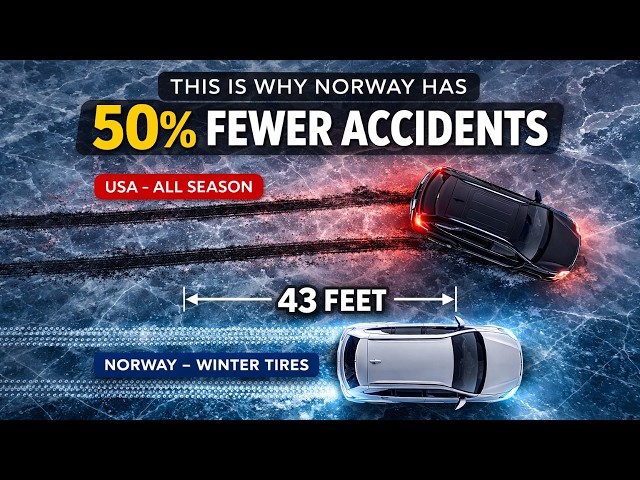
Norway has half the winter accident rate of the United States —
despite having roads twice as dangerous, steeper mountain passes,
longer winters, and almost no road salt. After two weeks of deep
research into Norwegian transport authority data, tire regulations,
and mechanic interviews, I found the system behind those numbers.
And it completely changes how you should think about winter driving.
In this video I break down exactly what Norwegians do differently:
the mandatory winter tire laws, the 3mm tread depth standard that
doubles the EU minimum, why 90% of Norwegians use studded tires
while most Americans have never even seen them, the tire hotel
system that ensures changes never get skipped, and the first 5
kilometers rule that Norwegian driving schools teach every new driver.
This isn't about driving skill. It's about preparation, equipment,
and a completely different philosophy toward winter roads.
⏱️ TIMESTAMPS
0:00 — Introduction: Norway vs USA Winter Accident Rates
1:20 — The Norwegian Winter Tire Law Explained
Show More Show Less View Video Transcript
0:00
Norway has roads that would be closed 6
0:02
months a year in most of America.
0:04
Mountain passes with 15% grades, black
0:07
ice from October to April, blizzards
0:09
that drop 3 f feet overnight. And yet
0:11
Norway has half the winter accident rate
0:14
of the United States. Even though their
0:15
roads are twice as dangerous. After 2
0:18
weeks researching how they do it, I
0:20
discovered something surprising. It's
0:21
not driving skill. It's their tires and
0:24
the system behind them. Most of it
0:26
directly contradicts what American tire
0:28
shops tell you. Let me show you what
0:29
Norwegians do differently and why it
0:31
works. The Norwegian tire system. Here's
0:34
the first thing you need to understand.
0:36
In Norway, winter tires aren't optional.
0:38
They're not a recommendation. They're
0:40
law. November 1st through April 15th,
0:42
every vehicle must have winter tires.
0:45
Not all season, not mud and snow rated.
0:47
Actual winter tires with the three peak
0:50
mountain snowflake symbol. If you're
0:51
caught without them, the fine is 1,500
0:54
Norwegian croner per tire. about $600
0:57
total for a single violation. Police
0:59
spot check vehicles regularly during
1:01
winter months. This is enforced. But
1:03
here's what surprised me. The law
1:05
doesn't just require winter tires. It
1:07
specifies minimum tread depth, 3 mm. Not
1:11
the 1.6 mm that's standard in the rest
1:13
of Europe. Not the 232 of an inch that
1:16
Americans use. Three full millime double
1:19
the standard minimum. Why tread depth
1:21
actually matters. A study by the
1:23
Norwegian Public Roads Administration
1:25
tested weaker tire performance at
1:27
different tread depths. Braking distance
1:29
on ice from 50 km per hour. At 3 mm of
1:32
tread, stopping distance averaged 28 m.
1:35
At 1.6 mm, the EU legal minimum, it was
1:39
41 m, 13 m difference, about 43 ft.
1:43
Three car lengths. The tire still looked
1:45
fine, still had legal tread in most
1:47
countries, but it had lost nearly half
1:49
its grip on ice. This is why Norwegians
1:52
replace winter tires when they hit 3 mm,
1:55
not because the law requires it, because
1:56
they've done the math on stopping
1:58
distance. Most Americans drive on winter
2:00
tires until they're bald or skip winter
2:03
tires entirely and run all seasons year
2:05
round. The studded tire decision. About
2:08
90% of Norwegians drive on studded tires
2:10
in winter. Metal carbide studs embedded
2:13
in the tread. 300 to 400 studs per tire.
2:16
In the United States, studded tires are
2:18
banned in many states where they're
2:20
allowed. Maybe 5 to 10% of drivers use
2:22
them. Norwegians consider them
2:24
essential, and the reason comes down to
2:26
salt. The United States applies 24
2:29
million tons of road salt every winter.
2:31
Norway uses less than 100,000. Because
2:33
of environmental law protecting their
2:35
fjords and water systems, roads stay icy
2:38
longer. Black ice is common. You need
2:40
mechanical grip, not just rubber
2:42
compounds. That's what studs provide.
2:44
Each one is 1 and 1/2 mm of tungsten
2:47
carbide that bites directly into the
2:49
ice, like tiny ice picks on every tire.
2:51
Testing shows studded tires provide 60
2:54
to 80% better braking on ice compared to
2:57
studless winter tires. One mechanic in
2:59
Oslo told me he can instantly tell when
3:01
a driver tried to save money with all
3:03
seasons. He said they come in after a
3:05
near miss every time. Same story. But
3:07
the biggest difference between Norway
3:09
and the US isn't the tires themselves.
3:11
It's how they treat them. The tire
3:13
change culture in Norway. Changing
3:15
between summer and winter tires is
3:17
automatic, cultural. It doesn't get
3:19
postponed. Most Norwegians use what's
3:21
called a tire hotel, a service that
3:23
stores your offseason tires and swaps
3:25
them twice a year. Drop off your car in
3:27
spring, pick it up with summer tires.
3:29
Come back in November, done. About $30
3:31
to $80 US per season. Because
3:33
professionals handle every swap, they
3:35
catch wear issues before they become
3:37
problems. Norwegians see it as basic
3:39
maintenance, like an oil change.
3:41
Americans see it as optional
3:43
inconvenience. That attitude gap shows
3:45
up directly in accident statistics. The
3:47
temperature pressure problem. Norwegians
3:49
check tire pressure constantly in
3:51
winter, weekly, many of them. Not
3:53
because their tires leak, because
3:54
physics. For every 10° C of temperature
3:57
drop, tire pressure decreases by about 1
4:00
PSI. In Norway, temperatures can swing
4:02
30° C from October to January, enough to
4:05
drop 3 to 5 PSI just from seasonal
4:08
change. Underinflated tires in winter
4:10
have poor fuel economy, uneven wear, and
4:13
worst of all, reduced grip precisely
4:15
when you need maximum grip. Most
4:17
Americans set tire pressure once and
4:19
forget it. Norwegians maintain
4:21
manufacturer specification actively
4:23
through the season. This isn't a secret
4:25
technique. It's just diligence.
4:26
Americans skip the first 5 km rule.
4:29
Norwegian driving schools teach
4:31
something specific about winter tire
4:32
behavior. The first 5 km after starting
4:35
your car, drive gently. Low speeds,
4:37
smooth acceleration, no hard braking.
4:40
Cold tires need to flex and generate
4:42
heat to reach optimal grip. Frozen tires
4:44
can cause micro cracking and separation
4:46
between tread blocks. Internal damage
4:48
you'll never see until grip fails. A
4:51
driving instructor in Bergen put it
4:52
simply. The tire is a machine. You warm
4:55
up a machine before you push it. Most
4:57
Americans jump in a cold car and drive
4:59
normally immediately on summer tires or
5:01
all seasons that weren't designed for
5:03
these temperatures. The accident
5:05
statistics that matter. Norway's winter
5:07
accident rate is 15 to 20 accidents per
5:10
10,000 vehicles. The United States is 33
5:13
to 45 per 10,000 vehicles. Norway has
5:17
worse conditions. Steeper roads, less
5:19
salt, more ice, longer winters, half the
5:22
accident rate. The difference isn't
5:24
driving skill, it's preparation. AAA
5:26
estimates that 65% of drivers in snow
5:29
states never buy winter tires. They run
5:32
all seasons year round. Tires that are
5:34
okay in summer, barely adequate in
5:36
winter, and on ice have 30 to 50% less
5:40
grip than actual winter tires. That
5:42
difference translates directly to
5:44
accident rates. The cost benefit
5:46
analysis. A set of studded winter tires
5:48
costs about $600 to $800. Add wheels for
5:52
easier changes, another $300 to 500.
5:54
Storage, 60 to 100 per year. Change
5:57
service, another 100. total roughly 800
6:00
to,200 upfront then 2 to 300 annually.
6:03
Compare that to a single winter accident
6:05
with injuries. Even a minor one costs
6:08
1,500 to 3,000 out of pocket after
6:10
deductibles and premium increases. A
6:13
serious accident runs 10,000 to 20,000
6:16
easily. One prevented accident pays for
6:18
years of winter tires. Norwegians pay
6:21
for the system because they've done the
6:22
math. Americans skip it to save money,
6:25
then pay more in accidents and
6:26
insurance. What you should actually do
6:28
if you drive in winter, do these five
6:31
things. One, buy actual winter tires
6:33
with the three peak mountain snowflake
6:35
symbol, not all seasons. If you're in an
6:38
icy region with minimal road salt, look
6:40
into studded tires if they're legal in
6:41
your state. Two, put them on separate
6:43
wheels. Makes swapping fast protects
6:46
your summer rims. Three, change when
6:48
average temps drop below 7 C, about 45
6:51
Fahrenheit. That's when winter compounds
6:53
start outperforming all seasons. Four,
6:56
replace at 4 mm of tread, not the legal
6:59
minimum. Four, that's when performance
7:01
starts declining. Five, check pressure
7:03
weekly. Maintain manufacturer spec. And
7:06
for the first 5 km after a cold start,
7:08
drive gently. Let the tires warm up. The
7:11
real secret, there is no one secret, no
7:13
trick. The Norwegian approach is a
7:15
system. Legal requirements, cultural
7:18
practices, consistent maintenance,
7:20
appropriate equipment. They don't think
7:21
of winter tires as optional safety
7:23
equipment. They think of them as basic
7:25
necessities like brakes. They don't
7:27
calculate cost against doing nothing.
7:29
They calculate cost against accident
7:31
risk. American culture treats winter
7:33
tires as excessive precaution. Norwegian
7:36
culture treats skipping them as
7:38
unacceptable negligence. Same roads,
7:40
same cars, different philosophy. Half
7:43
the accidents despite worse conditions.
7:45
Your action plan. Before next winter,
7:48
decide whether you want to take winter
7:50
driving seriously. If you do, budget for
7:52
winter tires. Find a shop that offers
7:54
storage. It's available in the US now,
7:56
not just Norway. Set reminders for early
7:58
November and late March. And check
8:00
pressure monthly. It takes 2 minutes.
8:02
For detailed information on winter tire
8:04
selection, studded versus studless
8:06
comparisons and storage options, I've
8:08
written a comprehensive guide at
8:10
yourmocare.com. Free link in the
8:12
description. The Norwegian approach
8:14
isn't complicated. It's just consistent
8:16
and it could cut your accident risk in
8:18
half. If this changed how you think
8:20
about winter tires, subscribe. Thanks
8:22
for watching and next winter drive like
8:24
a Norwegian.
#Autos & Vehicles
#Transportation