0:00
A car came in stalling at every red
0:02
light. No warning light, no obvious
0:04
code. The shop started where any
0:06
reasonable technician would fuel
0:08
delivery, ignition, throttle response, a
0:11
fuel pump, a rebuilt throttle body, two
0:14
ignition coils. Over $1,000 in parts and
0:18
labor later, the car still died at idle.
0:21
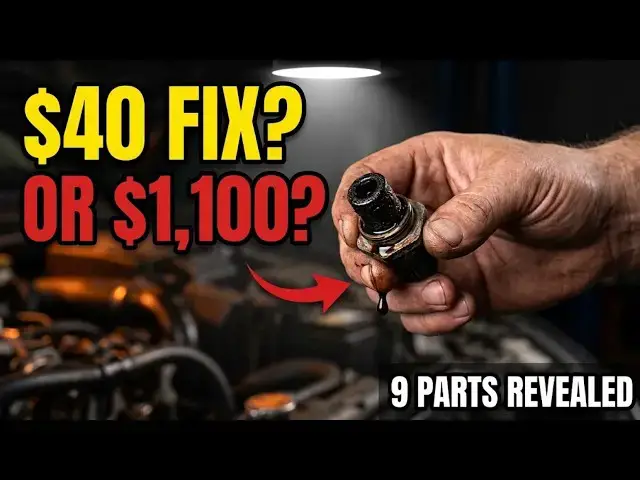
The real problem was a $40 sensor that
0:24
had been sitting under a plastic cover
0:26
the entire time. That is not a story
0:28
about a bad mechanic. That is a story
0:30
about how certain parts fail in ways
0:33
that look exactly like something else,
0:35
and how the diagnostic process, [music]
0:37
when it follows the most expensive
0:39
assumption instead of the most specific
0:41
test, can turn a $40 problem into a
0:46
invoice before anyone finds the real
0:48
answer. There are nine parts on this
0:50
list. Each one fails quietly. Each one
0:53
can mimic something more expensive. And
0:55
by the time we get to number one, you
0:57
will understand exactly why that sensor
0:59
fooled an experienced shop, and what to
1:02
ask for specifically before anyone opens
1:04
your hood. Part nine, the mass airflow
1:07
sensor. This sensor sits in the intake
1:09
duct [music] between your air filter box
1:12
and the throttle body, and its job is
1:14
deceptively [music] simple. Measure
1:16
exactly how much air is entering the
1:18
engine so the computer can deliver the
1:21
right amount of fuel. When it reads that
1:23
airflow incorrectly, whether because
1:25
[music] it is contaminated, partially
1:27
failed, or just dirty, the fuel mixture
1:29
goes wrong. The results can be a rough
1:32
idle, hesitation when you press the
1:34
accelerator, poor fuel economy, and in
1:37
some cases a stall. The check engine
1:39
light may or may not come on. According
1:41
to documented diagnostic experience at
1:44
ASE certified shops, the MAF sensor is
1:48
one of the most frequently misdiagnosed
1:50
components in a modern engine. When it
1:52
generates symptoms, those symptoms can
1:54
resemble a dozen different problems,
1:56
leading to fuel injector cleaning,
1:58
throttle body service, oxygen sensor
2:01
replacement, or idle control valve work,
2:03
none of which address the actual fault.
2:05
Here is the part that makes this
2:07
misdiagnosis particularly costly. In
2:10
many cases, the sensor does not need
2:11
replacing, [music] it needs cleaning. A
2:13
can of MAF specific cleaner costs $10 to
2:18
according to Family Handyman's
2:19
documented repair guide, written by a
2:21
50-year automotive industry [music]
2:23
veteran. Cleaning, rather than replacing
2:25
a dirty sensor, can save $300 or more.
2:29
The procedure takes roughly 20 to 30
2:31
minutes and requires no special tools
2:34
beyond removing the sensor from the
2:35
intake duct. MAF sensor replacement at a
2:38
US [music] independent shop typically
2:40
runs $200 to $400, depending [music] on
2:44
the vehicle, according to verified
2:45
pricing data from RepairPal and multiple
2:48
repair cost databases. On European
2:50
imports, that figure can reach $500 or
2:53
more. The cleaning that would have
2:55
resolved the same symptoms costs a
2:56
fraction of that, and it is routinely
2:59
skipped in favor of a parts replacement
3:01
that generates a more billable repair.
3:03
One additional connection worth noting,
3:05
a dirty or collapsed engine air filter
3:08
is a documented cause of MAF sensor
3:11
contamination. Debris that passes
3:13
through a degraded filter reaches the
3:15
sensor's delicate sensing element.
3:17
Replacing a $20 to $60 air filter and
3:20
reseating the air box at the same time
3:23
can prevent the contamination from
3:25
recurring after a cleaning. [music] Part
3:27
eight, the PCV valve. This one lives
3:29
tucked into the valve cover or buried
3:31
under the intake, depending on the
3:32
engine, and it rarely gets a second look
3:35
unless something has already gone wrong.
3:36
Its [music] job is to recycle the
3:38
pressure and vapor that builds up inside
3:41
the crankcase and route it back into the
3:43
engine to be burned instead of sitting
3:45
there. When it sticks closed, that
3:47
pressure builds with nowhere to go. It
3:50
can push oil past gaskets and seals that
3:53
were never designed to resist that kind
3:55
of sustained force. Owners bring their
3:57
car in for an oil leak. The shop [music]
3:59
may quote a valve cover gasket job or a
4:02
rear main seal, both multi-hour repairs
4:05
that can run several hundred dollars.
4:08
The average cost for a PCV valve
4:10
replacement itself is between $118
4:16
according to RepairPal. But the part
4:18
alone is often $5 to $20. The labor is
4:22
the cost, and it is rarely the first
4:24
thing a shop reaches for. When it sticks
4:26
open instead, it can create a vacuum
4:29
leak. That vacuum [music] leak may show
4:30
up as a rough idle or hesitation pulling
4:33
away from a stop, symptoms that can be
4:35
mistaken for an idle air control valve
4:38
fault or a throttle body issue, both of
4:40
which are more expensive to address.
4:42
[music] Turbocharged engines are
4:44
particularly sensitive to this one. A
4:46
failed PCV system [music] on a
4:48
turbocharged engine can pull oil
4:50
directly into the intake tract and burn
4:53
it quietly, draining a quart between oil
4:55
changes without any visible leak
4:57
underneath. Part seven, [music] the EVAP
4:59
purge valve. If your check engine light
5:01
has illuminated with a code mentioning
5:03
the evaporative emission system, this
5:05
valve deserves a look before almost
5:07
anything else. Its job is controlling
5:09
how fuel vapor moves from the charcoal
5:11
canister back into the engine to be
5:14
burned. When the code comes up, the
5:16
first assumption is often the gas cap.
5:18
Tighten it, clear the code, send the car
5:20
home. Sometimes that genuinely works.
5:22
When the light returns, the next
5:24
assumption tends to be the charcoal
5:26
canister. That repair can run several
5:28
hundred dollars depending on the
5:30
vehicle. The purge valve sits between
5:32
those two guesses in the diagnostic
5:34
sequence, typically costs $40 to $90,
5:37
[music] and can be the actual cause in
5:39
cases where both the gas cap and the
5:41
canister have already been checked
5:43
without resolving the fault. A proper
5:45
EVAP diagnostic, which may include a
5:48
smoke test alongside direct purge valve
5:50
testing, [music] can isolate the fault
5:52
significantly faster than guessing
5:54
through parts replacement. A rough idle,
5:57
a hard start, occasionally a faint fuel
6:00
smell near the engine bay. Those are
6:02
signs this valve may have failed, either
6:04
stuck open or stuck closed. In states
6:06
[music] that require emissions testing,
6:09
this code can fail an inspection
6:11
outright. [music] Part six, carbon
6:13
buildup in the throttle body. Every time
6:15
a modern engine breathes, a small amount
6:17
of oil vapor gets pulled through the
6:19
intake. Over tens of thousands of miles,
6:22
that vapor bakes onto the throttle plate
6:24
and the bore surrounding it. The result
6:26
can be a rough idle, hesitation pulling
6:29
away from a stop, and in some cases a
6:31
stall when the AC is running and the
6:33
engine is trying to hold a low idle
6:35
simultaneously. Those symptoms can be
6:37
mistaken for a failing idle air control
6:40
valve or a bad throttle position sensor.
6:42
Both of those parts are easier to
6:44
address with a scan tool reading. A
6:46
complete electronic throttle body
6:48
assembly can run $250 to $500 installed.
6:52
A proper cleaning with the correct
6:54
solvent [music] and roughly an hour of
6:56
labor costs a fraction of that. One
6:58
honest caveat, on some vehicles, the
7:01
idle requires a relearn procedure after
7:04
throttle body cleaning. If that
7:05
procedure is skipped, the rough idle can
7:08
briefly seem worse before it settles.
7:10
Ask specifically whether a relearn will
7:13
after any throttle body service. The
7:15
next part looks like the simplest
7:17
component in the entire cooling system.
7:19
That simplicity is exactly why it rarely
7:22
gets suspected and why it can send
7:23
drivers straight into conversations
7:25
about repairs that cost 50 times more.
7:28
Part five, the radiator cap. A radiator
7:30
cap is not just a lid. It holds the
7:32
cooling system at a specific pressure,
7:35
and that pressure raises the boiling
7:37
point of your coolant well above the
7:38
212° Fahrenheit that water alone would
7:42
reach. When the seal inside that cap
7:44
weakens even slightly, the system may no
7:47
longer hold that pressure properly.
7:49
Coolant can boil sooner than it should.
7:51
The result can be overheating, coolant
7:53
loss with no visible puddle underneath,
7:56
or a slow overflow from the reservoir.
7:58
Those symptoms overlap significantly
8:01
with early signs of a failing water pump
8:03
or a developing head gasket issue, both
8:06
of which [music] are significantly more
8:07
expensive. A cap tester takes about 2
8:10
minutes to run. It just has to occur to
8:12
someone to reach for it before
8:13
authorizing a cooling system teardown.
8:16
The cap itself costs $15 to $30. Part
8:20
four, [music] the transmission shift
8:22
solenoid. Inside your transmission's
8:24
valve body sit a small number of
8:26
electric solenoids whose job is
8:28
directing hydraulic fluid to the clutch
8:30
pack that needs engagement to move you
8:32
into the next gear. When one starts
8:34
sticking or fails, the symptoms can
8:36
include a delayed shift when pulling
8:38
away from a stop, a hard clunk between
8:41
gears, a transmission that seems to hunt
8:43
between two gears at highway speed, or
8:46
one that locks into a single gear, what
8:48
technicians call limp mode. Transmission
8:50
trouble is among the scariest phrases a
8:53
car owner can hear. The instinct [music]
8:55
can jump immediately to a full rebuild
8:57
or replacement, a repair that can reach
8:59
$2,000 to $4,000 or more. A scan tool
9:03
will often produce a code pointing to a
9:10
solenoid typically ranges from $150
9:13
to [music] $400, including parts and
9:16
labor, according to verified 2025 to
9:18
2026 repair pricing data from RepairPal
9:22
and AutoNation Mobile Service. A very
9:24
different conversation than a full
9:26
rebuild, and one that resolves the
9:27
problem on many vehicles [music] without
9:29
the transmission ever leaving the car. A
9:32
rough shift does not always mean a dying
9:34
transmission. Sometimes it means one
9:37
small electric valve has stopped
9:39
responding correctly. Part three, seen a
9:41
horror out. The coolant temperature
9:43
[music] sensor. This sensor feeds your
9:45
engine computer the information it uses
9:47
to set [music] fuel mixture, idle speed,
9:50
and when the cooling fans activate. When
9:52
it begins to drift, giving the computer
9:54
a reading that does not match the
9:56
engine's actual temperature, the engine
9:58
can run a leaner mixture than it should
10:00
on cold starts, quietly affecting fuel
10:02
economy every morning [music] without
10:04
producing an obvious symptom.
10:07
The version that sends owners into a
10:09
panic is the dramatic temperature gauge
10:11
reading. A sensor that suddenly reports
10:13
a wildly inaccurate temperature can send
10:16
the needle toward the red zone on a
10:18
dashboard with a perfectly [music]
10:20
healthy engine. That one sight sends
10:23
many drivers directly into a head gasket
10:25
conversation. Head gasket repair
10:27
involving cylinder head removal,
10:29
machining, and reassembly [music]
10:31
typically runs $1,500
10:34
to $2,500 or more on most vehicles once
10:38
parts and labor are combined. A range
10:39
[music] documented consistently across
10:42
RepairPal, KBB service estimates, and
10:45
YourMechanic pricing data. The coolant
10:47
temperature sensor that may have
10:48
triggered the gauge reading typically
10:50
costs $20 to $40. Testing it takes
10:53
minutes with a basic resistance check.
10:55
Part two, the downstream oxygen sensor.
10:58
This is the one most people confuse with
11:00
the sensors that actively [music]
11:02
control fuel mixture. The upstream
11:04
oxygen sensors do that work. They sit
11:06
before the catalytic converter and
11:08
directly influence how the engine runs.
11:11
The downstream sensor sits after the
11:13
converter. Its job is monitoring how
11:16
efficiently the converter is doing its
11:18
work, not controlling the engine, just
11:21
observing the converter. When the
11:22
downstream sensor fails, it can throw a
11:25
catalyst efficiency code that on a scan
11:27
tool resembles an [music] actual failing
11:30
catalytic converter. Under federal
11:32
emissions regulations confirmed [music]
11:33
by the EPA, catalytic converters on
11:36
light-duty vehicles must be covered for
11:39
eight years or 80,000 miles, whichever
11:42
comes first, under the federal emissions
11:44
warranty. That warranty is worth
11:46
confirming before authorizing any
11:48
converter replacement on a vehicle
11:50
within that window. The downstream
11:52
sensor causing that code typically costs
11:55
$40 to $80. Replacing it before
11:59
condemning the converter resolves the
12:01
problem in a meaningful number of cases.
12:03
A much larger repair carries a much
12:05
larger invoice, and that tends to shape
12:08
what gets recommended first. Part one,
12:10
the camshaft position sensor. This is
12:13
the $40 part from the opening. Here is
12:15
exactly what it does and why it can fool
12:18
experienced shops. The camshaft position
12:20
sensor tells your engine's computer
12:22
precisely where the camshaft is
12:24
positioned relative to the crankshaft in
12:27
real time. That information determines
12:29
exactly when to fire each fuel injector
12:32
and each spark plug. When the timing
12:34
signal becomes inaccurate or
12:36
intermittent, the engine can run rough,
12:38
stall, [music] lose power, or in some
12:40
cases refuse to start. NHTSA recall
12:43
documentation is direct on this point.
12:45
Ford recall 07-V-553 [music]
12:49
covering over 1 million heavy-duty
12:51
trucks specifically identified
12:53
intermittent camshaft position sensor
12:55
function as a cause of engine stall,
12:58
documenting that the sensor may function
13:00
intermittently, possibly resulting in an
13:02
engine stall. FCA US engineering
13:06
analysis, recorded in NHTSA safety
13:09
investigation documents, confirmed that
13:11
intermittent connection in camshaft and
13:13
crankshaft position sensors is a
13:15
documented stalling failure mode across
13:18
their vehicle platforms. RepairPal's
13:20
verified vehicle problem database lists
13:23
camshaft and crankshaft position sensor
13:25
failure as a confirmed cause of stall
13:27
and no start across multiple makes and
13:30
models. The specific diagnostic
13:31
challenge is this: Intermittent faults
13:34
[music] that recover before a technician
13:36
connects a scanner frequently do not
13:39
store [music] a permanent fault code.
13:41
NHTSA consumer complaint data for
13:44
camshaft sensor failures regularly
13:47
documents stall events with no warning
13:49
light as the presenting symptom. Drive a
13:52
stalling vehicle to a shop and by the
13:54
time a technician plugs in a scanner,
13:56
the engine may be idling perfectly. No
13:58
active fault, [music] no code to follow.
14:01
The diagnostic process then starts from
14:03
scratch, fuel delivery, [music]
14:05
ignition systems, throttle response, all
14:08
reasonable, all beside the point when
14:10
the sensor is the actual fault. It's
14:13
close relationship with the crankshaft
14:15
position sensor matters here. Both
14:17
sensors produce [music] overlapping
14:19
symptoms. Both can fail in ways that do
14:21
not immediately produce a stored code.
14:24
Asking a shop to test both specifically
14:26
before chasing fuel or ignition
14:28
components is the most important
14:30
question an owner can ask when dealing
14:32
with an unexplained intermittent stall.
14:35
The sensor itself typically costs $20 to
14:38
$100 depending on the vehicle with labor
14:41
adding $50 to $150 in most accessible
14:45
locations, making the total repair
14:47
generally between $70 and $250.
14:52
Compare that to a fuel [music] pump, a
14:54
rebuilt throttle body, and two ignition
14:57
coils before anyone found the real
14:59
answer. When this does not work, the
15:01
honest limits. Not every diagnosis that
15:04
considers an expensive repair first is
15:06
wrong. Some of these sensors and
15:08
components fail in ways that genuinely
15:10
require ruling out more serious causes.
15:13
A temperature gauge climbing with actual
15:16
overheating needs to be treated as
15:17
overheating until proven otherwise. A
15:20
transmission showing metal contamination
15:22
in the fluid [music] is communicating
15:24
something different than a single
15:25
solenoid fault. The goal is not to
15:27
assume the cheapest part is always the
15:29
answer. The goal is to confirm that the
15:31
cheapest, most likely part has been
15:33
specifically tested [music] before
15:35
authorizing a larger repair. The
15:37
question, has this specific component
15:39
been tested before moving to the next
15:41
one? Is worth asking at every step of
15:44
any diagnostic conversation. Nine parts.
15:46
Each one fails quietly. Each one can
15:49
mimic something more expensive. The MAF
15:51
sensor that gets replaced when a $15
15:55
would have restored it. The PCV valve
15:57
that gets investigated as a gasket leak.
16:00
The purge valve that sits between two
16:02
more expensive guesses. The throttle
16:04
body carbon that resembles a sensor
16:06
fault. The radiator cap that overlaps
16:08
with cooling system failures. The shift
16:11
solenoid that sounds like a transmission
16:13
rebuild. The coolant temperature sensor
16:15
whose gauge reading triggers a head
16:18
gasket conversation. The downstream
16:20
oxygen sensor whose code resembles a
16:23
catalytic converter failure. And the
16:25
camshaft position sensor documented by
16:28
NHTSA recall records and RepairPal data
16:32
as a confirmed cause of intermittent
16:35
stall without warning that fools
16:37
experienced shops because it fails in a
16:40
way that leaves no code, no light, and
16:42
no obvious starting point. Before any
16:45
repair over $300, ask what was
16:48
specifically tested to confirm that part
16:50
is the cause. That question changes what
16:53
gets recommended. [music] If this video
16:55
is going to save someone from a repair
16:57
they did not need, that is worth a like.
16:59
Pass it [music] to the person in your
17:01
life who is about to hand a shop their
17:03
keys without asking that question first.
17:06
Subscribe to Your Motor Care. Every week
17:08
one automotive system explained honestly
17:11
with the costs [music] verified and the
17:13
caveats included. And drop a comment
17:15
with this. Which of these nine parts
17:18
have you personally paid to replace
17:20
before someone found the real problem?
17:23
Those answers are exactly how the rest
17:26
of us learn where the misdiagnosis tends