live_tv
Livestream Starting Soon
00
Hours
:
00
Minutes
:
00
Seconds
Up next in 10

7 Critical Warning Signs Your Fuel Pressure Regulator Is Failing (Save $1000s!)
Sep 23, 2025

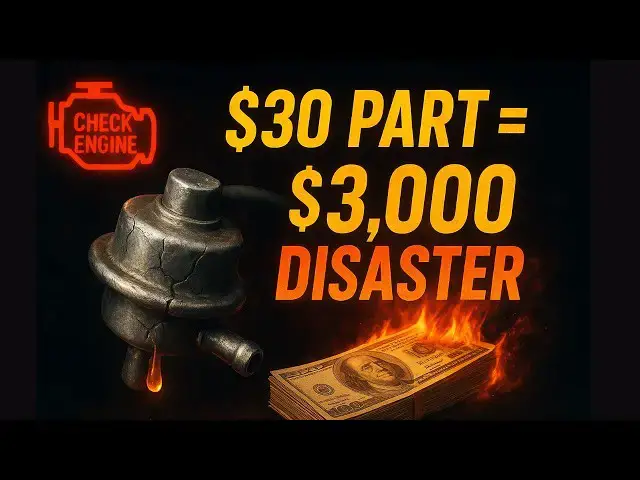
🚗 Is your car showing signs of fuel pressure regulator failure? In this comprehensive guide, I break down the 7 critical warning signs that could save you thousands in repair costs. From check engine lights to poor fuel economy, learn how to identify a failing fuel pressure regulator before it destroys your engine.
💰 COST BREAKDOWN:
Fuel Pressure Regulator: $25-80
Ignoring the problem: $3,000+
Catalytic Converter damage: $800-2,000
⚡️ FOLLOW US FOR MORE CAR TIPS:
Website: https://yourmotorcare.com
Facebook: https://www.facebook.com/Yourmotorcare/
Instagram: https://www.Instagram.com/Yourmotorcare/
fuel pressure regulator symptoms, P0172 code, system too rich, poor gas mileage, rough idle, failed emissions test, car won't start, fuel system problems, check engine light"
Show More Show Less View Video Transcript
0:00
What if I told you there's a $30 part
0:02
hiding in your engine bay that when it
0:04
fails could drain your bank account for
0:07
over $3,000 in cascade failures? Most
0:10
drivers cruise past this ticking time
0:12
bomb every single day, completely
0:15
unaware it's silently sabotaging their
0:17
engine's performance and their wallet's
0:19
future. I'm about to reveal the seven
0:21
unmistakable warning signs your fuel
0:23
pressure regulator is plotting against
0:25
you. And some of these symptoms are so
0:27
sneaky they'll fool even experienced
0:29
mechanics. The conductor of automotive
0:32
chaos. Right now, as you're reading
0:34
this, your engine is performing an
0:36
intricate ballet of combustion. Every
0:39
microsecond, fuel injectors are
0:40
precisely metering gasoline into your
0:43
combustion chambers at exactly the right
0:45
pressure. But there's one tiny component
0:48
orchestrating this entire performance.
0:51
Your fuel pressure regulator. Picture
0:53
this little device as the conductor of a
0:55
worldclass orchestra. When it's
0:57
functioning flawlessly, every instrument
1:00
plays in perfect harmony, creating that
1:02
smooth, efficient power you love. But
1:04
when this conductor loses control,
1:07
complete mechanical mayhem arms. Here's
1:09
what most people don't realize. Your
1:11
fuel pressure regulator isn't just some
1:13
optional accessory. It's typically a
1:16
vacuum operated marvel mounted at the
1:18
end of your fuel rail. Looking
1:19
deceptively simple with its small metal
1:22
housing and single vacuum hose
1:23
connection. Inside this unassuming
1:25
cylinder lives a thin diaphragm membrane
1:28
that responds to vacuum changes like a
1:30
mechanical genius. But here's where
1:32
disaster strikes. That diaphragm will
1:35
eventually tear. It's not a matter of
1:37
if, it's when. And once it fails, fuel
1:40
starts getting sucked directly into your
1:42
intake manifold where it absolutely has
1:44
no business being. Think of it like a
1:46
burst pipe in your house. The damage
1:48
spreads fast and costs big. Warning sign
1:51
number one, your dashboard is screaming
1:53
for help. That check engine light isn't
1:55
just decoration. It's your car's
1:57
desperate cry for attention. When your
1:59
fuel pressure regulator starts failing,
2:01
your engine computer becomes a digital
2:03
detective, noticing something seriously
2:05
wrong with the air fuel mixture. Here's
2:08
the tricky part that stumps countless
2:09
drivers. You won't see a code
2:11
specifically saying replace your fuel
2:13
pressure regulator. Instead, your
2:15
scanner will display codes like P0172
2:19
system too rich. Your car's brain is
2:22
essentially screaming, "There's way too
2:23
much fuel flooding in here, and I can't
2:25
compensate anymore." Ignore this
2:27
warning, and you'll graduate to the
2:28
advanced class of automotive nightmares.
2:31
Soon you'll see misfire codes P 031, P
2:34
032, P 033 marching across your scanner
2:38
like a parade of expensive problems.
2:40
That's because excess fuel is literally
2:42
drowning your spark plugs in gasoline,
2:44
preventing them from creating the spark
2:46
needed for combustion. Don't be that
2:48
driver who sees the check engine light
2:49
and thinks, "I'll deal with it next
2:51
month." Next month might mean replacing
2:53
your entire ignition system. Warning
2:55
sign number two, fuel where fuel should
2:58
never exist. Grab a flashlight and
3:00
prepare for a revelation that could save
3:02
you thousands. Walk over to your engine
3:04
bay and locate that vacuum hose
3:05
connected to your fuel pressure
3:07
regulator. If you spot even a single
3:09
drop of gasoline inside that vacuum
3:11
line, your regulator's diaphragm has
3:13
given up the ghost. This is automotive
3:15
CSI at its finest. Fuel in your vacuum
3:18
system is like finding blood at a crime
3:20
scene. It's irrefutable evidence that
3:22
something catastrophic has occurred. A
3:24
properly functioning regulator maintains
3:26
a perfect seal between fuel and vacuum
3:28
systems. When you find fuel
3:30
contamination in vacuum lines, it's game
3:32
over for that regulator. Think of this
3:34
discovery like finding water in your
3:35
basement after a storm. You don't shrug
3:37
and hope it evaporates. You immediately
3:40
investigate the source and fix the
3:41
breach before structural damage occurs.
3:43
Warning sign number three, your wallet's
3:46
worst nightmare at the pump. Suddenly
3:48
feeling like you're living at the gas
3:49
station. If your fuel economy has taken
3:51
a nose dive and you're watching your
3:53
hard-earned money evaporate into your
3:54
gas tank, your fuel pressure regulator
3:57
might be the silent thief robbing you
3:58
blind. Here's the devastating reality. A
4:01
torn regulator diaphragm creates a
4:03
direct highway for fuel to bypass your
4:05
precisely calibrated injection system.
4:07
Instead of metered amounts delivered
4:09
exactly when needed, raw gasoline gets
4:11
sucked into your intake manifold like
4:13
water through a broken dam. It's
4:15
automotive waste on an epic scale.
4:17
Picture leaving your garden hose running
4:18
24/7 in your backyard. That's
4:21
essentially what's happening inside your
4:22
engine. Constant fuel flow that serves
4:24
no purpose except draining your bank
4:26
account. A failing regulator can slash
4:28
your fuel economy by 30% or more,
4:31
turning your daily commute into a
4:32
financial hemorrhage. Calculate this
4:35
nightmare. If you're spending $150 per
4:37
month on gas, a bad regulator could bump
4:39
that to $200 or more. Over a year,
4:42
that's an extra $600 just floating away
4:44
in wasted fuel. Warning sign number
4:46
four, your engine's angry rebellion.
4:49
Your engine should idle like a content
4:51
cat purring on a sunny window sill,
4:53
smooth, steady, and peaceful. If your
4:55
idle feels more like a paint mixer
4:56
having a seizure, your fuel pressure
4:58
regulator is likely throwing your air
5:00
fuel mixture into chaos. Perfect
5:02
combustion requires a precise 14.7:1 air
5:05
fuel ratio. When excess fuel floods your
5:08
intake manifold through a failed
5:09
regulator, this delicate balance gets
5:11
obliterated. Your engine struggles to
5:13
burn this rich mixture efficiently,
5:15
creating erratic combustion that
5:17
translates into rough vibrating idle
5:19
conditions. Pay attention to your
5:21
tachometer during idle. If those RPMs
5:23
are bouncing around like a hyperactive
5:25
child, don't automatically blame your
5:27
idle air control valve or throttle body.
5:29
A failing fuel pressure regulator could
5:31
be the puppet master pulling the strings
5:33
behind this automotive chaos.
5:35
Professional mechanics know this secret.
5:37
Rough idle combined with rich running
5:38
conditions often points straight to
5:40
regulator failure, not the usual
5:42
suspects most DIY mechanics chase first.
5:45
Performance that's going nowhere fast.
5:47
Remember when your car responded to
5:48
throttle input like an eager athlete? If
5:51
now acceleration feels like you're
5:52
dragging anger through molasses, your
5:54
fuel pressure regulator might be
5:56
sabotaging your engine's power
5:57
potential. Excess fuel doesn't create
5:59
more power, it creates more problems.
6:02
When your combustion chambers are
6:03
flooded with too much gasoline, the
6:05
combustion process becomes inefficient
6:07
and sluggish. It's like trying to start
6:09
a campfire with gasoline instead of
6:11
kindling. You get lots of smoke and
6:13
drama, but terrible results. Your engine
6:15
is essentially drowning in fuel, and
6:17
drowning engines don't make horsepower.
6:19
They make headaches. That responsive
6:21
acceleration you once enjoyed becomes a
6:23
memory as your engine struggles to
6:25
process the fuel overload created by
6:26
regulator failure. This performance
6:28
degradation happens gradually, so many
6:30
drivers adapt without realizing their
6:32
car is operating far below its
6:34
potential. Don't accept poor performance
6:36
as normal aging. Investigate the root
6:39
cause, the emissions test catastrophe.
6:42
Here comes the expensive domino effect
6:44
that transforms a $30 repair into a
6:46
$3,000 nightmare. All that excess fuel
6:49
doesn't magically disappear. It gets
6:51
burned and expelled through your exhaust
6:53
system, creating excessive harmful
6:55
emissions that overwhelm your emission
6:57
control components. Your catalytic
6:59
converter becomes the ultimate victim in
7:00
this scenario. Designed to handle normal
7:03
exhaust output, it gets completely
7:05
overwhelmed trying to process the
7:06
pollution generated by your fuel flooded
7:08
engine. Think of a water filter trying
7:11
to process muddy river water. It's going
7:13
to clog and fail fast. When your
7:15
catalytic converter surrenders to this
7:16
overload, you're looking at replacement
7:18
costs between $800 and $2,000. But the
7:21
damage doesn't stop there. Your oxygen
7:23
sensors, designed to monitor clean
7:25
exhaust gases, also become casualties of
7:28
this rich running condition. Failed
7:30
emissions testing becomes inevitable.
7:32
And in many states, you can't register
7:34
your vehicle until these expensive
7:35
repairs are completed. What started as a
7:37
$30 regulator replacement suddenly
7:40
becomes a multi,000 emission system
7:42
overhaul. The ultimate engine rebellion.
7:45
The final symptom represents complete
7:47
system breakdown, hard starting or total
7:49
no start conditions that leave you
7:50
stranded and frustrated. Here's the
7:52
devastating chain reaction that unfolds
7:54
when you ignore the earlier warnings.
7:56
Excess fuel creates carbon deposits on
7:58
your spark plugs like barnacles on a
8:00
ship's hall. These carbon fouled plugs
8:02
lose their ability to create the spark
8:04
necessary for ignition. I've witnessed
8:06
spark plugs so contaminated by rich
8:08
running conditions that they look like
8:10
they'd been dipped in black paint and
8:11
left to cure. At this stage, you're not
8:13
just replacing a fuel pressure
8:15
regulator. You're looking at new spark
8:17
plugs, possibly fuel injector cleaning
8:18
or replacement, intake manifold cleaning
8:21
to remove carbon deposits, and extensive
8:23
diagnostic time to assess collateral
8:25
damage. The irony is heartbreaking. A
8:28
$30 part that could have been replaced
8:30
in 30 minutes has now created hundreds
8:32
or thousands of dollars in additional
8:34
repairs. The cost-saving revelation that
8:36
changes everything. Here's the financial
8:38
reality check that should motivate
8:40
immediate action. A fuel pressure
8:42
regulator typically costs between $25
8:44
and $80 depending on your vehicle.
8:46
Installation requires basic tools and
8:48
about 30 minutes of your time, even for
8:50
novice mechanics. Compare that modest
8:52
investment to the cascade of expensive
8:54
failures I've just described. Catalytic
8:56
converter replacement $800 to $2,000.
8:59
Oxygen sensor replacement $200 to $400
9:02
each. Spark plug replacement $100 to
9:04
$300. Carbon cleaning services $300 to
9:07
$500. failed emissions testing fees and
9:10
retesting $100 to $200. The math is
9:13
brutally simple. Spend $30 to $80 today
9:16
or potentially spend $3,000 plus
9:18
tomorrow when the damage spreads
9:20
throughout your engine and emission
9:21
systems. Your engine is trying to
9:23
communicate with you through these seven
9:25
warning signs. The question is, are you
9:27
listening? Don't become another
9:28
statistic of automotive neglect. Take
9:30
action now before that small problem
9:32
becomes a financial catastrophe that
9:34
could easily have been prevented.
9:36
Remember, in the automotive world, an
9:39
ounce of prevention truly is worth a
9:40
pound of cure.
#Autos & Vehicles
#Autos & Vehicles
#Vehicle Parts & Services
#Vehicle Repair & Maintenance