0:00
The multiplication rules for probability
0:05
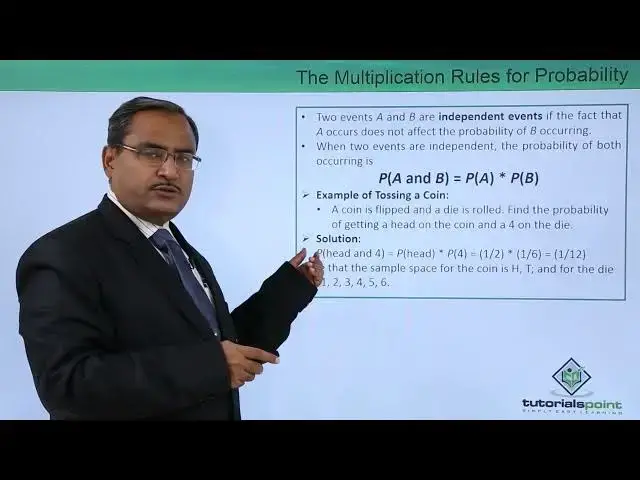
Two events A and B, and they are independent events. That means, in fact, that A occurs does not affect the probability of B occurring
0:15
That means, if A occurs, that will not affect the occurring of B event
0:21
So, when two events are independent, the probability of both occurring can be written in this way
0:27
that is probability of event A and event B is equal to probability of A into probability of B
0:35
And that is the multiplication rule for probability. So, let us take one example for the understanding
0:42
So, example of a of tossing a coin. So, a coin is flipped and a dye is rolled
0:49
So, I am not finding any dependence between them. And find the probability of getting a head on the coin and four on the die
0:56
So, in that case, we are having this solution. So, probability of occurrence of head and occurrence of four can be written in this way
1:05
That is a probability of head into probability of four. So, is equal to 1 by 2 because in case of coin tossing we're having two outcomes, head
1:15
and tail. So 1 by 2 into 1 by 6 and that is our 1 by 12
1:21
So note that the same, the sample space for the coin is head and tail
1:26
And for the die, it is 1, 2, 3, 4, 5, 6
1:30
So, in this way, in this particular example, we have discussed that how the multiplication
1:36
rules for probability can be applied. Thanks for watching this video