Up next in 10

Machine Learning - Probability and Counting Rules - The Addition Rules for Probability
Oct 17, 2024

Machine Learning - Probability and Counting Rules - The Addition Rules for Probability
https://www.tutorialspoint.com/market/index.asp
Get Extra 10% OFF on all courses, Ebooks, and prime packs, USE CODE: YOUTUBE10
Show More Show Less View Video Transcript
0:00
The addition rules for probability
0:05
Two events are mutually exclusive events. If they cannot occur at the same time, that is, they have no outcomes in common, then
0:15
we can use this addition rules for probability. So this addition rules for probability will be applicable between two events when they are
0:25
mutually exclusive events. Let us go for one example. A single die is rolled, getting an odd number and getting an event number in the outcome
0:37
So, they are obviously mutually exclusive. So when two events A and B are mutually exclusive, the probability that A or B will be
0:47
occurring in this way, will be calculated in this way, that is probability of event A or
0:53
even B is equal to probability of A plus probability of B. Let us go for a
0:59
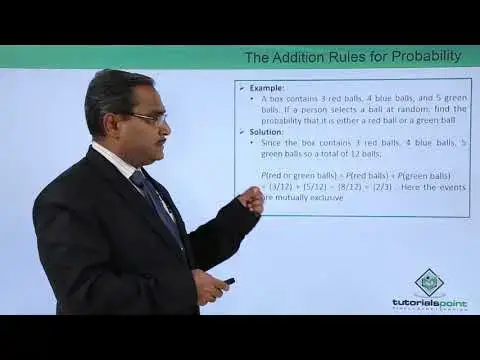
one example. A box contains three red balls, four blue balls and five green balls. If a person
1:08
selects a ball at random, find the probability that it is either a red ball or a green ball
1:15
So, since the box contains three red balls, four blue balls and five green balls, so a total
1:21
of 12 balls, that means three plus four, seven plus five, that is 12. So, probability of red
1:29
or green balls will be the probability of red balls plus probability of green balls
1:36
In the previous slide also we have discussed that one, probability of event A or event B is
1:42
equal to probability of A plus probability of B. So, this is known as the addition rule for
1:47
probability So here in this case we having this 3 by 12 plus 5 by 12 is equal to 8 by 12 is equal to 2 by 3 So here the events are mutually exclusive because at the same time a ball cannot be
2:04
of type red or green simultaneously. If A and B are not mutually exclusive, then the respective formula will be probability of
2:17
A or B is equal to probability of A plus probability of event B minus probability of A and B
2:27
So, here we are having one respective table. You can find that out of this eight nurses we are having seven female and one male
2:36
Out of say five physicians, we are having three female physicians and two male physicians
2:43
So how many female staffs are there? many male staffs are there, how many nurses, how many physicians, we have also done the calculation
2:52
And this is the total number of stops we have considered here
2:56
Now the probability is nurse or male. Nars or male. But we are having some nurses who are also male
3:05
So that's why we are having, they are not mutually exclusive, we are having some common
3:10
So in that case how to calculate? There is a probability of nurse plus probability of male or male
3:16
minus probability of male nurse. So that is 8 by 13. You can easily see that 8 by 13
3:23
That is a probability of nars out of 13 stops. Probability of male
3:29
So probability of male means this one. So 3 by 13 minus we are having only one male nurse
3:35
So minus 1 by 13. So the probability will be 10 by 13
3:40
So in this way, in this video, we have discussed that is the addition rules for probability
3:46
calculation. Thanks for watching this video
#Machine Learning & Artificial Intelligence