Up next in 10


Machine Learning - Concepts and Dimensions of Machine Learning
https://www.tutorialspoint.com/market/index.asp
Get Extra 10% OFF on all courses, Ebooks, and prime packs, USE CODE: YOUTUBE10
Show More Show Less View Video Transcript
0:00
In this video, we are discussing concepts and dimensions of machine learning
0:06
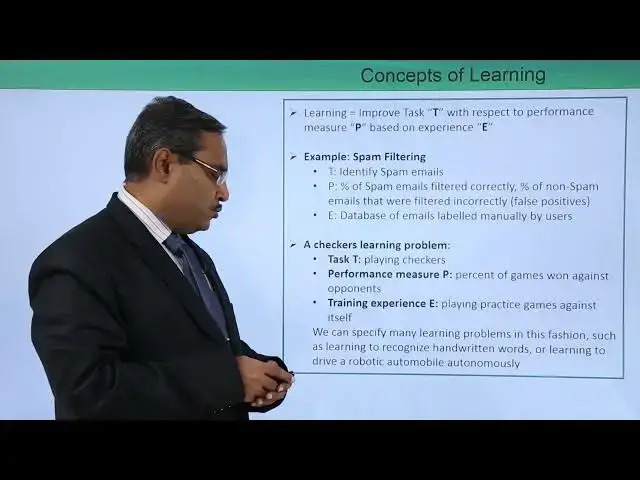
So, learning is equal to improve task T with respect to performance measure P and based on the
0:16
experience E. So, that is very important. So, we know that in case of machine learning, we are applying artificial intelligence
0:24
to the computer so that the computer can learn from the data
0:28
So, obviously, we should know that what is learning? So, learning is equal to improve task T with respect to performance measure P and based
0:40
on the experience E. So, as an example, if you go for the spam filtering
0:46
So, here T is the respective task. So identify spam emails. Next one is the P
0:54
So, P is actually, we'll be denoting the performance measure. So, percentage of spam emails filtered correctly and percentage of non-spam emails that were filtered
1:08
incorrectly, that is a false positive. So, that will decide the respective percentage
1:14
That means a percentage of spam emails filtered correctly and percentage of non-spam emails that
1:22
were filtered incorrectly, that is a false positive, will be denoting the perfect
1:28
measure for this case study And E what is the E is our experience So database of email labeled manually by users
1:39
So let us go for another one. A checkers learning problem. So task is T, playing checkers
1:48
and the performance measure P will be percentage of games own against the opponent
1:54
and training experience E will be the playing practice games against itself. So, this is another example we have considered here. We can specify many learning
2:06
problems in this fashion, such as learning to recognize handwritten words and learning to
2:14
drive a robotic automobile autonomously. So, these are the different examples. Here we
2:20
have considered two of them, but such, so many examples we can give right now. So, that
2:25
is a learning is equal to improve task t with respect to performance measure p and based
2:33
on the experience e you should remember this very particular line and statement another
2:41
example is that that is our signature matching so t that is a task is our determined if
2:48
signature belongs to correct person so that is a task so performance measure so that
2:54
is p percentage of signatures that were correctly matched and percentage of valid signatures that
3:00
were incorrectly labeled as not matching Next one is the E stands for the experience and database of signatures known to be of that person So this is the signature matching
3:14
There is another example of this machine learning. So now we shall discuss what is dimension of learning and what are five dimensions of learning
3:24
So dimensions of learning is nothing but one comprehensive model that uses what researchers
3:30
and theorists know about the learning to define the learning. learning process and there are five types of thinking what we call the five dimensions of
3:40
learning and are essential for a successful learning so let us go for the dimension number
3:46
one that is attitudes and perceptions so attitudes and perceptions affect students
3:52
abilities to learn for example if we can find that if students view the classroom as
3:59
unsafe and disorderly place then obviously the student will be, will not be liking to use that place for their learning process. So, they will learn
4:10
little there. So, that is known as the attitudes and the perceptions. Let us go for the
4:17
dimension number two. So, acquired and integrate knowledge. So, when students are learning
4:25
new information, they must be guided in relating the new knowledge to what they already
4:32
know and organizing that information and then making it a part of their long memory So whenever a student will be learning then that learning should get integrated to their previous knowledge so that the learning will be having a long
4:49
memory in their respective brain. So, we are having this one, that is our dimension number
4:55
three. So, extend and refined knowledge. So learning does not stop with acquiring and integrating
5:03
knowledge. So, learning cannot stop. It will go on acquiring and it will go on integrating
5:08
the knowledge which will be coming next. So learners develop in depth understanding through
5:15
the process of extending and refining their knowledge. Next one, we are going for the dimension
5:21
number four. So use knowledge meaningfully. So the most effective learning occurs when we use the
5:29
knowledge to perform some meaningful tasks. We might be having different knowledge
5:33
but which knowledge has to be applied to one task for the meaningful way that is a great skill
5:39
So, for example, we might initially learn about the tennis records by talking to a friend
5:44
or reading a magazine article about them. Next one, we are having the dimension number five
5:50
That is the last dimension. There is a habits of mind. The most effective learners have developed powerful habits of mind that enable them to think critically
6:01
and think creatively and regulate their behavior. So, in this way, we have defined what are the different dimensions of learning, and there
6:11
are five different dimensions we have discussed each one of them one by one
6:16
Thanks for watching this video
#Machine Learning & Artificial Intelligence
#Machine Learning & Artificial Intelligence