Up next in 10


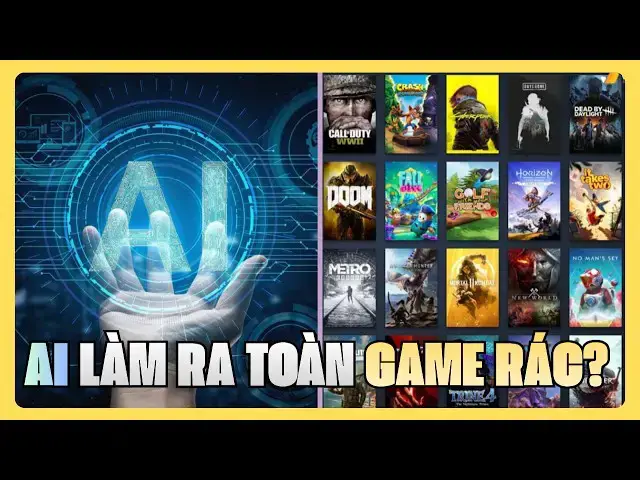
Hãy thử tưởng tượng một ngày nào đó, chỉ với một chiếc máy tính và vài câu lệnh AI, một cá nhân có thể tự tay tạo ra một tựa game hoàn chỉnh. Nghe thì có vẻ tuyệt vời khi ý tưởng bay bổng được hiện thực hóa, nhưng mặt trái của nó là gì? Khi thị trường bị nhấn chìm bởi hàng triệu sản phẩm sản xuất hàng loạt, liệu chúng ta sẽ có những siêu phẩm đột phá, hay phải sống trong thời đại ngập tràn game rác, nội dung đạo nhái và lừa đảo?
Trong video hôm nay, Thế Giới Game Việt sẽ cùng anh em mổ xẻ toàn diện hai mặt của Trí tuệ Nhân tạo (AI) đối với ngành công nghiệp game:
Cuộc cách mạng sản xuất: AI giúp tăng tốc code, phác thảo đồ họa và hạ thấp rào cản cho các studio Indie nhỏ.
Đột phá trải nghiệm người chơi: NPC thông minh, trò chuyện tự nhiên, thế giới mở tương tác linh hoạt thay vì câu thoại máy móc.
Mặt tối & Áp lực lao động: Khảo sát GDC 2026 cho thấy 52% nhân sự lo ngại tác động tiêu cực của AI và nguy cơ tái cơ cấu nhân sự.
Thảm họa "Game Rác" & Lừa đảo: Khi rào cản làm game biến mất, hệ lụy nào chờ đợi game thủ? Cách Steam quản lý nội dung AI.
Liệu AI có làm game mất đi linh hồn? Giá trị thực sự của sự sáng tạo và cảm xúc con người trong trò chơi điện tử.
Anh em đánh giá thế nào về làn sóng AI trong ngành game hiện tại? Liệu AI là trợ thủ đắc lực hay kẻ hủy diệt sự sáng tạo? Hãy để lại ý kiến dưới phần bình luận nhé!
Đừng quên ấn Like, Đăng ký kênh Thế Giới Game Việt và bật chuông thông báo để không bỏ lỡ các video phân tích chuyên sâu tiếp theo!
0:00 Khi một người có thể tự làm game bằng AI: Cơ hội hay thảm họa?
0:53 AI thay đổi quy trình sản xuất game AAA và Indie như thế nào?
2:39 NPC thông minh, trò chuyện linh hoạt – Bước tiến lớn của thế giới mở
4:38 Cơ hội cho studio nhỏ vs. Áp lực mất việc & Khảo sát GDC 2026
6:55 Nguy cơ ngập tràn "Game Rác" khi rào cản làm game biến mất
8:48 Rủi ro lừa đảo, nội dung độc hại và tranh chấp bản quyền trên Steam
#AIGaming #TheGioiGameViet #TriTueNhanTao #GameRác #GameIndie #PhatTrienGame
Show More Show Less View Video Transcript
0:01
Imagine a day where creating a game no
0:03
longer requires an entire studio with
0:05
hundreds of employees. A single person
0:07
at a computer, using ChatGPT,
0:09
image-generating AI, and a few coding
0:11
tools, could turn an idea into a
0:13
complete game. Sounds pretty amazing,
0:15
right? Ideas that once only existed on
0:18
paper. Now have the chance to become
0:19
reality. Open worlds could be more vast
0:21
, and NPCs could converse more
0:23
naturally. Independent developers also
0:24
have a chance to compete with the
0:26
industry giants. But wait, if anyone
0:28
can easily make a game, what happens
0:29
when the market is flooded with
0:31
thousands, or even millions, of
0:33
mass-produced products? Will we play
0:35
better games, or will we live in an era
0:36
where shovelware, plagiarized content,
0:38
and scams become increasingly hard to
0:40
distinguish? Today, join The Gioi Kim
0:43
Viet as we explore the two sides of AI
0:45
in the gaming industry, from
0:46
opportunities that could change the
0:48
future to the risks that we, as gamers,
0:50
need to be wary of. AI is changing how
0:55
games are produced. First and foremost,
0:58
we must acknowledge that AI is opening
1:00
up remarkable possibilities for the
1:02
gaming industry. Look at the
1:03
development process of a Triple-A
1:04
blockbuster. To create a vast open
1:07
world, developers need many departments
1:09
working together. Programmers, artists,
1:12
3D modelers, level designers, writers,
1:14
voice actors, and QA teams. Every
1:17
detail in a game world can take hours,
1:19
days, or even months to perfect.
1:21
That’s not even counting personnel
1:23
costs, bug fixing, performance
1:24
optimization, and delays that cause
1:26
project budgets to skyrocket. But with
1:28
the advent of AI, parts of this process
1:30
can be significantly accelerated. For
1:32
instance, AI can help programmers find
1:34
the source of bugs, suggest code
1:36
snippets, write internal tools, or
1:37
create initial test levels. Artists can
1:39
use AI to sketch character concepts,
1:41
design environments, and experiment
1:42
with various visual styles before
1:44
selecting the right one. Even tasks
1:46
like terrain generation, object
1:47
placement, or building basic assets can
1:49
be automated to a certain extent.
1:51
Instead of starting everything from
1:53
scratch, development teams can use AI
1:55
to create drafts, then refine, test,
1:57
and finalize them with human expertise.
1:59
This is especially significant for
2:00
projects with limited budgets. An indie
2:02
studio with only a few members can now
2:04
handle tasks that were previously
2:06
difficult to manage without additional
2:07
personnel. However, it is important to
2:09
understand that AI speeding up some
2:11
stages does not mean the entire game
2:12
development process will be equally
2:14
faster. A map generated quickly is not
2:16
necessarily interesting to explore.
2:18
Code that runs is not necessarily
2:19
stable when millions of players use it
2:21
simultaneously. A beautifully designed
2:23
character might not fit the artistic
2:25
style of the entire game. AI can create
2:27
materials, but turning those materials
2:28
into a truly engaging game remains a
2:30
major challenge. And that is the core
2:32
point of this revolution. AI not only
2:34
helps the gaming industry save effort
2:36
but also forces us to redefine the
2:37
value of humans in the creative process
2:39
. Smarter NPCs, more vibrant game
2:43
worlds. If AI in production helps
2:45
developers save time, then applying AI
2:47
directly into games is what will make
2:49
us, as gamers, feel the most distinct
2:51
change. Recall those familiar
2:53
role-playing games. When talking to
2:55
NPCs, we usually only have a few fixed
2:57
dialogue options. Whether you ask the
2:59
first time or the tenth, the character
3:01
still repeats the same familiar lines.
3:03
No matter how vast the game world is,
3:05
sometimes the characters make
3:06
everything feel quite robotic. But with
3:09
the combination of large language
3:10
models, voice recognition, and speech
3:12
synthesis, developers can create NPCs
3:14
capable of responding more flexibly.
3:16
Instead of just choosing a
3:18
pre-programmed line, players can try
3:19
asking questions in their own way. NPCs
3:23
can respond based on context, the
3:24
information they possess, or events
3:26
that have already occurred in the game.
3:28
Imagine you are playing an open-world
3:30
Wuxia game. When entering a tavern, we
3:32
could ask the innkeeper about a
3:34
mysterious character, scout for rumors,
3:36
or inquire about a quest without
3:37
necessarily following a fixed dialogue
3:39
tree. If well-designed, this system can
3:41
make every conversation feel more
3:43
unpredictable, helping players immerse
3:44
themselves deeper into the game world.
3:47
AI can also assist in adjusting enemy
3:49
behavior, teammate reactions, or how
3:50
the game presents challenges. Some
3:52
systems can analyze playstyles to help
3:54
personalize the experience. However,
3:57
this is a technological potential, not
3:59
a default feature for every game using
4:01
AI. An NPC might speak very naturally
4:02
but still provide incorrect information
4:04
, break the storyline, or reveal things
4:06
the character shouldn't know. If left
4:08
unchecked, AI can even cause quest
4:10
inconsistency and ruin the immersive
4:12
experience. In other words, an NPC that
4:14
can talk isn't necessarily a
4:16
well-designed NPC. It is important that
4:18
a character's dialogue, behavior, and
4:20
reactions serve the game world rather
4:21
than just showcasing the technology's
4:23
capabilities. And this is also one of
4:24
the most interesting development paths
4:26
to watch. AI can transform game worlds
4:28
from systems programmed with fixed
4:29
responses into more flexible,
4:31
interactive environments. But to turn
4:33
that potential into a truly engaging
4:34
experience, developers still need to
4:36
put in significant effort in design and
4:38
testing. Opportunities exist for small
4:40
studios, but the risk of job
4:42
displacement is also present. One of
4:44
the biggest changes AI brings is the
4:45
ability to lower the barrier to entry
4:47
for the gaming industry. Previously, to
4:49
create a complete game, you needed
4:51
knowledge of programming, graphics,
4:53
sound design, level building, and many
4:55
other skills. If you couldn't handle
4:56
everything yourself, finding partners
4:58
or hiring personnel was almost
4:59
mandatory. Nowadays, AI can assist a
5:01
single person in handling much more
5:03
work. A developer with game design
5:05
skills but poor drawing ability can use
5:07
AI to sketch characters. Those without
5:09
much programming experience can ask AI
5:11
to explain code, debug, or build
5:13
prototypes to test ideas. This is an
5:15
opportunity for unique ideas to emerge
5:17
from small teams instead of just from
5:19
studios with massive budgets. An
5:21
individual or indie developer team can
5:23
absolutely create an excellent game if
5:25
they know how to leverage technology,
5:26
have good design thinking, and spend
5:28
enough time polishing the product. But
5:32
the flip side is that when businesses
5:33
see AI helping one employee do more,
5:35
they might look to reduce headcount or
5:37
restructure their teams. According to
5:40
the 2026 State of the Game Industry
5:42
report by the Game Developers
5:43
Conference, based on a survey of over
5:45
2,300 industry professionals, 36%of
5:47
participants use generative AI tools in
5:49
their work. This rate among those at
5:51
game development studios is 30%, while
5:53
for those in publishing, support, and
5:55
marketing firms, it is 58%. Even more
5:58
noteworthy is the attitude of game
6:00
makers themselves. In this survey, 52%
6:02
of participants believe generative AI
6:04
is negatively impacting the industry,
6:06
up from 30%in the 2025 report. Only 7%
6:09
view the impact of this technology as
6:11
positive. These figures show that while
6:13
AI is becoming part of the workflow, it
6:15
does not mean everyone in the industry
6:17
is excited about it. However, we must
6:19
also fairly acknowledge that the game
6:20
industry has undergone many rounds of
6:22
layoffs due to restructuring, revenue,
6:24
costs, and market shifts. We cannot
6:26
take all layoff figures and conclude
6:28
that AI is the direct cause. What is a
6:30
well-founded concern is that jobs
6:32
capable of being partially automated
6:33
will face pressure to change. Workers
6:35
may have to learn new skills, pivot to
6:37
tasks requiring deeper expertise, or
6:39
compete in an increasingly demanding
6:41
job market. Therefore, the question is
6:43
not simply whether AI will replace
6:45
humans or not. The real question is,
6:47
when AI does more work at a lower cost,
6:49
how will the value of game developers
6:50
be assessed, and who will benefit most
6:52
from this change? When anyone can make
6:57
games, will the market be flooded with
6:59
junk? This is perhaps the downside that
7:01
gamers need to be most concerned about.
7:02
Just imagine, previously, a person
7:04
wanting to release a game had to invest
7:06
time, build content, hire artists,
7:08
write source code, and test the product
7:09
. Those stages created a certain
7:11
barrier that made mass-producing games
7:13
far from simple. But when AI can help
7:15
generate images, write dialogue,
7:17
produce code, and create assets at high
7:19
speed, making simple games becomes much
7:21
more accessible. On the positive side,
7:23
this is an opportunity for small
7:24
developers to bring their ideas to
7:26
players. But if someone is only
7:28
interested in quick profits, this
7:29
technology can also become a tool to
7:31
mass-produce shallow games. We can
7:33
envision a process as follows. Use AI
7:35
to generate character images, ask a
7:37
chatbot to write a simple plot, grab
7:39
existing source code, change the
7:41
interface, and release various games.
7:43
Of course, using AI to create assets or
7:45
reuse source code isn't all there is to
7:47
making games; the issue lies in whether
7:49
the product invests in gameplay,
7:51
creativity, quality, and value for
7:53
players. A game with beautiful visuals
7:55
but boring combat mechanics, repetitive
7:57
tasks, and a shallow story will
7:59
struggle to retain players based on
8:01
appearance alone. More worryingly, as
8:03
the number of products increases,
8:05
finding a truly high-quality game
8:07
becomes more difficult. Seriously
8:08
invested games may have to compete with
8:10
a large volume of similar products,
8:12
making it take longer for gamers to
8:13
choose. The Video Gaming Report 2026 by
8:16
Boston Consulting Group published in
8:18
December 2025 also warns that
8:20
generative AI could create a new wave
8:22
of games, including many low-quality
8:24
products. However, the report also
8:25
acknowledges that some games could
8:27
achieve breakthroughs thanks to this
8:28
technology. This means that AI can both
8:30
disrupt the market and create
8:31
opportunities for ideas that have never
8:33
appeared before. And there is a
8:35
distinction to be made: junk games are
8:36
not synonymous with AI games. A game
8:38
made entirely by hand can still be bad,
8:40
while a game that uses AI can still be
8:42
excellent. What gamers should evaluate
8:44
is the actual quality, not merely
8:46
whether or not the game uses AI. Risks
8:49
of fraud, harmful content, and
8:51
copyright disputes. If junk games
8:53
mainly cause players to waste time or
8:54
money, a more serious issue is that AI
8:56
can be exploited to create products
8:58
with fraudulent intent. Imagine a game
9:00
that advertises that you can earn real
9:02
money just by logging in, completing
9:03
tasks, and battling every day.
9:05
Eye-catching images, epic promotional
9:06
videos, professionally designed
9:08
characters, and tempting promises can
9:09
make many people believe it. But behind
9:11
that appearance, the product may
9:12
require players to deposit money to
9:14
unlock rewards, provide login
9:15
credentials, or access unsafe links. AI
9:17
can help bad actors create more
9:19
persuasive advertising content, images,
9:21
and text at a low cost. However, it
9:23
must be clear that AI does not
9:24
automatically turn a game into malware,
9:26
and not all play-to-earn games are
9:28
scams. The risk stems from humans
9:29
exploiting technology to carry out
9:31
fraudulent acts. Another issue is
9:33
inappropriate content. In games that
9:35
allow AI to generate dialogue, images,
9:37
or content on the fly, the system can
9:39
produce harmful responses,
9:40
misinformation, or content unsuitable
9:42
for children if control mechanisms are
9:44
lacking. In particular, games with
9:45
communication features need content
9:47
filters, reporting mechanisms, and
9:49
clear limits to prevent the abuse of AI
9:50
to harass players or create content
9:52
that violates regulations. Furthermore,
9:54
copyright is also a headache for the
9:56
gaming industry. If a studio uses AI to
9:58
generate characters, music, or content
9:59
that bears a striking resemblance to
10:01
someone else's work, they may face
10:03
intellectual property disputes. The
10:05
commercial usage rights for
10:06
AI-generated assets also depend on the
10:08
tool's terms of service and applicable
10:10
laws. This is not just a far-fetched
10:13
hypothesis. On Steam, Valve has
10:15
established a mechanism for declaring
10:17
AI usage, distinguishing between
10:18
content created during development and
10:20
content generated in real-time during
10:22
gameplay. For content generated by AI
10:24
during gameplay, developers must also
10:26
describe the control measures in place
10:27
to restrict illegal content. This shows
10:29
that game distribution platforms must
10:31
also find ways to adapt to new
10:32
technology instead of only caring about
10:34
whether the game functions. For gamers,
10:37
my advice is quite simple. Download
10:39
games from reliable sources, check
10:41
publisher information, read community
10:43
reviews, and be especially wary of
10:44
games promising unusual profits. Do not
10:46
provide passwords, authentication codes
10:48
, or payment information to
10:50
applications from unknown sources. As
10:51
technology advances, we need to be more
10:53
vigilant when entering the digital
10:55
world. So, does AI cause games to lose
10:59
their soul? This is a question that
11:01
does not have an absolute answer. For
11:03
some gamers, the value of a game lies
11:05
not only in beautiful graphics or
11:07
engaging gameplay but also in the story
11:09
behind it. The way developers build
11:12
characters, the emotion in each piece
11:13
of dialogue, the music tied to
11:15
memorable moments, and the artistic
11:17
mark of the creative team. When a game
11:19
uses too much automatically generated
11:21
content without careful editing,
11:22
players may feel characters lack
11:24
personality, dialogue is generic, and
11:25
the game world lacks consistency.
11:27
However, we should not assume that
11:29
AI-assisted content always lacks
11:31
emotion. A good developer can use AI to
11:33
test many ideas, then select, refine,
11:35
and incorporate only the truly
11:36
appropriate details into the product.
11:38
The deciding factor isn't whether AI is
11:40
used, but whether humans truly invest
11:42
their creativity, emotions, and
11:44
responsibility into the final product.
11:46
A great game doesn't just need to look
11:48
good; it needs players to want to keep
11:50
exploring, care about the characters,
11:51
cherish valuable moments, and want to
11:53
return to that world even after
11:55
finishing it. AI can support the
11:57
process of creating those experiences,
11:59
but the technology itself does not
12:00
guarantee they will emerge. Where is
12:04
the future of the gaming industry
12:05
headed? Overall, AI is opening up two
12:09
paths that can coexist. On the positive
12:11
side, technology helps reduce
12:13
repetitive tasks, supports small
12:14
studios, fosters new ideas, and unlocks
12:16
more engaging forms of interaction. In
12:18
the future, we could see games with
12:20
flexible NPCs, intelligently reactive
12:22
worlds, and experiences that are better
12:24
tailored to each individual player. On
12:28
the negative side, AI could be abused
12:29
to mass-produce content, increase
12:31
pressure on workers, trigger copyright
12:32
disputes, and make it difficult for
12:34
players to distinguish quality products
12:36
. For games created solely for quick
12:38
profit, there is no basis to claim that
12:39
the worst-case scenario will inevitably
12:41
happen. The future also depends on how
12:43
studios use technology, the policies of
12:45
distribution platforms, legal
12:46
regulations, and the reaction of the
12:48
gaming community itself. What we can do
12:50
right now is encourage transparency,
12:52
respect creators 'rights, raise
12:54
moderation standards, and judge games
12:56
based on actual quality. As for
13:01
developers, AI should be a tool to help
13:03
create better games, not an excuse to
13:05
cut corners on testing or release
13:06
unfinished products. As gamers, we also
13:10
need to be open to new technology but
13:12
shouldn't easily accept everything just
13:14
because it's labeled with AI. What do
13:19
you think about the AI wave changing
13:20
the gaming industry? Will AI help us
13:22
experience groundbreaking masterpieces
13:24
that no one previously had the
13:25
resources to create? These two
13:27
technologies will flood the market with
13:29
soulless games, reducing opportunities
13:31
for genuine developers and causing
13:32
human creative value to be overlooked.
13:34
Personally, I don't think AI is the
13:36
enemy of the gaming industry. But if we
13:40
only chase production speed and profits
13:42
, we may lose the very things that make
13:44
video games special. Because after all,
13:46
what makes a game live on in the hearts
13:48
of players is not how fast it was made,
13:50
but the experiences, emotions, and
13:52
memories it leaves behind. Leave a
13:54
comment below and share your own
13:55
perspective. Don't forget to follow The
13:57
Gioi Game Viet to stay updated with the
13:58
latest news, analysis, and perspectives
14:00
on the world of gaming. Goodbye, and
14:01
see you all in the next videos.
Games