Up next in 10



Professor AJ Kooti explains what are Internal Controls for Cash Receipts in Accounting as part of his financial accounting course series.
https://www.youtube.com/watch?v=fRFXGIyh-OI
Show More Show Less View Video Transcript
0:00
All right now let's look at specific internal controls or examples of internal controls for
0:04
cash receipts meaning the cash going out. First one is going to be over-the-counter receipts. I
0:11
want to make sure I have over-the-counter receipts. So all records coming in excuse me
0:15
this is cash coming in all records of cash are on the cash register at the time of each sale
0:20
I want to make sure that every sale that I have goes through cash register because that gives me
0:24
a written record of what is coming in so I can make sure that my cash is meeting what it should
0:29
be. A lot of times when you run a cash register at the end of your shift you
0:33
have to close it out to make sure it you know what's in there is what it should be in there. Also I want again, there it is again, separate custody from the
0:41
record-keeping. Those who keep up with accounting is not the ones that's
0:44
typically on the cash register. You want to keep those two things separate. Another
0:48
thing that we use for internal controls for cash receipts, the cash coming in, is
0:52
what we call cash shorten over. This is a specific account now. This is used to
0:57
account for any errors discovered between the cash in the cash register and the cash receipt amount If you ever worked a cash register you know you had that time where at the end of the shift you count out your drawer and you a dollar short or two dollars short or maybe a dollar over or a quarter over or who knows
1:13
Remember, what we have on our receipt is what we sold. What we have in our drawer is what we
1:18
actually have. So when we're doing the journal entry for that, we want to make sure that they
1:22
match. Our debits have to equal our credits. And sometimes if we're over or we're short
1:26
we have to use an account to force that match with the debits and credits and that's what we're using
1:30
with cash short and over. Let's look at an example of this real quick to see how this works. So after
1:35
removing the starting amount, assume golf company cash register was to have a balance of $600. We
1:43
sold $600 worth of stuff. That's our revenue but it only contained $5.95 at the end of the day
1:49
that's our cash so we're short five dollars okay how would we journalize
1:55
this well first and foremost we have cash it goes up so we're gonna start
2:00
with that debit cash and we're gonna debit the cash for the amount that we actually have which is 595 and then we have the revenue side of it what we actually did the work for rendered the product or the service and we going to call that revenue And that going to be the because that what we earned But we have to make our debits and our credits equal
2:18
So we're missing $5. And what are we going to call that $5? Well, we're going to call it cash
2:22
shortened over. You don't even have to choose which one it is because where you put it in the
2:26
debit or the credit will tell you if it's short or over. Cash shortened over is treated like an
2:31
expense or a revenue. When it's short, it's treated like an expense. It's going to be closed
2:35
out just like an expense. When it's on the credit side or when it's over, it's going to be treated
2:40
like a revenue. So again, it's going to be closed out just like any of the other ones
2:45
And so where it goes will tell you if it's short or over. I want to give you another example just
2:49
to kind of show you the other side of it real quick. What if they were to have 600, but they
2:53
actually had 605. So in this type of equation, this example, we're actually $5 over. So again
2:59
we'll have cash of the 600 because that's our 605 excuse me because that's what we actually had
3:05
We have the revenue of 600 because that what we earned and then this time because we over we going to put the five dollars on the credit side that would mean my debits and my credit equal And I going to call it cash short and over for the again That how you handle cash short and over account
3:20
It's just we'll use it to force it. But it's only for minimal accounts or minimal amounts
3:25
We're not talking about hundreds of dollars here. All right. Lastly, we're going to talk about cash receipts by mail
3:31
Sometimes cash is paid to us through the mail. And we need to come up with some internal controls to keep that amount safe
3:37
And when I say cash, I'm not literally talking currency, sometimes checks
3:41
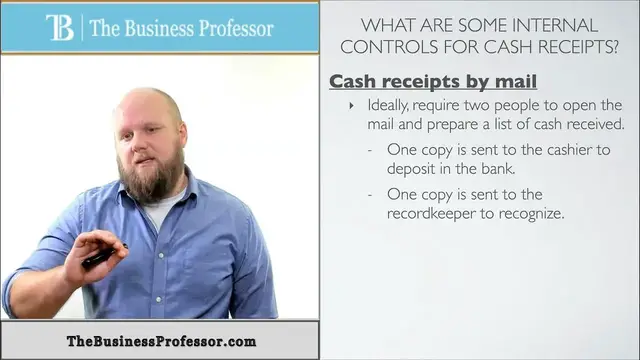
Ideally, you want to require two people to open the mail and prepare the list of the cash received
3:46
So two people open it. Why two? Because it's a lot harder for two people to clue together on everything than one person to keep the same story across the board
3:54
So it's just an extra layer. And when you're opening this cash, one copy is sent to the cashier to deposit in the bank
4:01
They're the ones that's in custody of the cash. and then another copy is sent to the record keeper so they can put it into the books
4:08
So that is the internal controls just specifically for cash received by the mail
4:13
So I hope that made sense to you. Appreciate it
#Arts & Entertainment
#Business Finance
#Accounting & Auditing
#Billing & Invoicing
#Credit Reporting & Monitoring
#Bookkeeping
#Debit & Checking Services