Up next in 10



Professor AJ Kooti explains what is the Depreciation of Long-Term Assets in Accounting as part of his financial accounting course series.
https://thebusinessprofessor.com/en_US/accounting-taxation-and-reporting-managerial-amp-financial-accounting-amp-reporting/depreciation-depletion-and-amortization
Show More Show Less View Video Transcript
0:00
Alright, now let's get into what we've been waiting for this whole time, which is how
0:04
do we expense long-term assets? We use what's called depreciation. And I'm sure you've heard that term before, but not in the sense that we, the way we talk
0:12
about it in accounting. You know, in most of the real world we talk about depreciation and appreciation
0:18
In accounting we don't have appreciation. Depreciation is just the term that we use to expense these long-term assets
0:26
So let's talk about depreciation real quick. This is the process of allocating the cost of the plant asset to expense while it's in use
0:34
So think about this from the perspective of like supplies. You remember we talked about it and again it was exaggerated but we said every time
0:39
we used the supplies up we expensed it. But when you have an asset that's going to be used for multiple years you don't use it up
0:47
You're not going to use your car up. You're not going to lose your tires at the end of the first year and then lose your doors
0:52
in the second year. not using it up but we do need to expense it in the periods that we use them
0:58
Again, following the matching principles. So how do we do that? Again, we use
1:02
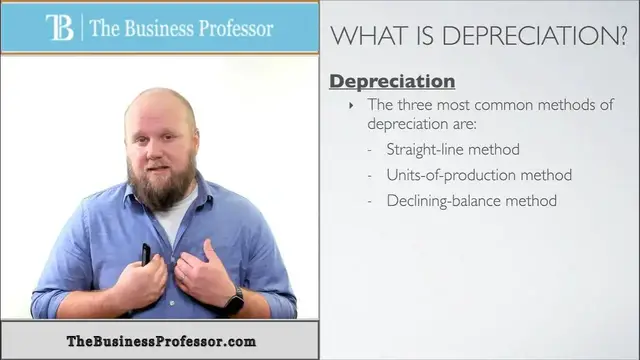
depreciation and there's multiple ways, there's different methods to depreciate things but the most common three are one, excuse me, there are three factors that
1:14
are needed to compute depreciation first. Let me get to this. There are three
1:17
things that you need to have in order to do depreciation or compute depreciation. First is the total asset cost and if you remember that why I put such a big focus on it earlier is why you need to know how to calculate total asset asset cost is because it the first piece to depreciation Second you need to have the salvage value Salvage value is what you plan on getting it back after its useful life So you can kind of think of
1:38
it as the trade-in value of a car. So what is the trade-in value after the five years you keep it
1:42
and use it? It's kind of the same thing. And then we have the useful life, what we think we're going
1:47
to use it in terms of years. Now if you notice, the total asset cost is set in stone. It's exactly
1:53
what you paid for it. The salvage value and the useful life are both estimated numbers. I think
1:57
this is what it's going to be worth in the five years. I think I'm going to use this for five
2:00
years. Those things can change, but the only thing that's set in stone is the total asset cost
2:05
That's why it's so important. Now, let me go back to what I was saying earlier. There are three
2:10
common, the most common methods in terms of depreciation. There are other ones, but these
2:14
are the three most common, especially dealing with intro to financial accounting classes. The first one is the straight line method. As the name implies, it's straight across the board
2:22
The second one is the units of production method. Now we're going to use units to figure out the commonality or the denominator
2:29
the common denominator for how we're going to expense these things. The third one is called the declining balance method
2:35
I look at these as an easy, medium, and hard. You have the straight line method, which is the easy method
2:40
You have the units of production, which is the medium method. And you have the declining balance, which is the hard method
2:46
Straight line has one step. Units of production has two steps. Declining balance has three steps
2:51
That's the way I look at them. So we're going to do them in that order
2:54
So hopefully that made sense and we'll get into the steps in the next video
#Accounting & Auditing
#Physical Asset Management
#Bookkeeping