Up next in 10



Here are 5 questions on the difference between GAAP vs IFRS that you’ll see on the CPA exam.
Show More Show Less View Video Transcript
0:00
Alright in this video I've got five IFRS questions for you
0:06
So let's just get started. The first one, under IFRS, how does a gain or loss qualify as extraordinary
0:19
A, items are not labeled extraordinary under IFRS. B, it has to be infrequent in occurrence
0:29
occurrence, C, it has to be both unusual and infrequent in nature, or D, it has to be unusual in nature
0:40
The answer here is A. Items are not labeled extraordinary under GAP or under IFRS
0:53
Next question. Under GAP, companies can choose from LIFO, FIFO, or AVERS
0:59
for inventory cost methods. What inventory cost methods are allowed under IFRS
1:06
A is only FIFO and averaging. B, only LIFO and averaging. C, only averaging
1:15
Or D, all three methods are allowed. The answer is that under IFRS
1:23
LIFO is not allowed. So that would leave us with A. Felines, FIFO and Averaging
1:33
Specific identification is allowed under IFRS as well in certain circumstances but in general for the test you going to see questions like this So the answer is FIFO and averaging Just remember that under IFRS LIFO is not allowed
1:51
It's not an inventory cost method that you can use. Next question
1:59
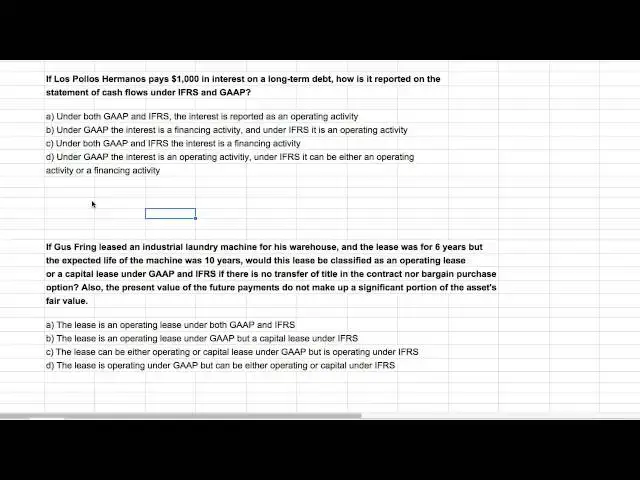
If Los Poyos Armanos pays $1,000 in interest on a long-term debt
2:05
how is it reported on the statement of cash flows under IFRS and GAAP
2:10
Is it A, under both Gap and IFRS, the interest is reported as an operating activity
2:16
Or B, under Gap, the interest is a financing activity and under IFRS it is an operating activity
2:24
C, under both Gap and IFRS, the interest is a financing activity
2:30
D, under Gap, the interest is an operating activity, but under IFRS it can be either an operating activity or a financing activity
2:40
The answer here is D. Under Gap, interest expense and interest revenue is classified as an operating activity for the statement of cash flows
2:56
But under IFRS, interest expense can be either an operating activity or a financing activity
3:10
Next question, if Gus Fring leased an industrial laundry machine for his warehouse
3:16
and the lease was for six years, but the expected life of the machine was 10 years
3:22
would this lease be classified as an operating lease or a capital lease under Gap and IFRS if there is no transfer of title in the contract nor a bargain purchase option Also the present value of the future payments do not make up a significant portion of the asset fair value
3:42
So the answers are A, the lease is an operating lease under both Gap and IFRS
3:48
B, the lease is an operating lease under Gap but a capital lease under IFRS
3:53
C, the lease can be either operating or capital under GAAP, but under IFRS it is an operating lease
4:02
Or D, the lease isn't operating, it is an operating lease under GAAP, but can either be operating or capital under IFRS
4:12
Now, this is a good question because it makes this simple to remember
4:18
this was something that was hard for me when I was trying to kind of memorize the differences between GAP and IFRS
4:29
But what it is, in this case, none of the GAP requirements for capital lease are met in this situation
4:36
So it would be an operating lease under GAP. Under IFRS, the only thing that needs to be there for it to be classified as a capital lease is
4:48
that the life of the lease has to be a major portion of the expected life of the asset
4:55
And 60% meets that definition. So under IFRS, this could be either a operating lease or a capital lease
5:08
So it can be either one. So the answer is D Next question Vomino pest control is being sued for 10 million and their lawyer estimates there a 51 chance of losing 8 million
5:25
and a 49% chance of losing nothing. What should Vominoos record as a loss related to the lawsuit under GAP and IFRS
5:35
A, record a loss of $8 million under both Gap and IFRS
5:39
B, record a loss of 10 million under IFRS and 8 million under Gap
5:45
C, do not record any loss under either method. Or D, record a loss of 8 million under IFRS and no loss under Gap
5:56
So the answer here is D. Under Gap, you would not record a loss in this case
6:05
Under IFRS, a contingent loss must be recognized. if it is more likely than not
6:13
So if it's more likely than it is not likely, then you recognize the contingent loss, the liability
6:23
So a 51% chance is kind of that tipping point where it is more likely than it's not likely
6:31
So 51%. In this case, you would record the liability at $8 million
6:35
Under GAB, the threshold or the word they use is a loss must be probable, which is defined as likely
6:46
51% does not meet that. So under GAAP, you wouldn't record a loss under GAAP
6:55
So those are the five IFRS questions for today, and I hope you learn something new
#Business Education
#Accounting & Auditing
#Bookkeeping