Up next in 10



The American force posture in the Caribbean "resembles preparation for airstrikes" against the Maduro regime, not just cartels.
Show More Show Less View Video Transcript
0:00
The USS Gerald R. Ford, the world's largest and most powerful aircraft carrier, is in the Caribbean
0:06
Is it the latest sign the U.S. is charting a path toward war with Venezuela
0:11
And if so, how might that play out? President Donald Trump deployed the Ford and its strike group to the Caribbean
0:20
to help combat drug smugglers and narco-terrorists in the region. The Ford CSG and its nearly 4,000 personnel join an already impressive list of U.S. assets in the region
0:32
A list that includes another 10,000 sailors and marines aboard an amphibious ready group
0:38
several guided missile destroyers, a not-so-secret special operations vessel called the MV Ocean Trader
0:45
and at least one nuclear-powered submarine. Oh, and for good measure, the U.S. has another 10 F-35B fifth-generation multi-role stealth fighters stationed on Puerto Rico
0:59
It's all more than enough to take out any targets in the area, cartel or otherwise
1:05
Now, we've reported on this before, so for a full breakdown of the legal arguments the White House is using to justify the Caribbean operations, check out SAN.com
1:14
In the meantime, let's go ahead and take a look at how US operations in Venezuela might play out against the Maduro regime
1:21
Obviously we have a map here of the area in question and these different dots represent some but not all of the potential targets the US might hit They are mostly air and naval stations with a few army or dual facilities kind of sprinkled in Like I said not an exhaustive list by any stretch
1:44
but some sites that the U.S. might find some interest in. The El Libertador Air Base, which is
1:52
right here, this yellow dot, that is the main Venezuelan airbase and logistics hub, the country's
1:58
main military complex, and the head of the defense ministry would be located here in the capital of
2:05
Caracas. And on the island of Orchila, that's kind of a strategically located air and naval base
2:12
Venezuela has some forces there as well. As you can see, most of all of these facilities
2:18
are in the northern part of the country along the coastal region. Not a surprise
2:25
most Venezuelans live close to the coast. Now, according to experts at places like the Center
2:31
for Strategic and International Studies, the U.S. does not have enough resources in the area
2:37
to launch a land invasion into Venezuela. There are only about 14,000 total U.S. personnel in the
2:44
region, and American doctrine dictates not getting into a fight like that unless you can overwhelm
2:51
your opponent with vastly superior numbers. Venezuela's combined armed forces total around
2:57
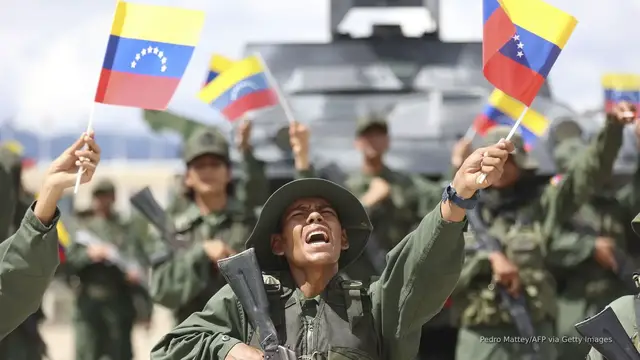
100 and Maduro says the country militia numbers in the tens of thousands So long strikes seem the most likely followed up by a potential for some special operations forces carrying out covert missions To stop incoming U missiles and attack aircraft Venezuela would need to rely on its inventory of mostly Russian air defenses
3:23
systems like the S-300VM or Buk-M2. They are mobile, but Ukraine's armed forces are taking out those systems left and right in its war against Russia
3:33
so it's safe to assume the U.S. is not going to have a problem with the older, mostly outdated systems either
3:40
Venezuela has 18 older U.S.-made F-16s and 31 Russian-made Su-30 fighter jets
3:47
but most are not operational and neither could hold a candle to any of the U.S. fighters in the region
3:55
On the sea, Venezuela's much smaller navy would not hold out long against the U.S. either
4:01
Aside from several smaller missile and patrol boats, including two from Iran, Venezuela's maritime force posture rests on two Corvettes, two frigates, and two non-operational conventionally powered submarines
4:17
If we go ahead and assume the U.S. and Venezuela get into conflict, all signs point to the U.S. owning the skies fairly quickly and enforcing a naval blockade without much pushback
4:29
Now that not to say there might not be a chance for possible American losses but the experts I spoke to while researching this topic said that the Venezuelan military really doesn pose much of a threat to the U Okay so the U owns the skies say that the U also enforces a naval blockade around the northern part of the country At that
4:52
point, F-35s, drones, or a combination of the two could then be used to call in direct fire
4:59
missions on some precise locations like military bases or older runways and airstrips that the
5:06
cartels might also be using. But a large boots-on-the-ground style operation still doesn't
5:13
seem likely. As we said earlier, most of the Venezuelan population lives in the central and
5:18
excuse me, most of the population lives in the north, leaving the central and southern portions
5:24
largely sparsely populated. So U.S. boots-on-the-ground would force most of the Maduro's
5:33
military that is loyal to him and the militia would have really nowhere else to go but south
5:40
into the sparsely populated rural areas, which would create sort of a guerrilla style insurgent
5:48
war similar to what the U.S. faced in Iraq and Afghanistan. So while Congress has declined to
5:56
block the president's current operations against the alleged drug smuggling boats, support for
6:02
military action in Venezuela could and likely would wane the more this conflict escalates
6:10
For more reporting like this, download the Straight Arrow News app today
#news