Up next in 10



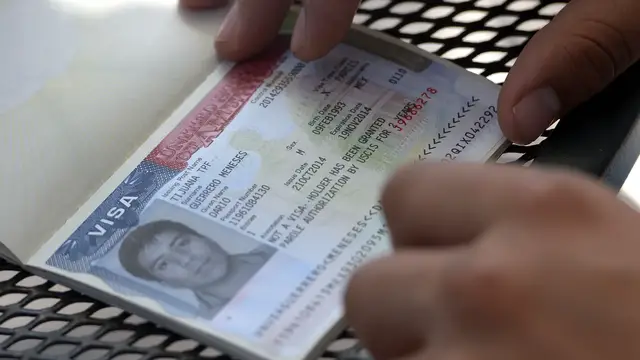
Up to 200,000 people who entered the U.S. on temporary business or tourism visas could lose those visas under a Trump administration review.
Show More Show Less View Video Transcript
0:00
American citizenship, a process that can take years to achieve
0:11
U.S. immigration laws have not changed in decades, but the interpretation and implementation of those laws are constantly evolving
0:19
and that remains a hot topic. So how does one become a citizen of the United States
0:24
Ladies and gentlemen, our newest American citizen. themselves. The path depends entirely on where they start. Some paths lead to the finish line
0:34
others to dead ends. Before we can talk about citizenship, we really need to talk about the
0:39
various types of statuses a non-citizen who's in the U.S. might hold, and then the various paths
0:44
someone who's outside of the U.S. might try to follow to even get into the U.S. with the hopes
0:49
of eventually being able to apply for asylum or for U.S. citizenship. Katie Meyer is the director
0:54
of the Immigration Law Clinic at Washington University in St. Louis and a professor of
0:59
practice. Meyer explains that non-citizens generally fall into four distinct categories. First, there are non-immigrant visa holders. Those are everything from, you know, your temporary
1:11
visas who come to go to Disneyland, to students, to medical workers, to people who work in hotels
1:18
to other types of temporary and seasonal workers in the U.S., okay
1:23
A really broad number of categories. Generally, those non-immigrant visa holders do not have a path
1:31
onto permanent resident status in the U.S. and therefore don't have a path to citizenship
1:37
There are a few programs that might have sort of accompanying programs
1:43
that often lead to permanent status, but they are not designed to lead to permanent status and citizenship
1:49
Second we have the immigrant category those seeking lawful permanent residence There are generally three paths here family employment and the diversity visa lottery However there is another critical path for those who are not coming through the traditional visa system
2:06
specifically refugees and asylees. They enter the U.S. with status, with refugee status
2:14
Asylees are people who came to the U.S., applied for asylum, and were granted asylum
2:18
That is a category of people who in the future will be able to apply for permanent resident status
2:24
making them like immigrants. And then after that, we'll be able to apply for citizenship
2:29
Finally, a fourth group falls outside these categories. They often don't hold traditional
2:35
status, but are a significant population. And I'll call them, you know, people who hold other
2:40
immigration documentation. That includes programs, protections that we hear about a lot on the news
2:47
temporary protected status, DACA, people who have been found approvable for a special visa for
2:56
victims of crimes. Once a non-citizen identifies which category they fit into, the next step is
3:02
usually to apply for a visa. So the normal process is someone who's outside of the U.S
3:08
is petitioned for for most immigrant visa categories. So we're not talking about the
3:12
temporary ones, the permanent visa categories, the actual person who wants to immigrate to the U.S
3:17
cannot apply for themselves. There are very few exceptions. Generally, they must be petitioned for
3:24
So if it's the family-based category, their U.S. citizen close family member, their spouse
3:31
their child over age 21, their parent, or in limited circumstances, their sibling
3:37
must be the one who files the petition. Congress places a limit on the number of visas allowed
3:42
But there are key exceptions. For the spouses of U.S. citizens, the unmarried young children of U.S. citizens, they don't have to wait in a line
3:52
Congress said we not going to cap or limit the number of visas for those family members But most other family members if it employment you need to show that employer still has that position waiting for you
4:04
And that you still have the qualifications for that job. You must prove you're not what the law calls inadmissible
4:12
You're not not able to be admitted into the U.S. under the statute
4:17
In plain terms, you can't have a criminal background. Could be simple arrests, could be prior immigration violations
4:24
Came on a visa and didn't leave when you were supposed to. Could be certain public health grounds, right, if you have certain communicable diseases
4:32
And more increasingly lately, could be if the government has reason to believe you are likely to become a public charge, might need to go on welfare in the future
4:41
Approval rates can vary wildly, often running between 60 and 90 percent, depending on the origin
4:47
If you are approved, you'll use your visa at the border. Your papers are stamped and you are granted lawful permanent resident status
4:55
The first step on the road to naturalization. The actual green card, as we call it, will come in the mail later
5:02
You have to pay a fee to get the card. That will come later. But you are a lawful permanent resident once you enter on an immigrant visa
5:11
The clock starts ticking for those who obtain lawful permanent residence and want to become an American citizen
5:18
To apply for a citizenship, you must live in the United States for a minimum amount of time
5:23
either five or three years. There is an exception for spouses of U.S. citizens
5:28
not other relatives of U.S. citizens, but spouses. The idea is Congress has sort of long had this idea of, you know, promoting marriage and family unity
5:37
So if you can apply after only three years, three years after getting permanent residence
5:42
if you are still married to and living with your U.S. citizen spouse
5:46
at the time you apply and go through the process. You must pass a couple of tests
5:50
prove that you can speak, read, and write English at at least a second grade level You must pass a U history and civics exam You must prove you have been a person of good moral character while living in the U And you must be willing to take the
6:05
oath of allegiance to the United States. And with that, you are now officially an American citizen
6:11
The process is cumbersome, but for those who enter the country illegally, the chance of becoming a
6:17
citizen is very slim. You are not eligible to apply for permanent residence, even if you're
6:23
married to a U.S. citizen, even if you have U.S. citizen kids, if you entered the U.S. without
6:28
permission. The opening line of that statute that Congress wrote says you must have been
6:33
quote, inspected and admitted or paroled into the United States. Basically, to become an American
6:39
citizen, they must leave the country and apply for a visa from their home country. For those
6:44
facing deportation, the battle is an uphill one. You have to be able to prove you've been a person
6:49
of good moral character during 10 years. Plus, the final hardest element is proving that your
6:55
deportation would cause, quote, exceptional and extremely unusual hardship on one or more of your
7:02
qualifying relatives. And the case law has said when Congress wrote exceptional and extremely
7:08
unusual, Congress was very clear that this hardship must be rare. It must go far beyond
7:15
the normal hardship you would expect a family to suffer from separation
7:20
Immigration statutes have remained largely unchanged since the 1990s. Most changes since then have been tweaks in implementation, usually driven by executive authority
7:31
You can have the heads of agencies, you know, at Department of Homeland Security, Department
7:36
of Justice, issue formal regulations. Regulations are rules that are promulgated or put out by the agency that say, this is
7:45
how we are interpreting and applying the law passed by Congress. And you get some wide differences
7:51
between how different administrations will interpret that
news