Up next in 10



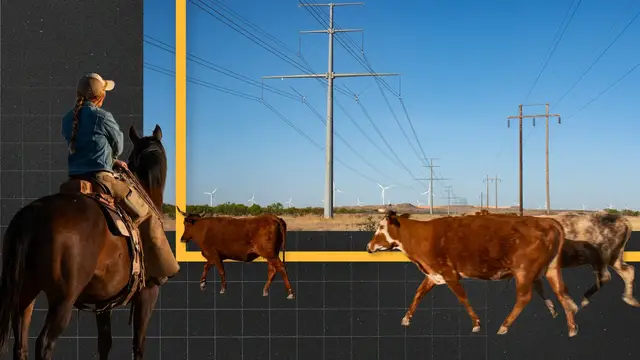
Transmission line routes across private property are driving a wedge between two quintessentially Texan industries: oil and cattle.
Show More Show Less View Video Transcript
0:00
We might have to accept, essentially at gunpoint, a power line that then our kids have to deal with
0:06
Tim Ingalls wants to restore the 40,000-acre frying pan ranch outside of Amarillo, Texas
0:12
that's been in his family since 1881. But the mission he shares with his partners at the company Ranchlands
0:19
is complicated by something we all tend to take for granted, the power grid
0:30
I'm a land and livestock kind of guy. I love cattle and I love taking care of land
0:36
We graze one tiny area really hard. They smash that grass and then you move them off of that
0:42
And then you give that little area a ton of time to recover
0:46
So give it like a year of recovery and then rain and time. And it'll come back even stronger than what it was before
0:53
So we use the electric fence as a tool to force the cattle into those areas that they might not want to be in
0:59
There's already one electric transmission line running through the land, which the ranchers say interferes with their electric fence
1:07
And utility company Accel Energy plans to build three more. They want to construct around seven miles of right-of-way, which is 450 foot wide
1:19
The overall goal is to create a 765 kilovolt power line from eastern New Mexico up to the Potter substation in Amarillo
1:32
But for the last 30 miles, once it gets near Amarillo, they claim that they cannot build a bigger substation to take just a single 765 line
1:42
So they have to downgrade it and widen the footprint and have three of these things rather than just one
1:48
Transmission lines are the highways for the grid that bring electricity from where it's generated to where it's consumed
1:55
How much electricity transmission lines can handle at once is measured in kilovolts
2:00
Texas is planning to build a network of 765 kilovolt lines across the state
2:06
That would be like adding 12-lane superhighways to the map. Those plans place ranchers and private landowners at odds with the oil and gas industry
2:16
The industry wants greater access to electricity in the production hub of the Permian Basin in West Texas and New Mexico
2:25
When the ranchers set up beneath the transmission line, they've encountered problems
2:30
The power lines, they definitely dictate the routes that we can take with our tent fence
2:37
our electric tent fence that we use to separate the pastures up
2:41
If you cross directly underneath the power lines, it'll short your electric line out
2:46
and then it'll actually turn it, like it have frequency when the line is turned off So you end up with yeah just a line that you can use one way or the other In a statement Excel Energy tells Straight Arrow
3:01
electric fencing is commonly used near transmission infrastructure. When properly installed and
3:07
grounded, electric fencing can safely coexist with transmission facilities. Grounding connects a
3:14
circuit to the earth, giving excess electricity somewhere to go. It's a safety mechanism that
3:19
avoids a buildup of voltage that could create a dangerous shock. We have grounding rods that will
3:24
pound into the ground as far as we can go. There's different things you can do to make the
3:30
grounding more effective. You can pour buckets of water on that area. Grounding rods are always
3:35
most effective after a rain. But even with grounding rods, the frying pan team finds the
3:41
fence does not function properly. I imagine that it would only increase it, that it would affect it
3:46
more the more power lines there are. The ranchers worry that Xcel Energy's plans could limit the
3:52
progress they've seen after several years of their grazing technique. A lot of the areas that had
3:58
kind of deeper cattle trails or arroyos are starting to heal up. We've had, you know
4:06
larger wildlife herds than I've really seen growing up here. I mean, just last year, I think
4:11
we had a pronghorn herd of like 35 animals on our ranch, which I hadn't really seen before in my
4:15
life. There's a lot of benefits that we're seeing, and I think there's still a lot more work that we
4:20
can do to figure out how to take it to the next level. This is hardly the first transmission line
4:25
route to ruffle feathers. Julie Cohn, a historian who has written a book on the development of the
4:31
power grid, explains why. Different stakeholders had different perspectives on what a transmission
4:37
line is doing and for whom and how they are either going to be harmed or going to benefit
4:42
That conflict is playing out across the country. A transmission line planned for Missouri and other Midwest states was canceled in 2025
4:51
An eminent domain fight in Georgia has gained national attention. Historically, landowners have gone to extreme lengths to prevent projects
5:00
like farmers in 1970s Minnesota. They'd head out at night with a picnic in their trucks
5:06
and they'd actually pull the tower down and have a little celebration
5:11
In modern-day Texas, a 2023 law called for three east-west transmission lines within the state's isolated power grid run by the Electric Reliability Council of Texas, also known as ERCOT
5:25
Todd Staples is the president of the Texas Oil and Gas Association
5:30
In a statement shared with Straight Arrow, he explains his support for new transmission lines
5:35
Strategic modernization of our transmission infrastructure is essential to support demand from growing sectors like AI and critically the oil and natural gas production and transportation that propel growth in all sectors of the Texas economy The result Landowners suddenly start receiving notices from power companies The load itself is controversial to some people
6:01
This is going to be a really difficult challenge for the Public Utility Commission
6:06
to take into account these opinions and determine what is going to be the best way to accomplish the goals of the legislation
6:14
The Excel power line falls outside of the main Texas grid and is part of the Southwest Power Pool
6:21
It will run from a substation west of Amarillo for 180 miles to a substation southeast of Carlsbad, New Mexico
6:29
There's still a long way to go before Excel has permits in hand. First, the company needs approval from regulators, including the Public Utilities Commission of Texas
6:39
Once approved, Excel can use eminent domain to take the land. Having been through this before, Ingalls thinks his only option is to negotiate for the best possible financial compensation
6:52
But that doesn't mean he agrees with the process. The whole process is pretty invasive
6:58
You know, basically they have these different routes that they select, and then they kind of pit different landowners somewhat against each other, saying, well, I want it to go this way, I want it to go that way
7:06
I think this country was basically founded on the right to have your own property rights without the state taking them or a king taking them
7:14
He's not alone. In the Texas Hill Country, utility company Encore and the Lower Colorado River Authority are partnering to build another 765 kilovolt line
7:26
It's among the first 765 kilovolt lines proposed in Texas, and they could make the grid more efficient
7:32
Jennifer Schmidt is the head of operations at Rhythm Energy, a retail electric company that sells power to consumers
7:40
When you get over 300 miles, give or take, 765 kV is more effective
7:47
You have fewer line losses, you have a lower cost going into getting the power
7:53
to the places where people are using it. The Texas Oil and Gas Association says upgrading the grid benefits all of society
8:01
In his statement to Straight Arrow, the association's president, Todd Staples, said
8:06
Texas's security depends on robust critical infrastructure, including oil and natural gas
8:12
production and data centers, both of which strengthen our economy and meet our nation's
8:17
needs on our soil, not in foreign countries that may not share our best interests
8:22
But the Encore and LCRA line has drawn hundreds of challenges. Dave Clark is a retired accountant who owns property near the proposed route
8:32
He says the transmission line lit a spark in his community. This process has just been horrible for landowners
8:39
In the summer of 2025, landowners received notice from Encore and LCRA
8:44
The companies hosted three public meetings but Smith said they did not provide much information In March the companies mailed out 90 packets informing landowners of final route options
8:56
All of a sudden, landowners who hadn't had any involvement in this in nine months
9:01
are learning for the first time that they're impacted. Clark works alongside the non-profit Friends of the San Saba River
9:08
to help neighbors with the legal process. After the final routes were announced, landowners had about 30 days to decide if they would intervene in the case at the Texas PUC
9:18
That involves hiring a lawyer and filing dozens of pages of testimony on why the route should go around their land
9:25
An administrative judge reviews all of the company's proposed route options and landowner testimony and recommends a route to the commission
9:34
At this point, the fight is over whose land the line will cross, not whether to build it at all
9:41
It's a challenge. And quite frankly, landowners, they're the only people that have anything to lose in all of this
9:51
While landowners face a confusing legal process, all electricity users within the state's ERCOT grid pay a portion of the construction
9:59
We have found in the data that there is a higher percentage of transmission costs being allocated to residential and small commercial customer classes
10:09
Those transmission costs are based on four summer days with the highest electricity demand each year
10:16
Schmidt points out that residents usually run their air conditioning. But large commercial and industrial facilities are more likely to ramp down their power use
10:26
that creates the disproportionate cost share on monthly bills, which she says can get worse
10:34
If you ingest a ton of large commercial and industrial, a ton of data centers
10:38
you start to have that subsidy really lean towards residential and small commercial picking up the bill
10:44
Schmidt says she favors reforming how transmission costs are allocated. Back at the frying pan ranch, Ingalls wants to change how landowners are compensated
10:54
for giving up control of their property. We should be talking about royalty payments
10:59
for as long as these power lines are out there that increase with inflation
11:03
rather than a one-time payment that they can then, you know, just forget after 20 years
11:10
that we have to deal with for the rest of our lives that we own this land. For now, the Ranchlands team
11:17
will continue working their herd of over 1,000 cattle with only one transmission line to navigate around
11:25
I don't really see the public benefit behind this, certainly not as a ratepayer
11:29
not as just a general consumer of electricity. I think it is more for business, by business, and for business
11:38
And somehow that they are still granted eminent domain rights
news