Up next in 10



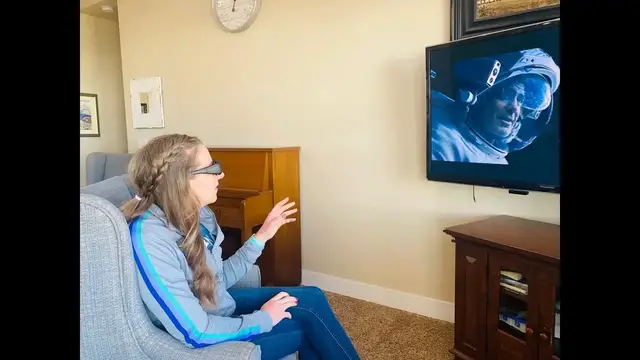
Wouldn't it be amazing if watching TV was the cure to a lifetime of eye problems??
It definitely isn't that easy, but watching 3D movies is a great exercise for strengthening 3D vision and building binocular skills in a simple way.
For the free "Do My Eyes Work Together" Test go to https://strabismussolutions.com/test/
For my recommendations on 3D equipment go to https://strabismussolutions.com/3dtv/
Show More Show Less View Video Transcript
0:00
Hi, my name is Melissa Daniels and I have strabismus
0:03
Strabismus is just when your eyes do not point in the same direction
0:07
This is what my eyes looked like three years ago and over the last three years I've done a
0:13
combination of vision therapy and surgery in order to get my eyes looking pretty straight
0:18
and working pretty well together. One of my favorite activities or exercises that I do for
0:25
my eyes is watching 3D movies. Why? Because it's fun. I can do it with my family. It's something
0:31
that's sustainable, something that I can do long term. So are 3D movies going to fix everyone's
0:39
lazy eye? It's not really lazy eye, it's strabismus, but that's kind of the slang term
0:44
And the answer is no, I'm sorry. There's no easy fix. I wish I could tell you that you could just
0:50
watch movies and it would fix your vision forever, but it's just not realistic and I'm not going to
0:55
lie to you, but it is an amazing exercise once you're already on that path. So in
1:03
this video I'm going to talk about what the problem is, how a 3d TV or 3d movies
1:08
can help, and the equipment you're going to need to get started. The problem with
1:13
strabismus is that your brain doesn't know how to use the input that's coming
1:17
in through each eye. I think of each eye like a camera and the brain's job is to
1:23
to take those two pictures and overlap them into one picture that lines up and has depth
1:28
This is really hard for people with strabismus. And teaching the brain to use both eyes is a very long process
1:37
It's not going to be fixed by one app like Amblyoplay or Vivid Vision or watching 3D movies
1:42
It's going to take in-office vision therapy and a ton of work. Is it worth it
1:46
Of course. It's amazing to have 3D vision, especially after having 2D for my whole life
1:53
but that's the basic idea of the problem. Your brain just doesn't know how to use both eyes and
1:59
so you need to figure out how to use both eyes together. And if you don't know if you're using
2:04
one eye or both eye, I know that when I first started, I had no idea. I'm like, well, I don't
2:08
know. I think I'm using both eyes, but I actually wasn't. I actually made a quiz test, whatever you
2:13
want to call it where you can I think there six different tests that you can take that kind of help you see whether your eyes are working independently or together That is free on my website It strabismusolutions slash test If your eyes are not working together
2:29
or then a 3D movie, what's going to happen is you put on these glasses and each eye is only seeing
2:36
a certain view of the video. So, you know, my right eye is seen from this angle and my left
2:43
eye is seen from this angle and it's mimicking what people see in real life. And then my brain
2:47
takes what each eye is seeing, puts it together in the back of my brain and creates this 3D effect
2:52
of stuff coming out of the TV, stuff going behind the TV, right? So if you're only using one eye
2:59
like I was before I started this whole process, then you're just only going to see from the left
3:06
eye angle. So it's just going to be exactly the same as real life for you. So you won't see any
3:10
of the effects coming towards you or anything like that. And it's not going to like make your
3:14
eyes magically work together any more than just walking around outside is going to
3:20
So it's not going to do harm, but it's really probably, it probably will give you a headache
3:24
is honestly what's going to happen. If you are in vision therapy and you have learned to use both eyes, but you're not able
3:32
to do that consistently, now you're the person that a 3D TV is perfect for
3:37
Or if you have like an intermittent eye turn and sometimes your eyes work together and
3:41
sometimes they don't. or when you know how to straighten your eyes if it makes you feel really tired
3:45
and you get headaches and things like that, then this could be a great exercise for you as well
3:50
So for people who are able to use their eyes together at some point, when I'm in real life
3:55
and I'm going from 2D to 3D vision, and so three years ago, I had 2D 100% of the time
4:02
And over the last three years, I've slowly learned to see in 3D
4:06
And now I think I'm seen in 3D maybe half the time, but I really don't know
4:11
You know, I can sit here and look at these glasses and think, are they in 3D
4:15
Aren't they? Is that 3D or is that 2D? Like I second guess myself constantly wondering, are both of my eyes turned on and engaged
4:22
or am I just using one eye? And I love 3D movies because I know that if I'm seeing something come out of the screen
4:30
or go into the screen, I know both eyes are engaged. So I'm getting a lot more feedback
4:35
And there's a lot of exercises that give that same feedback, but you can't sit and do the
4:40
exercise for an hour and a half whereas a movie you can watch for a much longer time It makes it easier for both of the eyes to work together because what each eye is seeing is isolated It just is a more
4:53
I don't even know how to explain it. It's just easier to see in 3D in that environment. It's kind
4:58
of like artificial, an artificial environment. So it's like, it's like, here you go, here it is
5:02
Here's your 3D all packaged in this nice little present with a bow on top. Whereas in real life
5:07
it's a lot harder, you've got stress going on and a lot of different factors coming into it
5:11
So it kind of helps you get in the habit of using both eyes. Also, like one of the best exercises
5:19
and the first time I ever saw 3D in my life was actually on a 3D TV. Now, it was in my optometrist's
5:26
office on a computer system called VTS4, which is only available to optometrists. But that's where
5:34
I saw it. I was wearing active shutter glasses like these, looking at the TV, and I saw a ring
5:40
kind of floating in front of the screen. And so it was the easiest environment. You know
5:46
I tried polarized glasses with vectographs and red and green glasses with, you know, I have
5:51
different exercises like that on my website where you've got the red and the green rings and they're
5:55
moving and you can see depth. Those were all a lot harder for me to see depth. But the 3D TV with
6:01
the shutter glasses, those were the way that I was able to see 3D at first. And then eventually
6:07
I was able to do it and spill into the other types of exercises and into real life. But the 3D was
6:13
the easiest scenario for me to see it in. Okay. So you obviously, if you're in vision therapy
6:21
you should just get a 3D TV. Okay. I'm just telling you, you should do it because it's so worth it
6:26
here are your options. Okay, I'm going to go through it kind of quick because I'm trying to
6:32
not make my videos so long. So you got to have some sort of screen that you can view it on. So
6:38
you either have to have a TV or projector. If you want a TV, you have to buy it used. There are not
6:44
3D TVs available to the general public. So there's two types of like either TVs or
6:51
projectors and two types of glasses and so you've either got the three LCD or you've got the DLP and
7:00
so they really like you can read reviews and there people that have very strong opinions on either one I have only tried the LCD and it great And that the same that my optometrist uses but I think the DLP is a little less expensive
7:16
and actually a lot less expensive and more accessible. So I think either way, people say
7:20
the 3D effects are great. There's pros and cons to both, but you just have to make sure that they
7:25
match. You know, you have your TV and your glasses match or your projector and your glasses match
7:29
Okay, so you need the TV, you need the glasses, then you need a Blu-ray player that plays 3D movies
7:36
So not all Blu-ray players are capable for 3D. So that's just something to make sure, 3D capable Blu-ray player
7:45
And then you need 3D movies. So 3D movies, sometimes they come in a pack, like I found out I had one, miraculously
7:54
because I bought some Disney movie that came with like the digital version and the 3D and the Blu-ray
7:58
and the DVD. And so sometimes you'll get them in like a package or you can just buy them online
8:04
You can get tons of them on eBay for so cheap. Another option is you can just go on Vudu
8:10
So if you already have a lot of times, you know, if you bought a projector, it came with the glasses
8:15
and you already have the setup, but not the Blu-ray player. You can actually rent 3D movies on Vudu
8:20
and just watch them without having to have the Blu-ray player or like the hard DVD
8:29
I think that a 3D TV is something that if you have strabismus and you're doing vision therapy
8:35
and you started this as an adult, especially if you have like a severe strabismus like I do
8:41
that I was born with this strabismus and it's going to take, you're going to have to maintain
8:47
it over your whole life probably. Not if you got it as an adult, right? Like this isn't for people
8:53
who it's like I've only had it for six months or use both their eyes together a lot. This is for
8:57
people who've suppressed one eye their whole life. There's going to have to be some maintenance and I
9:02
think a 3D TV is an amazing way. I have a friend and that's what she does. She watches, tries to
9:06
watch one 3D movie a week to help maintain and it works great for her. So it's just a really good
9:12
option to help exercise and, you know, stress what you're already doing in vision therapy and
9:18
then help you keep maintaining that progress long term. So hopefully this video is helpful to you
9:24
and understanding how a 3D TV and watching 3D movies can help strengthen your vision
9:29
and I will see you in the next video
#Vision Care
#Eye Exams & Optometry
#Laser Vision Correction