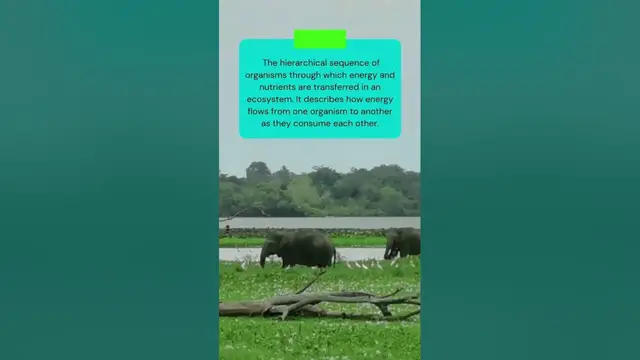

This is what is FOOD CHAIN in ECOLOGY #shorts
Sep 3, 2023

In ecology, a food chain is a linear sequence of organisms through which energy and nutrients pass as one organism eats another. The food chain starts with a primary producer (an autotrophic organism that can make its own food, such as plants or algae), which is then eaten by a primary consumer (a herbivorous organism that feeds on plants), which is then eaten by a secondary consumer (a carnivorous organism that feeds on herbivores), and so on.
For example, a simple food chain in a terrestrial ecosystem might be: grass (primary producer) → rabbit (primary consumer) → fox (secondary consumer). In this food chain, the grass is eaten by the rabbit, which is in turn eaten by the fox. Each organism in the food chain represents a different trophic level, or feeding level.
Food chains are important in ecology because they illustrate how energy and nutrients flow through an ecosystem, and how different organisms are interconnected and dependent on one another for survival. However, most ecosystems have complex food webs with many interconnected food chains, which more accurately represent the relationships between organisms in an ecosystem.
#foodchain #ecology #naturefacts
Show More Show Less