0:00
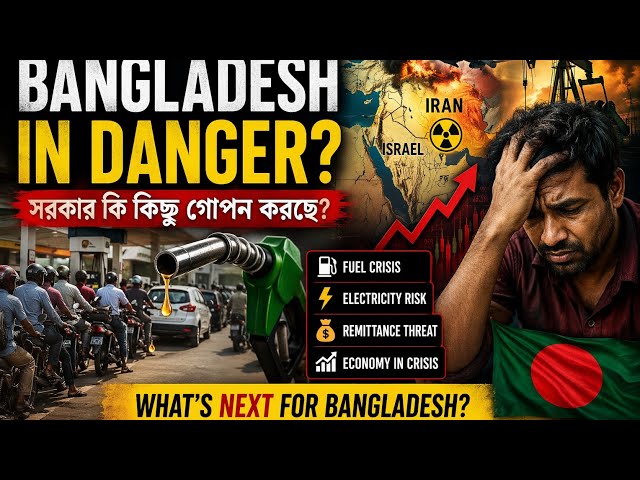
Is the government hiding something?
0:02
First of all, there is currently no real
0:04
fuel shortage in Bangladesh. So, how
0:06
serious is the oil crisis actually? And
0:09
how much impact could the Iran war have
0:11
on Bangladesh? In the end, will the
0:14
government be able to handle the
0:15
situation? Many people believe this is
0:18
not their problem. They think the
0:20
government has fuel in their tanks. Why
0:22
should we worry? But the reality is
0:25
different. The war seems endless. The
0:28
chances of a ceasefire working are lower
0:30
than the chances of it failing. Instead
0:33
of peace or compromise, the Middle East
0:35
is likely heading toward prolonged
0:37
instability. So, in the coming days,
0:39
there is no clear long-term solution to
0:41
the fuel crisis. Even though Bangladesh
0:44
has some capacity to produce petrol and
0:46
octane locally, why is there still a
0:49
crisis? The biggest reason is
0:51
mismanagement. We as a nation often
0:54
create more problems than actually exist
0:56
through corruption, inefficiency, and
0:59
poor coordination at government,
1:01
private, and individual levels. The
1:03
situation has been made worse. In many
1:05
cases, we create our own crisis. But do
1:08
we realize what bigger crisis is waiting
1:10
ahead? The fire of the Iran war will not
1:12
stop at petrol pumps. Its impact will
1:15
reach your home, your bedroom, even your
1:17
kitchen. Already, office hours have been
1:20
reduced. Shops and shopping malls are
1:23
being ordered to close by 7:00 p.m.
1:25
Electricity production is being
1:27
affected. If the war continues for a
1:29
long time, the situation becomes simple
1:32
to understand. Many power plants in
1:34
Bangladesh still rely on furnace oil and
1:36
diesel which are imported mainly from
1:38
the Middle East. The government is
1:40
trying to import from alternative
1:42
sources with subsidies, but it is not
1:44
enough. As a result, electricity
1:47
production will decrease. This will
1:49
impact industries, factories and
1:52
multiple sectors. The most alarming
1:54
issue will be fertilizer. Production
1:57
will decrease and importing fertilizer
2:00
will become more difficult because other
2:02
countries will face the same problem.
2:04
And as a result, food production will
2:06
suffer. At the same time, fuel prices
2:08
will rise. Transportation costs will
2:11
increase. From food to daily essentials,
2:13
everything will become more expensive.
2:16
The market could become hotter than the
2:17
deserts of the Middle East. Even the
2:20
finance minister has clearly stated that
2:22
this is not just Bangladesh's crisis. It
2:25
is a global problem. If the war does not
2:27
stop, fuel demand will increase and
2:30
pressure on supply will grow. However,
2:33
petrol supply will not completely stop
2:35
because Bangladesh produces around half
2:37
of its petrol and about 30% of its
2:40
octane locally. Electricity production
2:43
will decrease but it will not completely
2:45
collapse since Bangladesh mainly depends
2:48
on gas and coal. But the real fear lies
2:51
elsewhere. If the situation worsens,
2:53
Bangladesh may have very limited options
2:55
left. Although the war is happening
2:58
thousands of kilometers away, its impact
3:00
could hit Bangladesh hard. Because this
3:03
war is no longer limited to just two
3:05
countries, it has spread across the
3:07
Middle East and already changed the
3:08
region's future. Even if the war ends
3:11
today, Arab countries could lose around
3:13
$200 billion in economic growth.
3:16
Unemployment could rise significantly,
3:18
potentially affecting millions of
3:20
people. And if this situation worsens,
3:23
economic slowdown could hit countries
3:25
like India, Pakistan, Sri Lanka, Nepal,
3:29
and especially Bangladesh. Now, let's
3:31
talk about one of the most critical
3:33
factors, remittance. A large portion of
3:36
Bangladesh's economy depends on money
3:38
sent by workers abroad. Nearly half of
3:41
that comes from the Middle East.
3:43
Millions of Bangladeshi workers are
3:45
employed in countries like Saudi Arabia,
3:47
UAE, Qatar, Kuwait, Oman, and Bahrain.
3:52
They work in construction, transport,
3:55
cleaning, restaurants, retail shops, and
3:58
petrol pumps. These jobs are difficult,
4:02
lowpaying, and often unstyable. Yet,
4:05
they are the backbone of many rural
4:07
families. Their income supports
4:09
education, health care, and small
4:12
businesses back home. Now, imagine what
4:14
happens if those jobs become uncertain.
4:17
If the war continues, job opportunities
4:19
will decrease. Visa restrictions may
4:22
increase. Contracts may not be renewed.
4:25
Many workers may be forced to return
4:27
home without savings. That would create
4:29
a massive economic shock. Remittance
4:32
inflow will drop. Unemployment will rise
4:35
rapidly. At the same time, industries
4:37
inside Bangladesh may struggle due to
4:40
fuel shortages and reduce production.
4:42
Layoffs could increase across sectors,
4:45
including garments and manufacturing.
4:47
All these factors together show how
4:50
serious the situation could become. If
4:52
everything hits at once, the impact
4:55
could be devastating. However,
4:57
everything discussed so far represents
4:59
the worst case scenario. If the war ends
5:02
quickly, the impact will likely be
5:04
smaller. But this is a global issue and
5:07
preparation is crucial. If we fail to
5:10
prepare in time, indirect effects of the
5:13
war could harm millions. Some estimates
5:15
suggest that over a million people in
5:17
Bangladesh could fall below the poverty
5:19
line due to this crisis. That is why
5:22
awareness and planning are essential.
5:25
policymakers and the public must work
5:28
together. There should be discussions,
5:30
planning and accountability. Questions
5:33
need to be asked. What is the plan for
5:35
the future? Are we prepared for what's
5:37
coming? That is a question for all of
5:40
us. Stay aware, stay prepared, and share