Up next in 10


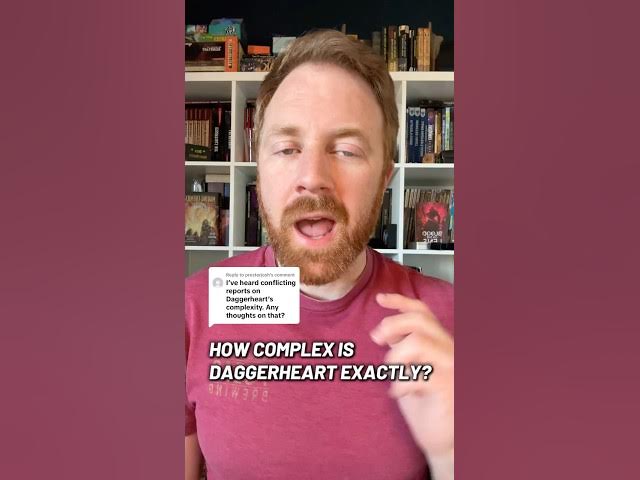
Daggerheart isn’t as mechanically complicated as DnD, and its complexity changes very little with level, but combat is still crunchy enough to feel satisfying.
#daggerheart #ttrpg
Show More Show Less View Video Transcript
0:00
How complex is Daggerheart exactly
0:02
compared to RPGs that we may be more
0:04
familiar with? Most of the people in the
0:06
tabletop community at least know Dn D.
0:09
So like that's kind of the baseline that
0:10
we measure everything against. Compared
0:13
to Dn D, most of Daggerheart is less
0:16
mechanically complex, but the combat
0:18
still is satisfying, engaging, and sort
0:22
of crunchy. It's not quite as
0:25
mechanically It's not quite as
0:26
mechanically involved as D and D's
0:28
combat, but it still gives you that
0:30
satisfying level of crunch from doing
0:33
something interesting in a fight beyond
0:34
just like I declare the enemy dead, roll
0:37
a dieice, I win. Outside of combat, it's
0:39
mostly a narrative game. Anytime you're
0:41
making a check, you'll roll the duality
0:43
dice and you'll apply an ability score
0:45
generally. And if you have a relevant
0:47
experience, you can spend a hope to
0:49
apply the bonus from that experience.
0:51
But really, that's it. Like there's no
0:52
skill proficiencies, there's no tool
0:54
proficiencies. You don't have to worry
0:56
about a long list of capabilities or
0:59
like do I have the right thing that I
1:01
know how to use. No, you can just say,
1:03
"Oh, my character has the experience uh
1:05
lying liar who lies. So, I'm going to
1:08
apply that experience to me trying to
1:11
deceive this town guard." Spend a hope,
1:13
get the bonus, roll the dice, you're
1:15
good. Done. In combat, the action system
1:18
is a lot simpler than D&Ds. There's no
1:20
bonus actions. There's no reactions
1:22
really. Like you don't have a once per
1:24
turn reaction. There are reaction roles
1:26
that work basically like saving throws
1:28
in 5e, but there's no actual reaction
1:31
part of your action economy. On your
1:33
turn, you move and you take an action
1:35
and that's it. And most of the actions
1:37
are fairly fast to resolve. So even if
1:40
you're doing like highle capabilities
1:42
and if you have a whole bunch of
1:43
abilities because you're a highle
1:45
character, the game's complexity doesn't
1:47
increase that much beyond level one. You
1:50
might be rolling more dice. You might be
1:52
doing more damage. The number scale is
1:53
going to be larger, but the actual
1:55
complexity of the game doesn't seem like
1:57
it gets that much worse than it is at
2:00
level one. So, I think it delivers a lot
2:03
of the satisfying crunch that you get
2:05
from D&D combat. It's not quite as
2:07
crunchy as D and D combat. It's
2:08
certainly not Pathfinder, but um I think
2:11
it's going to scratch that itch for a
2:13
lot of players without needing to be
2:16
quite as complicated as D and D 5e
2:18
combat.
Arts & Entertainment
Games
Games
Roleplaying Games
Roleplaying Games