Up next in 10



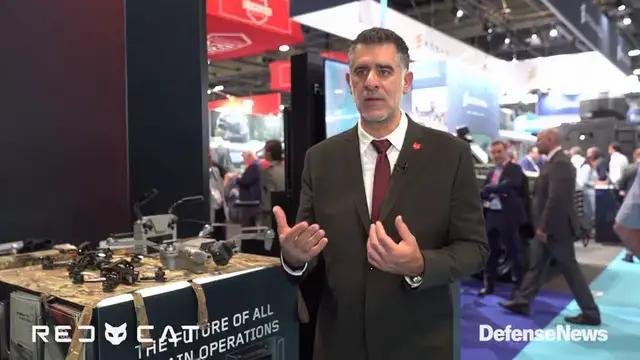
At Eurosatory 2026, Red Cat showcases Hellcat™, Black Widow™ and AI-powered solutions designed for contested environments.
Show More Show Less View Video Transcript
0:00
It's no question that contested environments, GPS-dened environments, are the most dynamic
0:06
And that's, from a customer perspective, those are the most questions that we get are
0:10
how are you guys going to be able to operate in those really challenging environments
0:15
So we spend a lot of time really working with the end users, working with our industry partners
0:20
from both a communications aspect, a sensor aspect, even targeting. All of that is optimized over time through our systems
0:42
There's been a lot of lessons learned from the battle in Ukraine. Red Cat is very fortunate enough to have had employees over there on the front lines working with Ukrainian warfighters
0:51
and folding that optimization and development back into our own portfolio of products
0:57
For instance, we work with a lot of industry partners like Doodle Labs
1:01
like Sightline Intelligence, that allows us to not only optimize our systems in current battlefield conditions
1:08
but again, take that soldier feedback and fold it back into our product development process
1:12
for platforms like Black Widow and for the newest platform that we've just unveiled called Hellcat
1:17
Hellcat was based on the backbone of Black Widow. And what I mean by that is Black Widow was specifically developed for the short range reconnaissance program for the U.S. Army, in which it's a winner of that program
1:31
What we did was we took that foundation and applied it to a global customer base, knowing that each one of those customers has a different set of requirements, a different set of needs, wants and desires
1:42
And how are we going to answer that? We're going to answer with modularity and open system architecture
1:46
We're going to answer with the idea that if they have a specific command and control system they want to use, we can integrate that in
1:52
If they have a specific antenna system they want to use, we can do that. If they have specific sensors, we can also integrate that in
1:57
So we been able to actually make it extremely open for our allies around the world So historically if you thinking about the idea of sensor that concept
2:11
is not new. It's been on the battlefield for a very long time. Unfortunately, the result of that has been those systems are very high-dollar values
2:22
being in the hundreds of thousands of dollars. You fast forward to today, RedCat has been able to develop a low-cost sensor-to-shooter
2:29
kit. And so the gap that we're really filling is empowering the warfighter in the moment
2:33
to have rucksack portable kit, both on the ISR side and the precision effects side
2:39
to not only identify and recognize the target, but add a layer of AI and autonomy onto that for
2:45
aid of target recognition, recognize the target, classify the target, and then be able to engage
2:52
that target with another low-cost solution like the Fang. So here we're talking about
2:57
integrate your ISR asset with Black Widow or Hellcat, integrate your family of FANG drone systems for precision strike
3:05
put those together into one common control system, all under $50,000, and you have a low-cost kit
3:12
And that's the gap that we're really filling with this solution. So I started at Red Cat about four years ago
3:19
and I was specifically brought in to reposition the company to become a defense and security company
3:24
but even above and beyond that, to become an all-domain company. And so what that means is not only were we developing
3:30
and are developing aerial robotics and autonomous systems, but how are we then integrating those systems into the other domains
3:38
For instance, we've already demonstrated integrating our small drone solutions into ground robotics, into armored vehicle convoys, other domains
3:48
We just started a year ago a maritime division developing unmanned surface vessels
3:52
So you know over time we been able to really work with all of these domains and it all about interconnectivity and interoperability not only within our own ecosystem but how do those solutions then interoperate with allied countries and their protocols It an enormous challenge but RedCat is again well to be having the tendrils
4:15
and the open interfaces and the open architecture to have this interconnected battlefield
4:19
which is really what customers are looking for. They want you to seamlessly weave into current and future battlefield operations
4:25
and RedCat is well-positioned for that. Red Cat's goal is to be a multi-domain company
4:35
Obviously, the world is three-quarters water. So without a USV line, our CEO recognized early last year
4:42
that we need to be in the business of USVs, and that's what we do. Blue Ops manufactures small USVs, so USVs under 40 feet
4:50
We have three products, 5-meter, 7-meter, and 8-meter. We're at the beginning of a very explosive market segment right now with USVs
5:01
Keep in mind, the world needs tens of thousands of these to effectively defend coastlines from sovereign nations around the world, not to mention, you know, missions and expeditions
5:13
So we're at the beginning of a massive demand cycle for USVs, especially small ones
5:18
Blue Ops' primary strategy over the next 12 to 24 months is massive growth, responding to this huge demand cycle we're seeing for unmanned surface vessels globally
5:29
As I mentioned, the world is three quarters water. Sovereign nations have huge coastlines that need to be covered. The time is now and the demand is large
5:38
RSTL is a company specialized in tethering technology for small drones and we are partner
5:51
of RedCat Holdings. We joined actually the RedCat Future Initiative and we do have a tethering capabilities for
5:59
the Black Widow and the Tilted drones. So with the RSTL tether technology, you can convert immediately the Black Widow into a
6:06
permit persistence wash tower with ISR with unlimited flight time Taser drones is a game changer on the battlefield and we see a very strong traction and request on the European region for the type of technology that is enabling to have an immediate protection and ISR without any flight time limitation with your drones
6:30
and you can also use it as a high-variable antenna, expanding the coverage to your ground mission
6:37
but also to other type of missions, maritime, USV, UGV. So it's a real game changer for the battlefield
6:44
On RSL, we are working on the next-gen tethering technology and solution
6:49
that will be to have tether drones integrated to vehicles, vessels, UGVs
6:57
that is going to be a real game changer in the way of using unmade UAV with vehicles
7:10
So one of the biggest buzzwords in the industry right now is the term artificial intelligence
7:16
It's really kind of been boiled down into a buzzword, but really what forms around the idea of AI is a thousand different problem-solving applications
7:25
How Redcat is really, you know, serving the needs of the warfighter is we've partnered with some of the best companies in the industry that offer a variety of AI applications
7:35
So adding that layer, that AI layer into our tech stack is extremely important because what we're trying to do is reduce the cognitive load on the warfighter
7:42
But really it folds into our business model of the drones really being like a flying cell phone
7:47
Just like your cell phone, you have a variety of applications. You don't use them all at once
7:51
The warfighter utilizes it the same way. They'll have a variety of applications used on the battlefield, but for very specific tasks, they will have applications they can use in the moment that are all AI driven
8:03
And that's extremely important to have that flexibility for the end users
#news